Marigold Tattoos: 26 October Birth Flower Ideas
The marigold is October's birth flower and one of the trickiest blooms to tattoo well, because all those layered petals can turn to mush at small sizes. Here are 26 designs that hold up, from single-needle buds to bold Day of the Dead pieces.
What the Marigold Actually Means
October gets the marigold, and some birth-flower lists hand it cosmos as a second option. Both are useful to know before you sit down with an artist, because the marigold carries more weight than most birth blooms.
There are also two very different plants sold under the name. Tagetes is the dense pompom marigold, the one packed with dozens of ruffled petals in hot orange and rust. Calendula, or pot marigold, is flatter and more daisy-like, with a single ring of narrow ray petals around an open center. Tell your artist which one you mean, because the pompom needs more room to read and calendula shrinks down beautifully.
The symbolism runs in several directions at once. In Mexico, cempasuchil marigolds line ofrendas during Dia de los Muertos, their scent said to guide spirits home, which makes the flower a natural memorial motif. In India, marigold garlands hang at weddings, temples and doorways as a symbol of devotion and auspicious beginnings. Victorian flower language was less kind, tying marigolds to grief and jealousy, and that darker note is exactly why some people choose it. Practically, it is a flower that blooms hard into the cold months, which suits an October birthday better than any sentiment written on a card.
Small Marigolds That Stay Readable
1. Single calendula bloom on the inner wrist
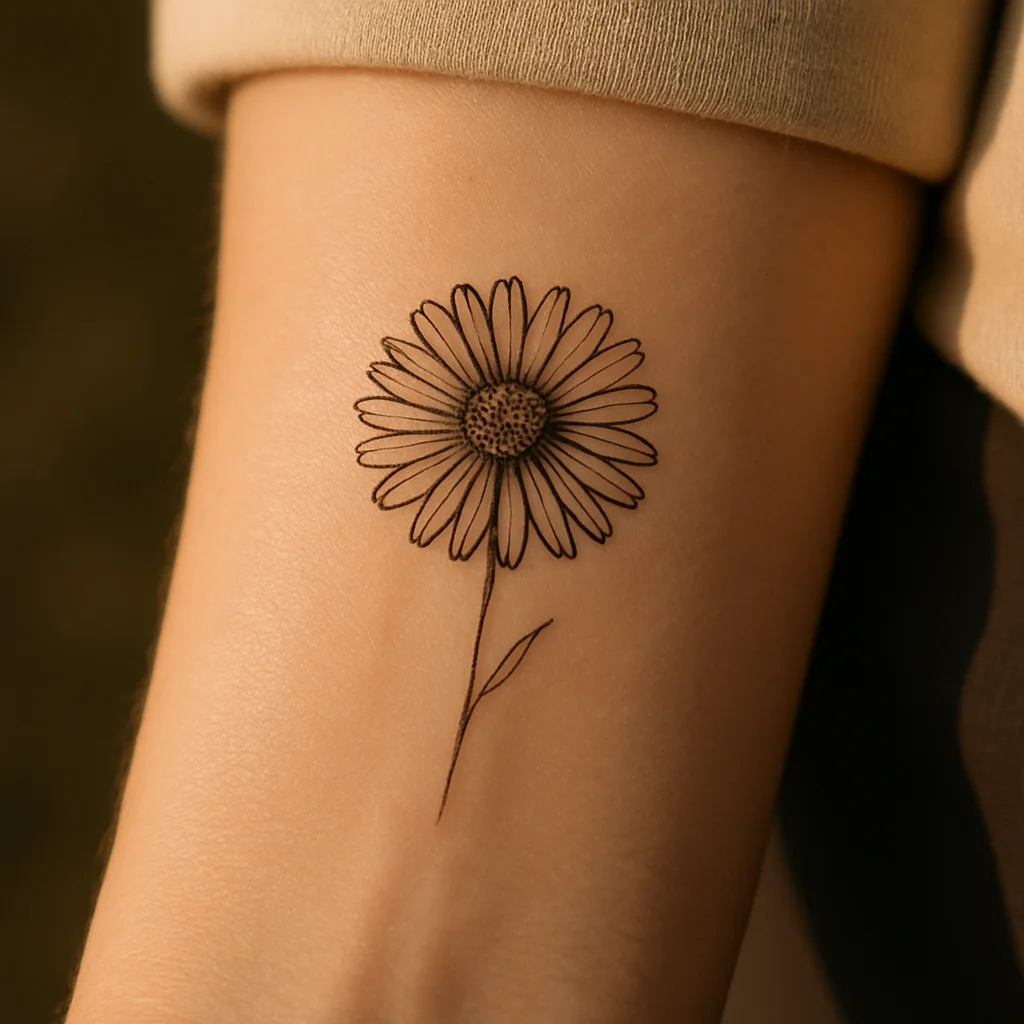
Calendula's flat ring of narrow ray petals is the smartest choice for anything under two inches, because each petal keeps its own gap of clean skin. Sized about the width of a dime and set two fingers up from the wrist crease, it stays crisp for years. Ask for eight to twelve petals rather than a full ring, so the shape does not close up as the lines soften.
2. Closed marigold bud on the side of the wrist
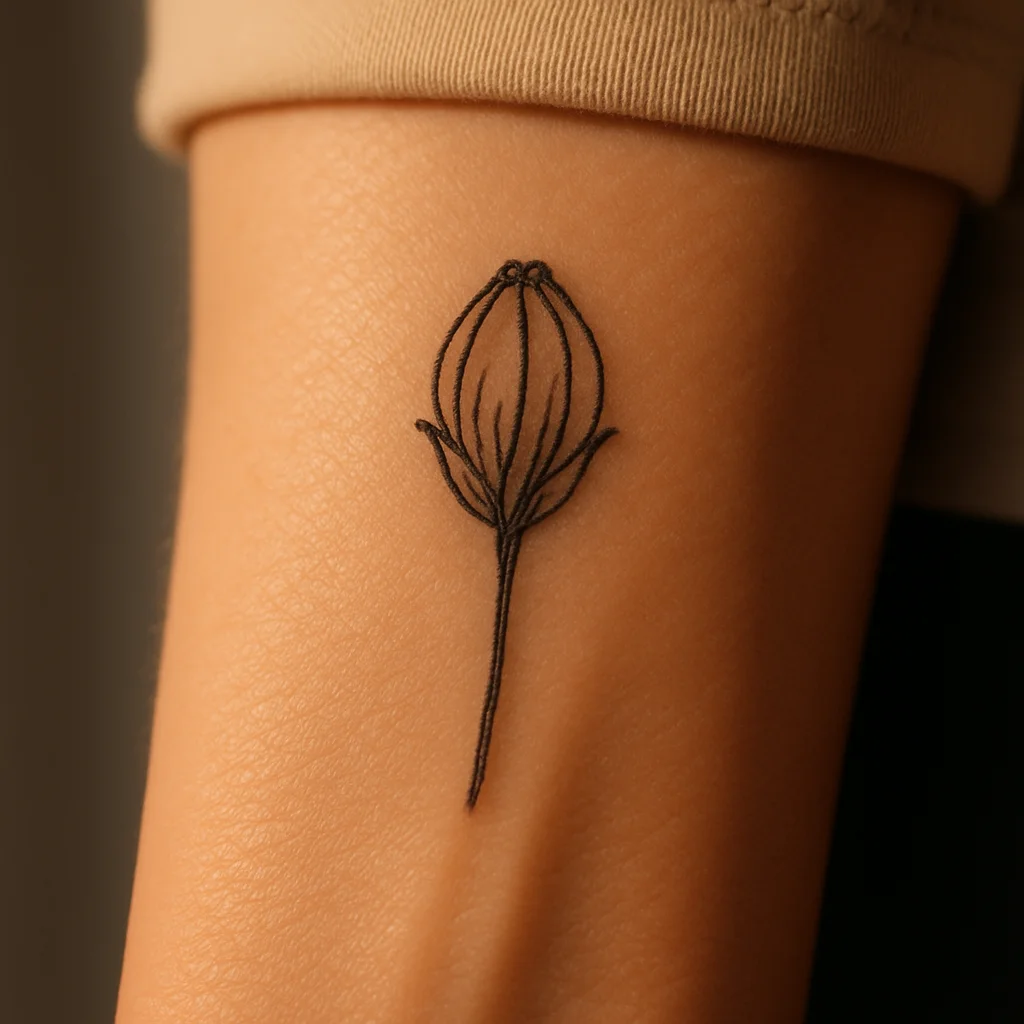
A bud sidesteps the whole legibility problem: you get one teardrop silhouette, a few overlapping sepals and a short stem. It reads as a marigold to anyone who knows the plant and as a neat botanical shape to everyone else. This is a great first tattoo and usually lands at a shop minimum.
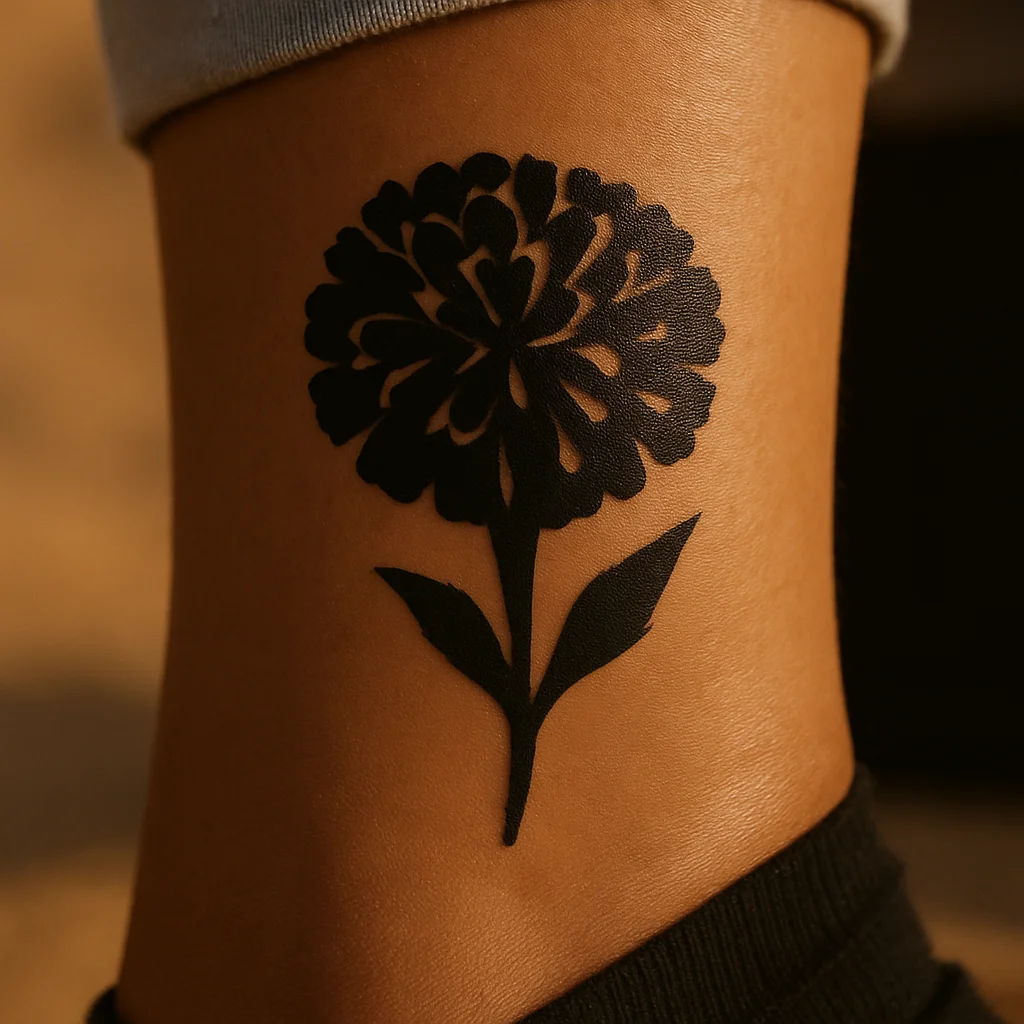
3. Solid black pompom silhouette on the ankle
Instead of drawing every petal, have your artist carve the marigold head as a solid black mass with negative-space slashes suggesting petal edges. At two inches on the outer ankle it stays punchy for decades, since bold shapes age far better than dense detail. Keep it above the sock line if you would rather not have it rubbing all winter.
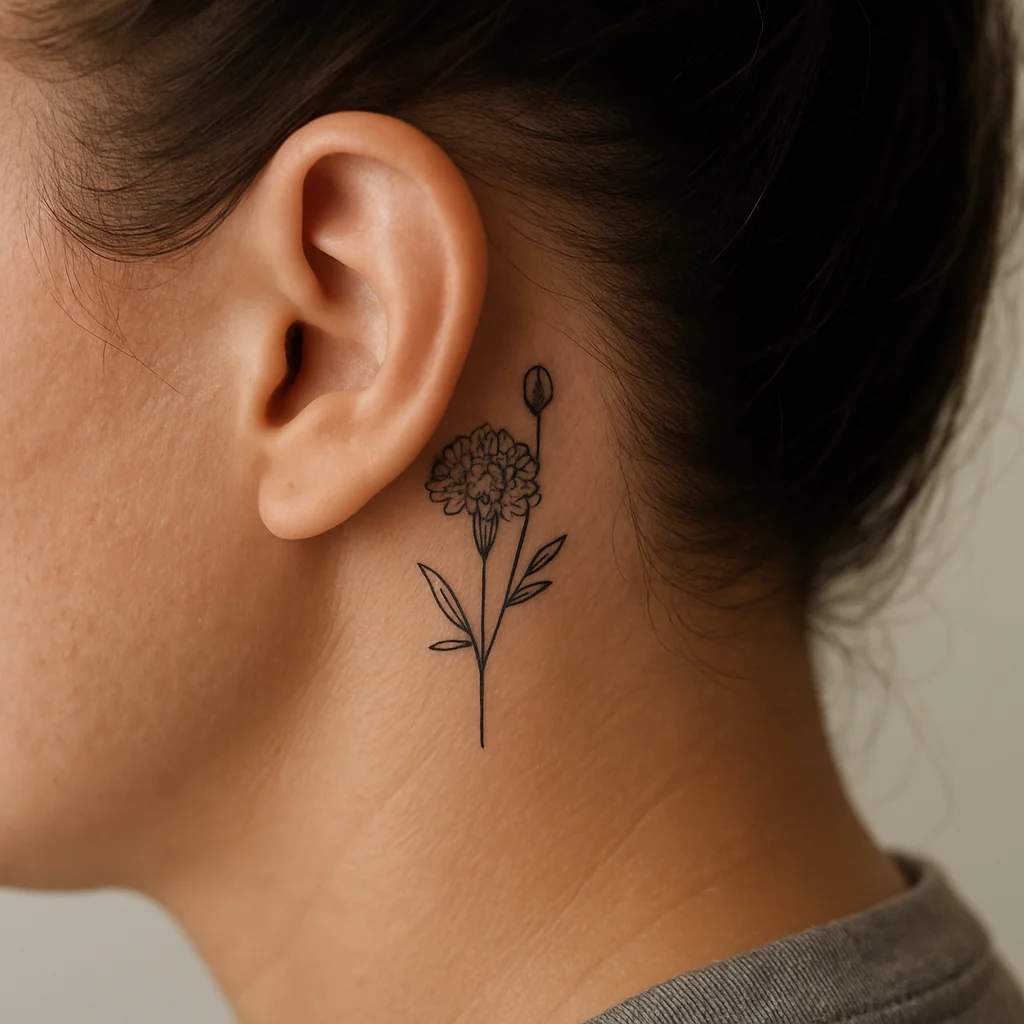
4. Tiny marigold sprig behind the ear
One small bloom, one bud and two leaves on a curving stem, roughly an inch and a half, tucked into the hollow behind the ear. It is a quick sitting and easy to hide, though skin here turns over fast, so plan on a touch-up. If you are weighing this spot, our guide to behind-the-ear tattoos that hold up covers the trade-offs.
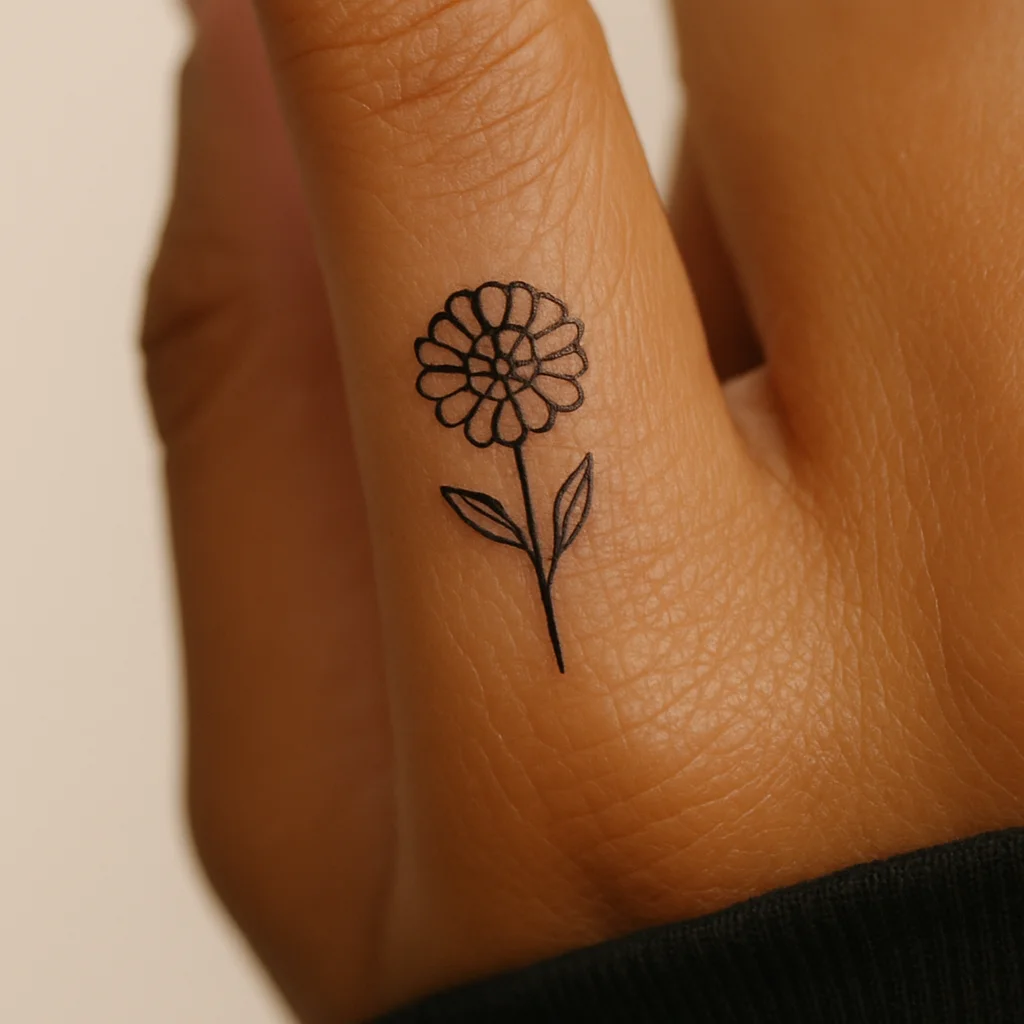
5. Marigold outline on the side of a finger
A half-inch calendula in simple outline, riding the side of the ring or middle finger where it peeks out rather than sitting on the flat top. Go in knowing finger tattoos fade and blur more than anywhere else, and budget for repeat visits. Ask for slightly thicker lines than feel right, since fingers eat detail.
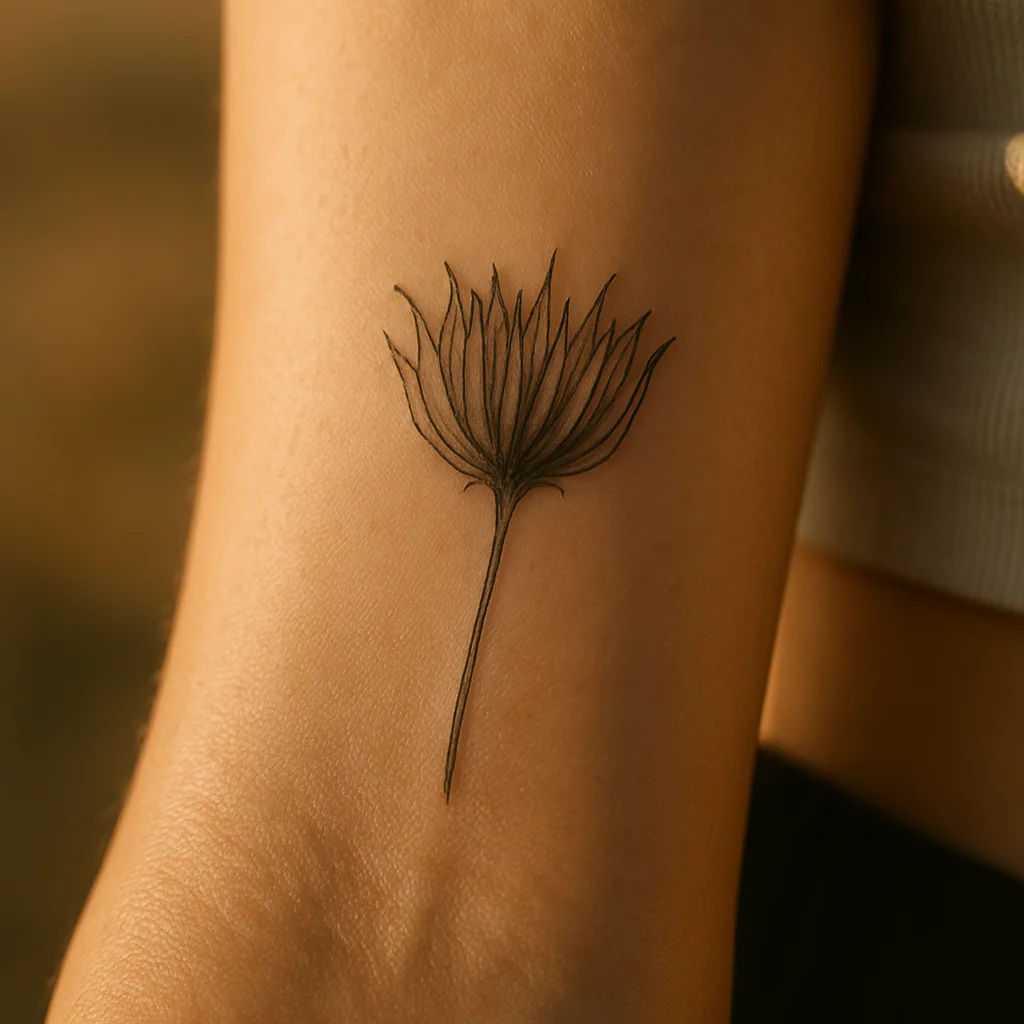
6. Dried marigold seed head on the inner wrist
Spent marigolds dry into a spiky little crown of seeds, and that shape is far easier to tattoo small than a fresh bloom. It suits people drawn to the flower's grief symbolism more than its brightness. Two inches tall in fine black linework, no color needed.
Fine-Line and Single-Needle Marigolds
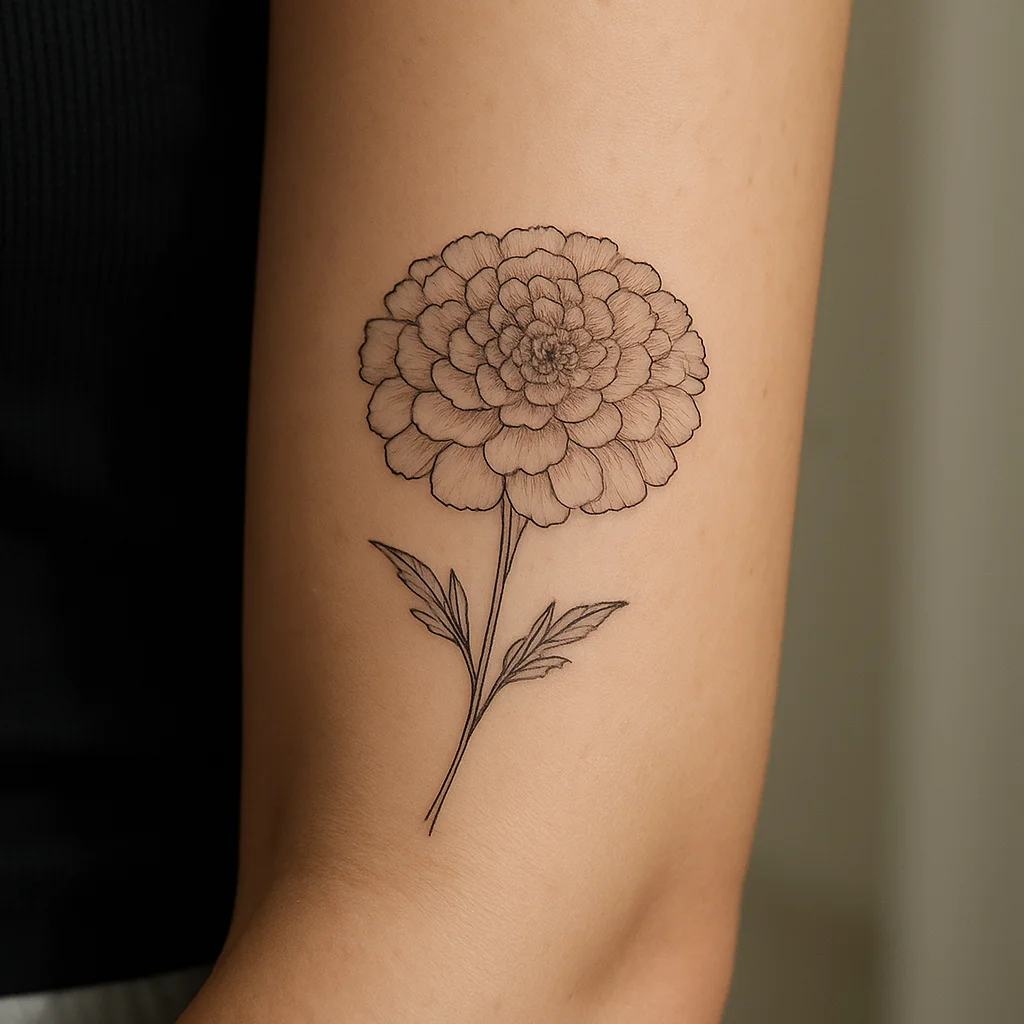
7. Single-needle Tagetes bloom on the inner forearm
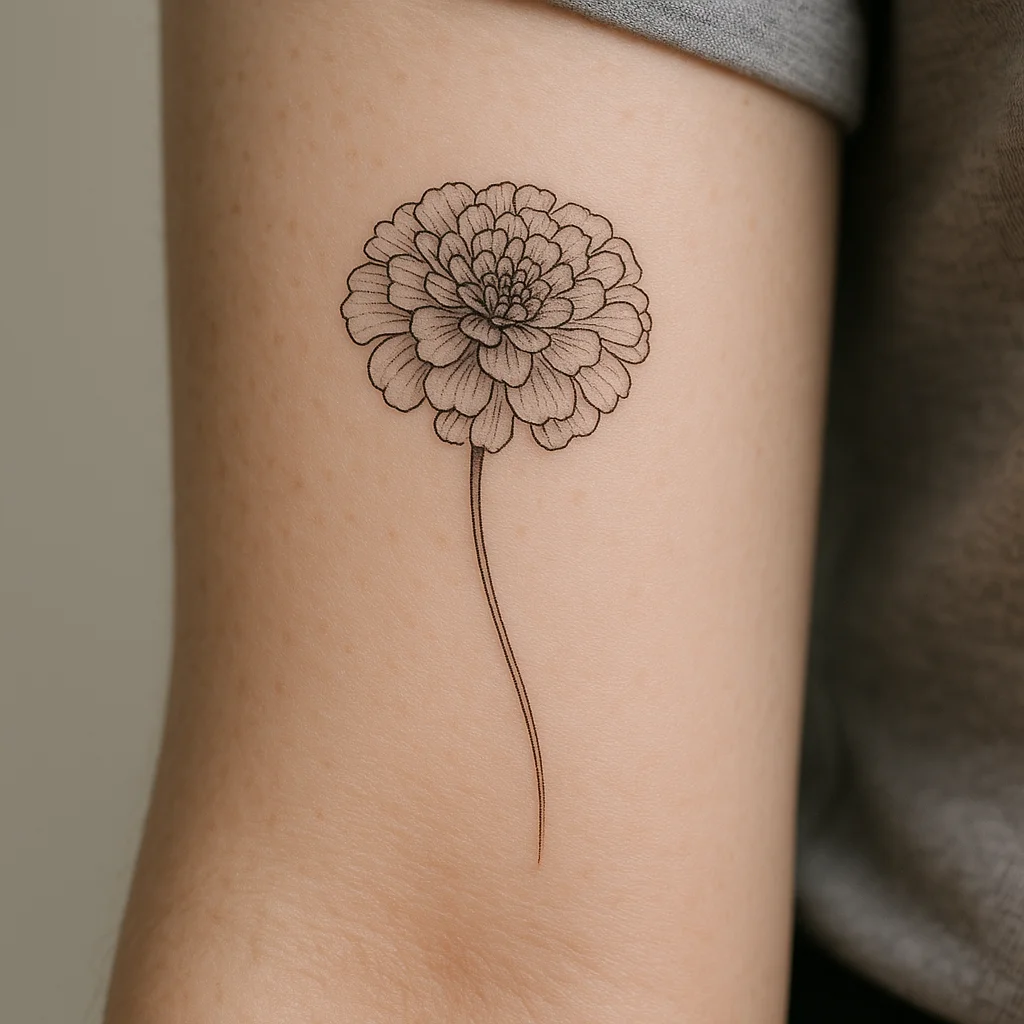
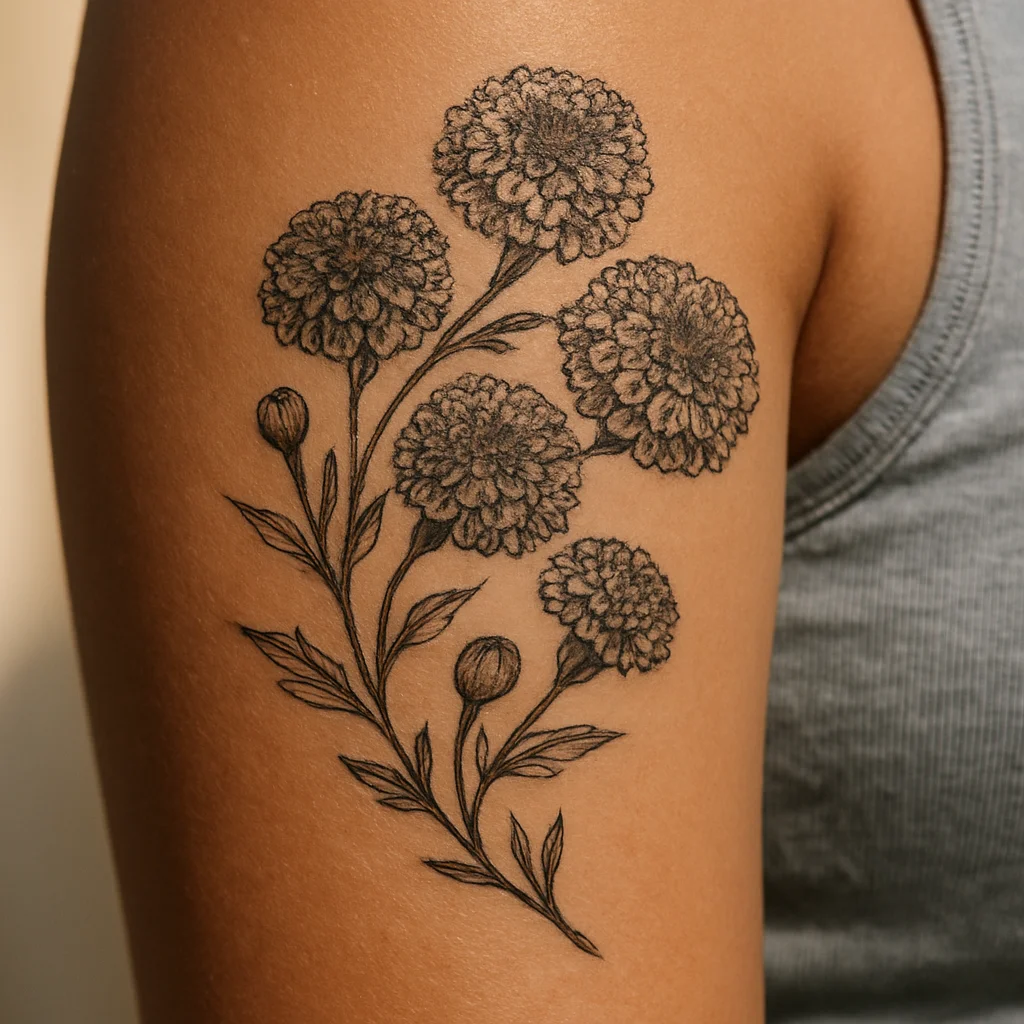
This is the classic October birth flower tattoo: one pompom head, three inches across, built from concentric rings of petals that get looser toward the outside. It only works if the artist leaves breathing room between petal layers, so ask to see healed fine-line florals in their portfolio before booking. The inner forearm is flat, low-friction and easy to view, which makes it the most forgiving home for detail like this.
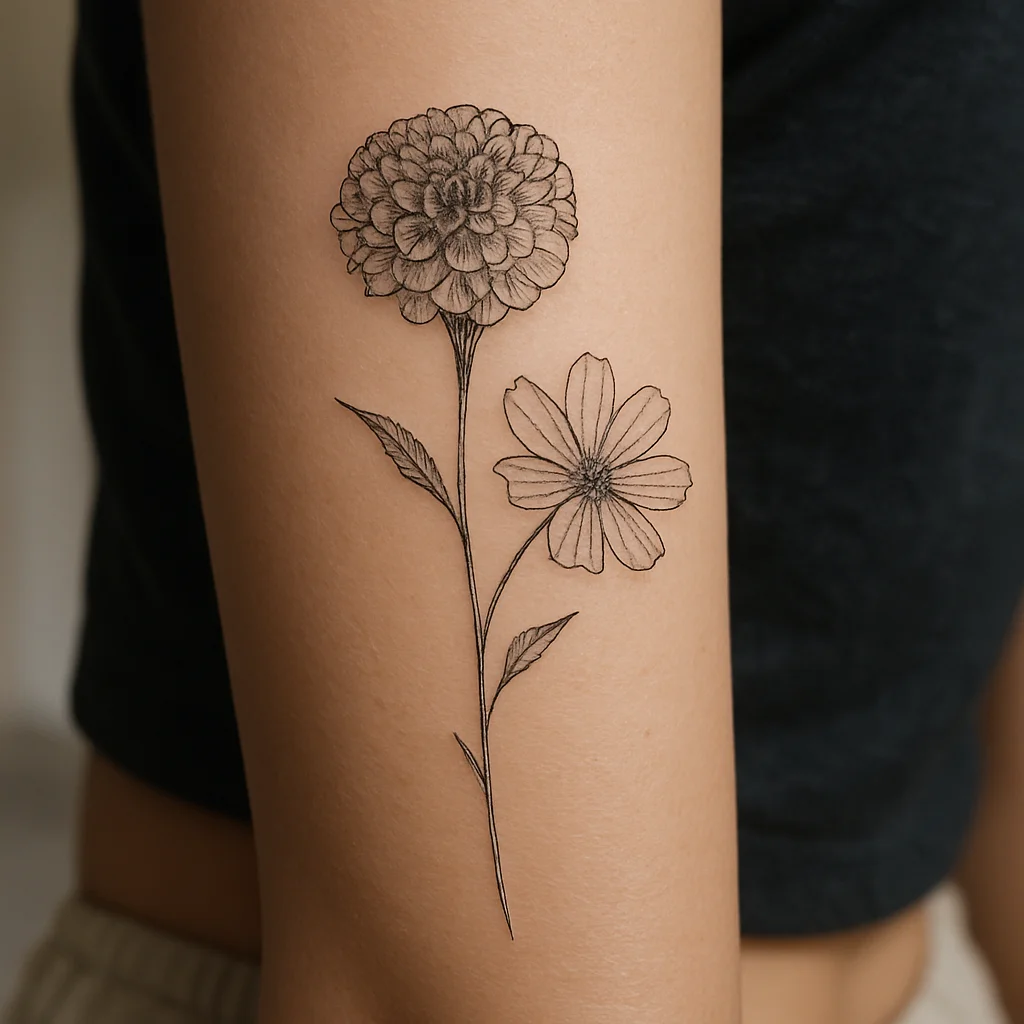
8. Marigold and cosmos on one stem
Since October claims both flowers, some people braid them: a dense marigold head low on the stem and an airy eight-petalled cosmos rising above it. The contrast in petal density does the visual work, and the piece reads as botanical rather than decorative. Four to five inches on the outer forearm gives both blooms space.
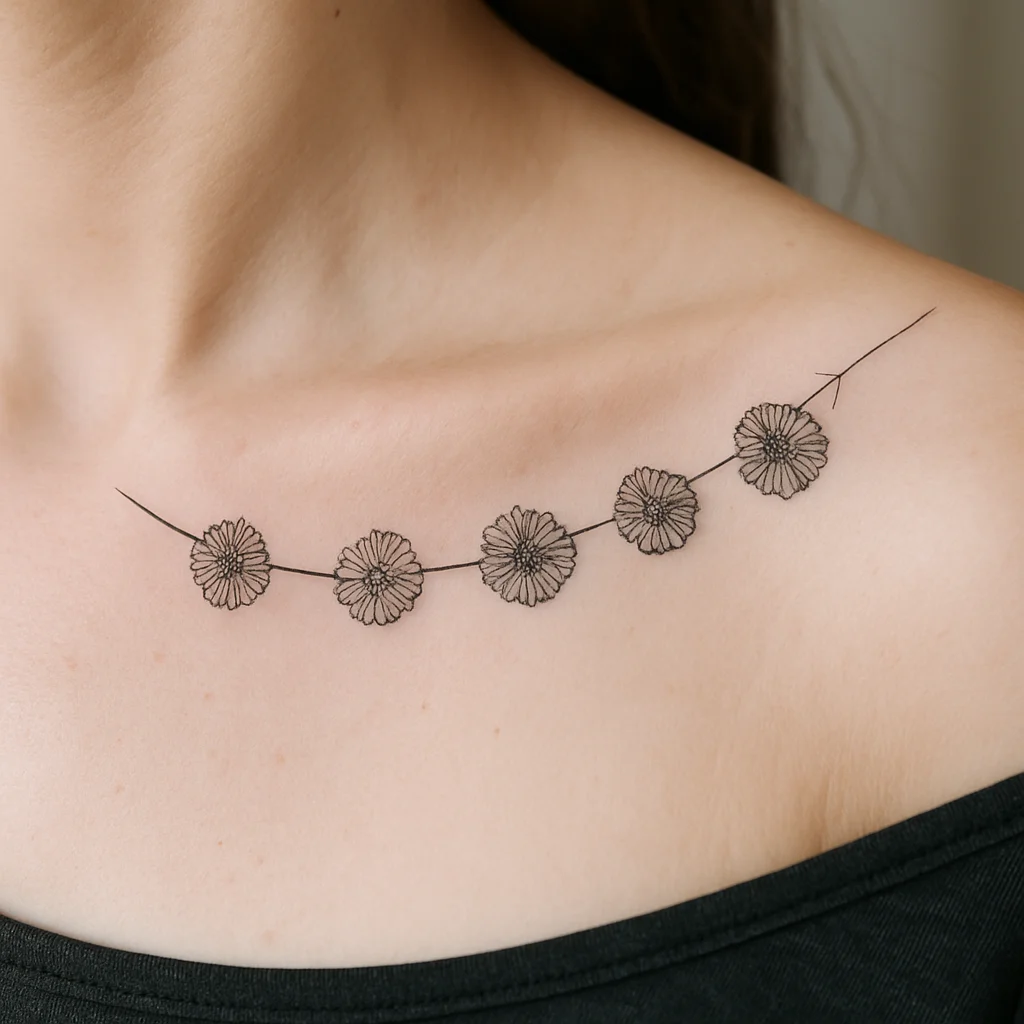
9. Marigold garland along the collarbone
A strung garland of small marigold heads, the way they hang over Indian doorways, following the collarbone with the largest bloom near the sternum end. Keep the heads at half an inch or less and vary their angles so it looks threaded, not stamped. Expect a sharper sting over the bone itself.
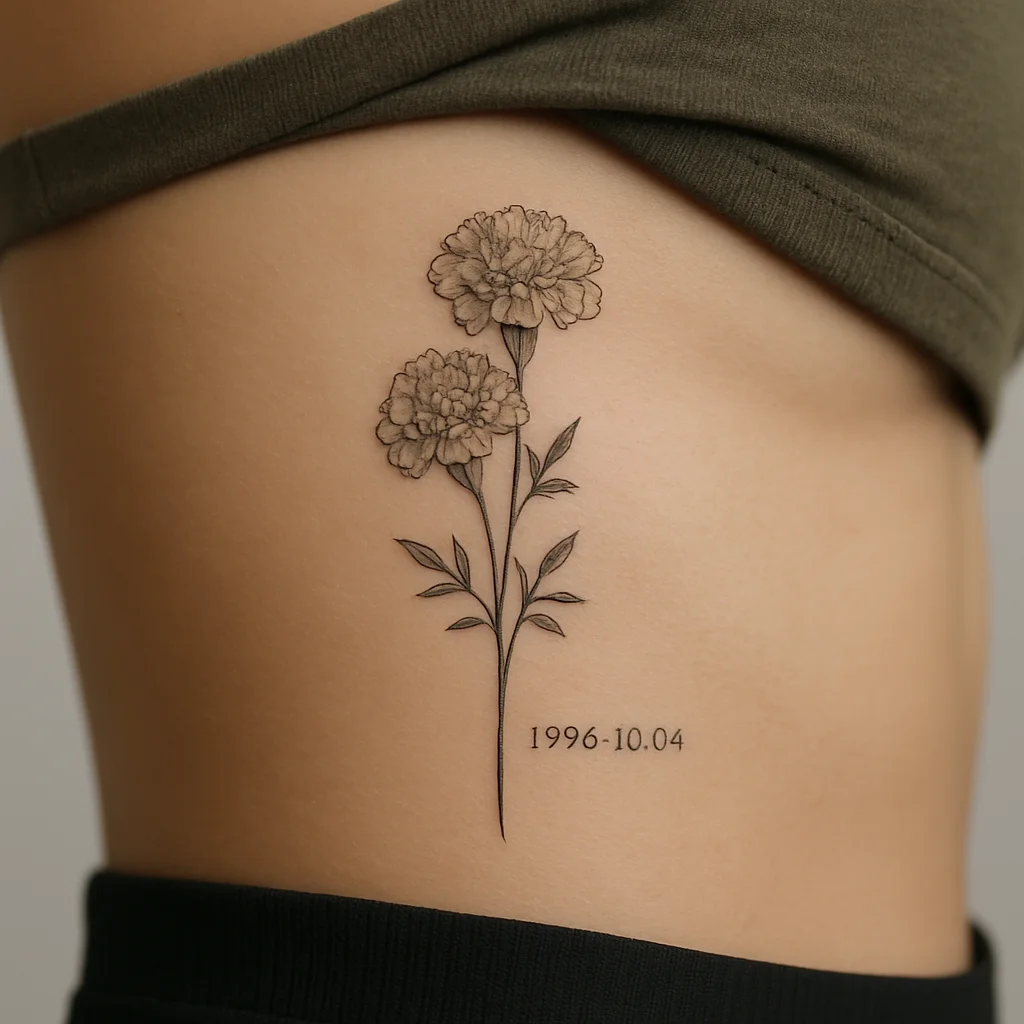
10. Marigold sprig with birth numerals on the ribcage
A single stem running vertically down the ribs with the date, or just 10, set in small fine-line type beside the stem. Vertical placements suit the rib cage because they follow the natural line of the body instead of fighting it. It is a genuinely spicy sitting, so book a short session.
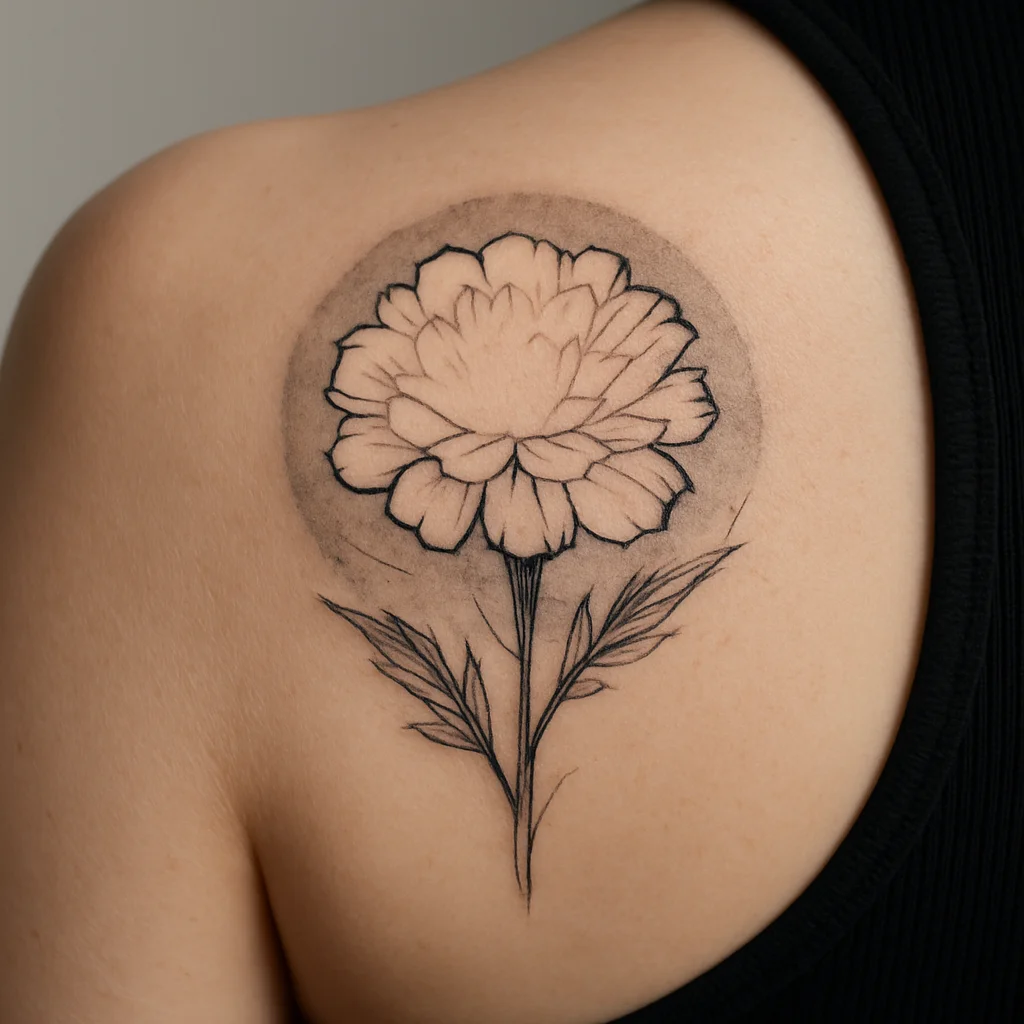
11. Negative-space marigold in a soft grey circle
The artist lays a smooth grey wash circle, then leaves the marigold shape as bare skin inside it with only the petal edges lined. The effect is like the flower catching low sun. Works best three inches or larger, on the shoulder blade or outer forearm where skin stays smooth.
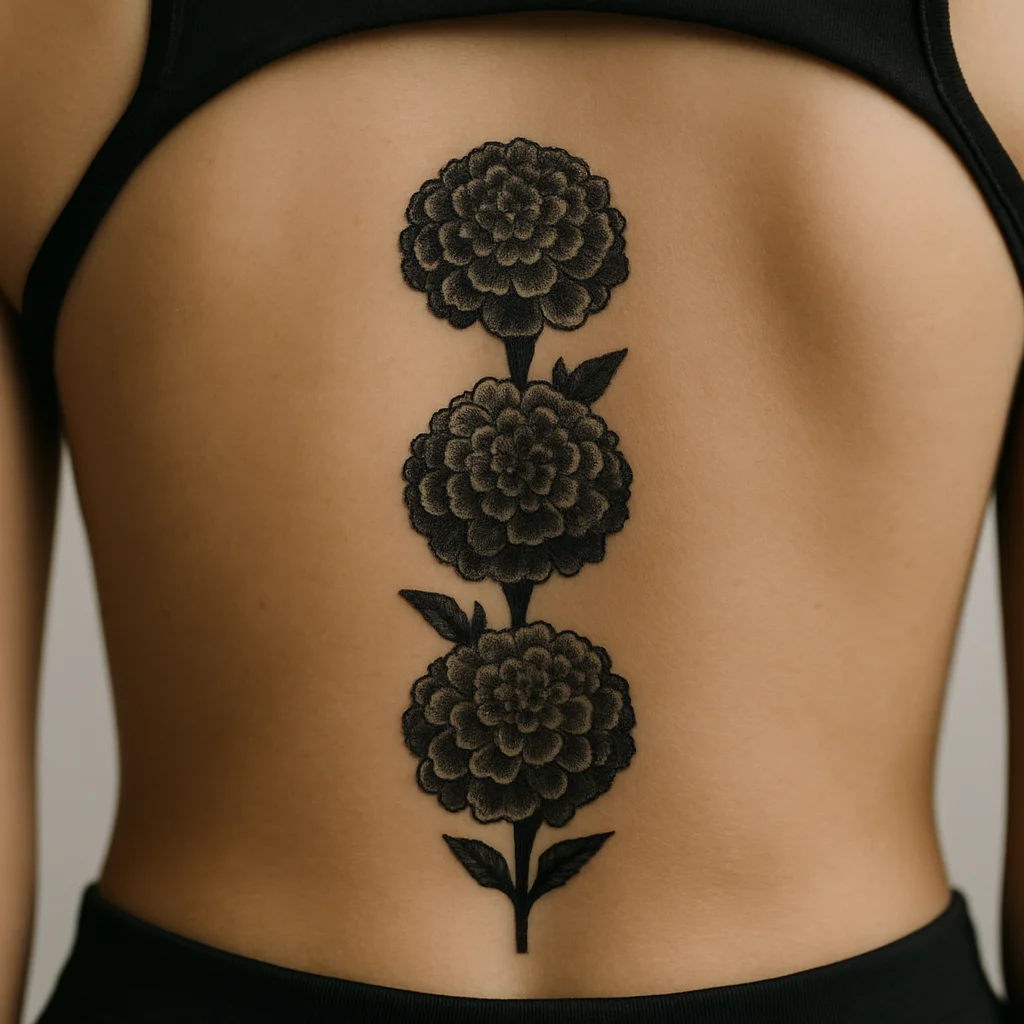
12. Dotwork marigold down the spine
Two or three marigold heads stacked along the spine, shaded entirely in stippling so the petal volume comes from dot density rather than line. Dotwork ages softly, which is an advantage on a flower this layered. Budget more chair time, since stippling is slow work.
Bold Marigolds: Traditional, Blackwork and Day of the Dead
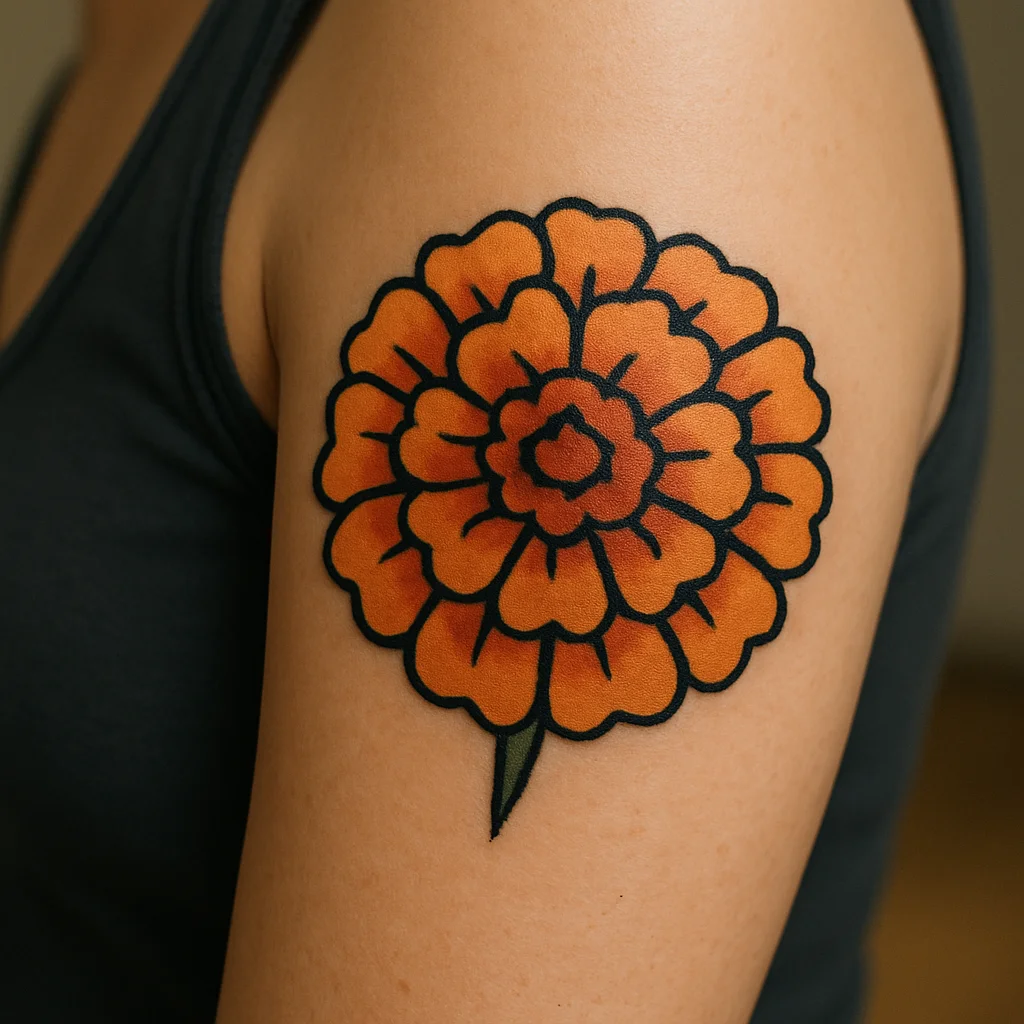
13. American traditional marigold with a bold outline
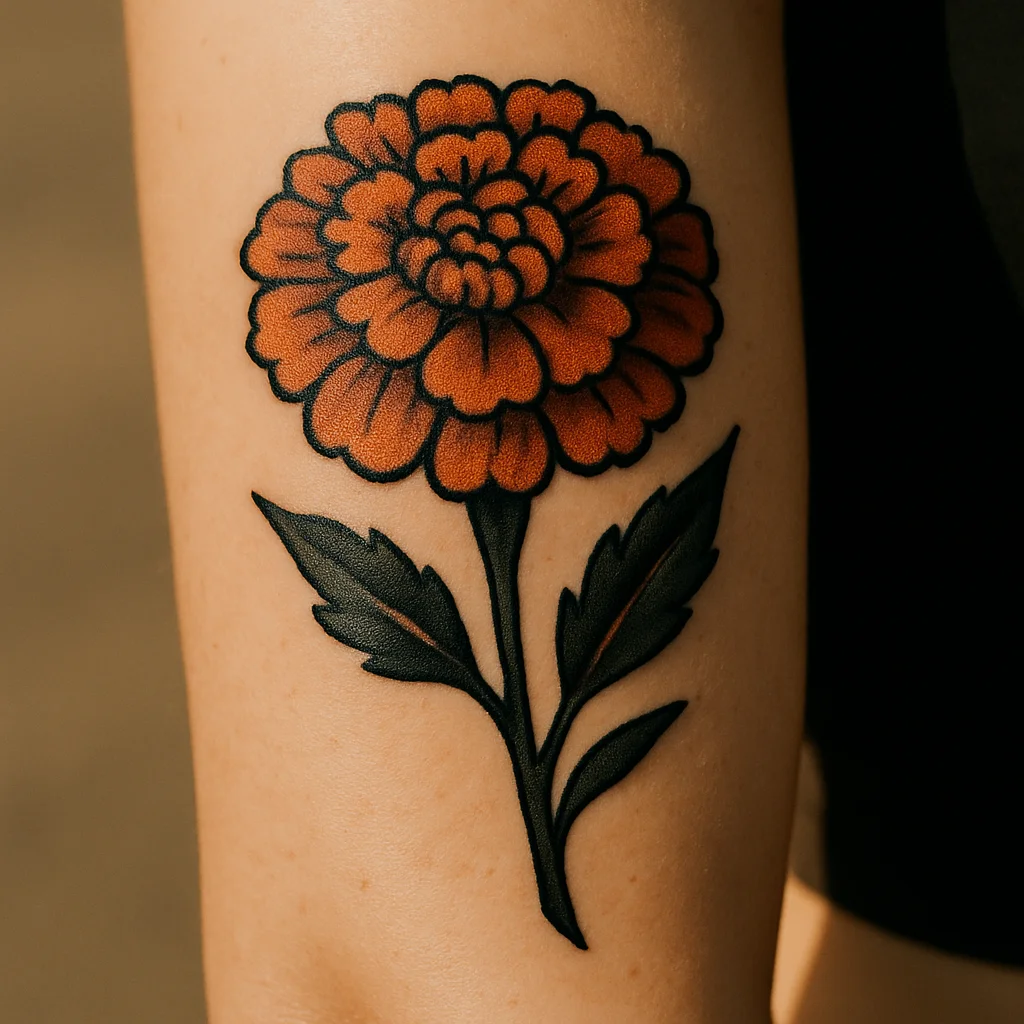
Heavy black outline, simplified petal layers, packed orange with a rust-red core and one hard black shadow under the head. Traditional styling solves the marigold's density problem by editing petals down to shapes that read from across a room. Four inches on the upper arm is the sweet spot, and it will still look right in thirty years.
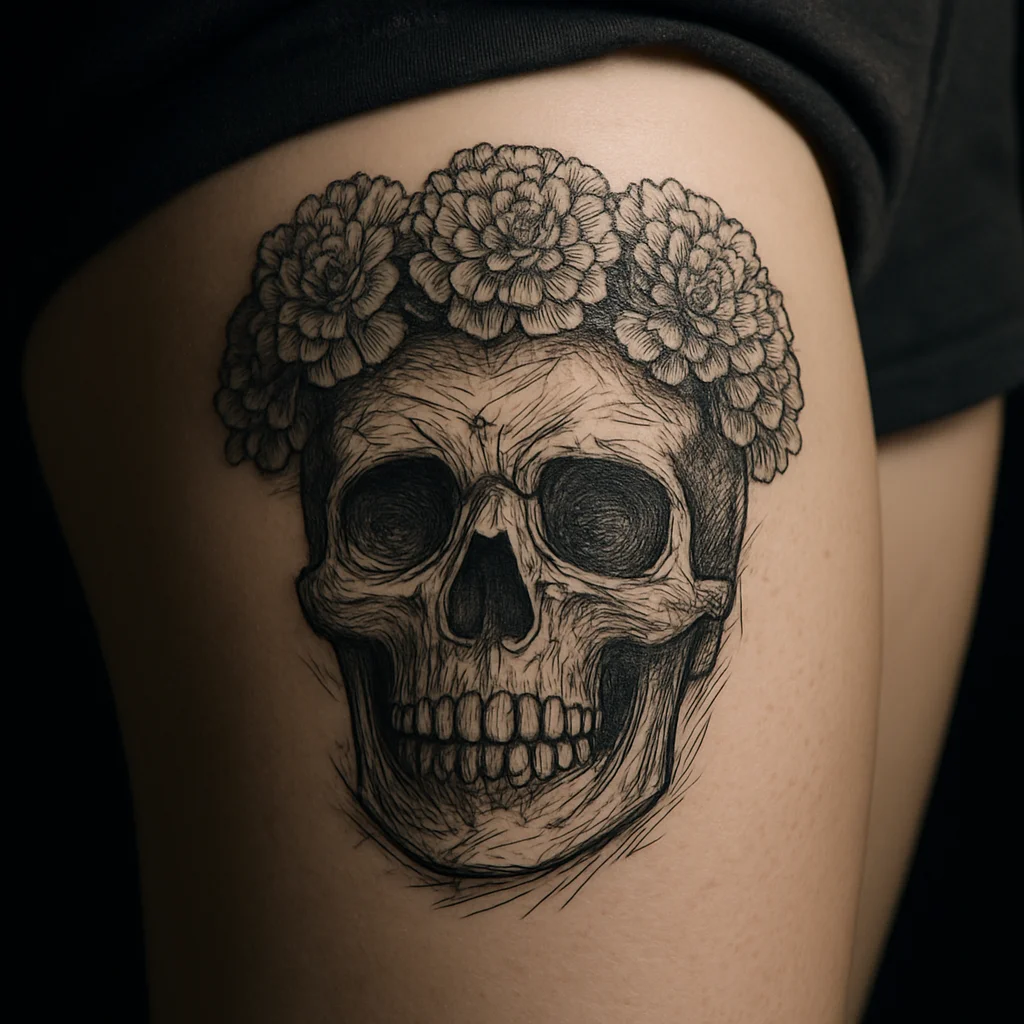
14. Cempasuchil crown on a sugar skull
A skull with marigold blooms ringing the crown like an ofrenda arrangement, in neo-traditional color with the orange kept saturated against dark background shading. This is a memorial piece with a specific cultural anchor, so talk with your artist about doing it respectfully and well. Thigh placement gives you five to seven inches of room without the piece dominating.
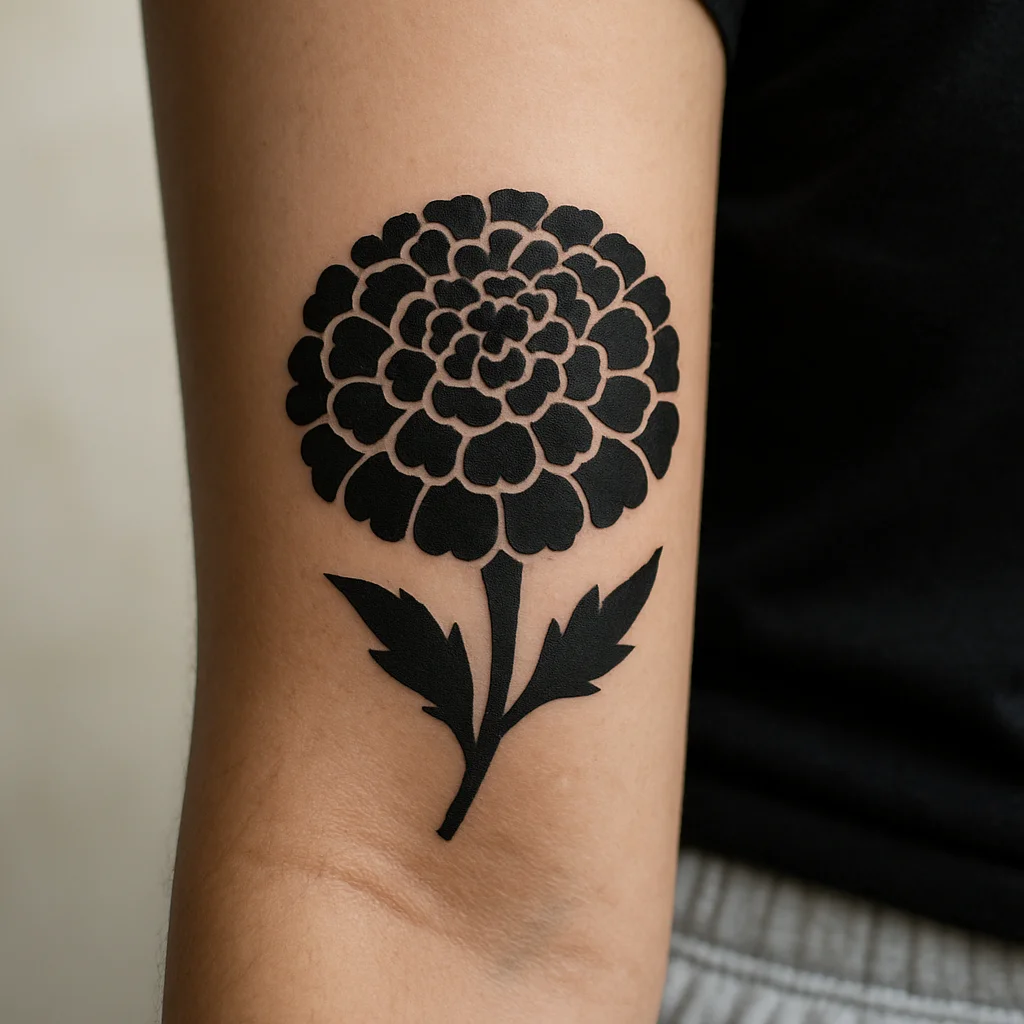
15. Blackwork pompom on the outer forearm
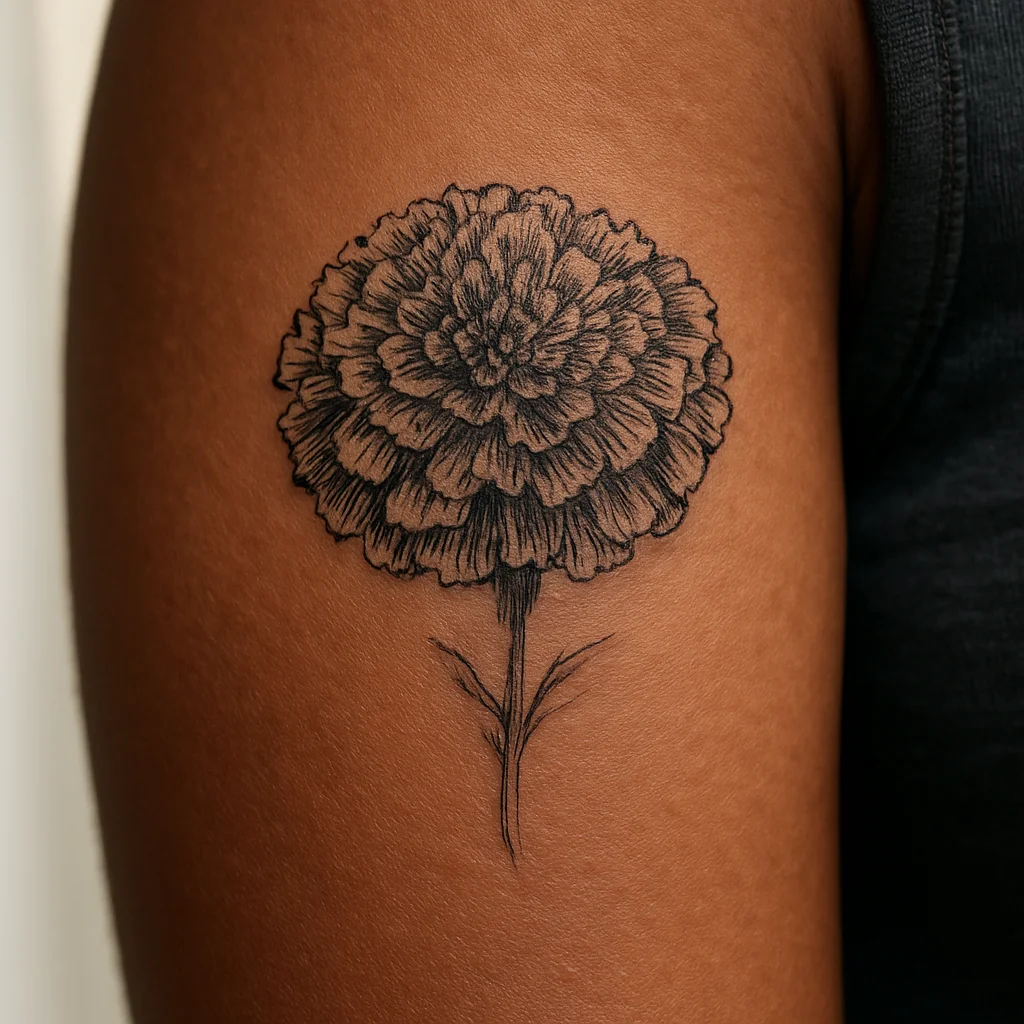
All black, all texture: petals carved with fat negative-space gaps, deep shadow in the flower's throat, no color at all. Blackwork florals are the most durable version of this flower because they rely on contrast rather than pigment brightness. Great option for anyone worried about orange fading.
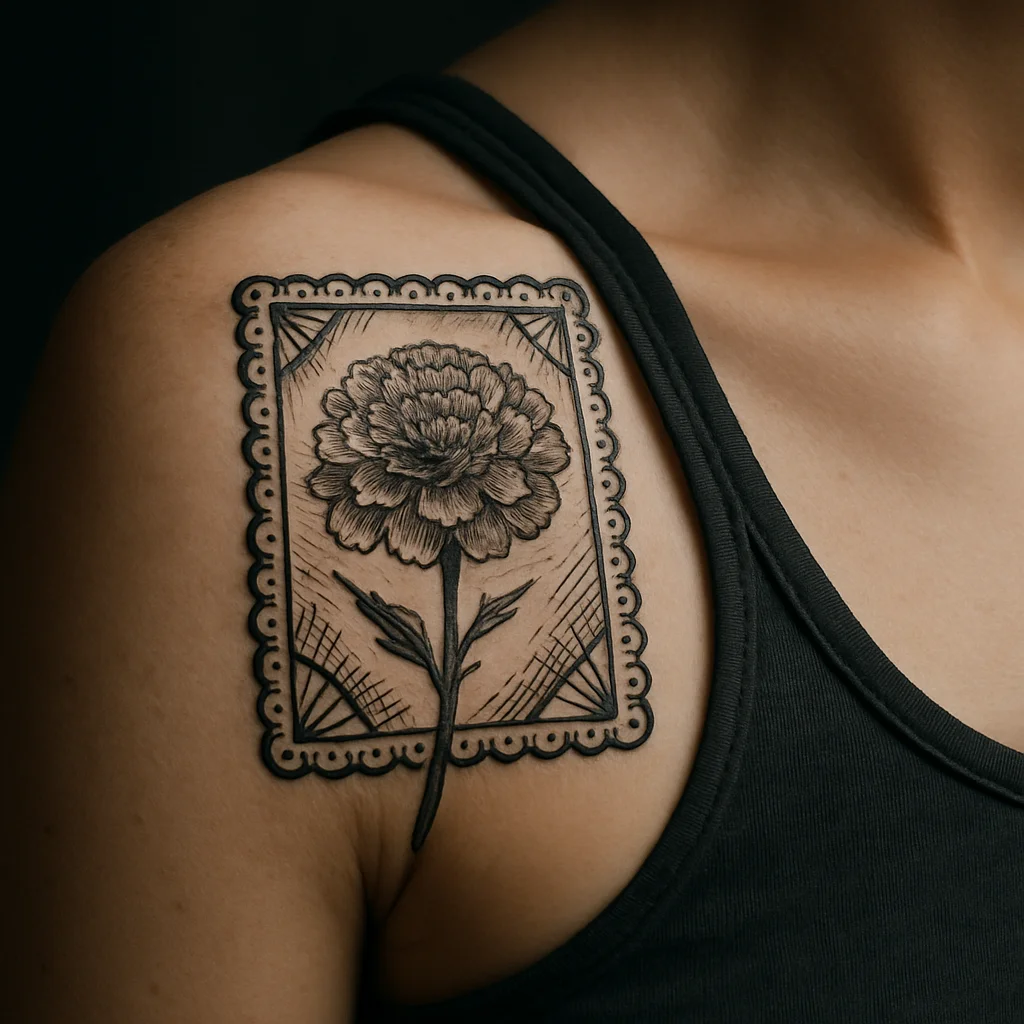
16. Marigold framed by papel picado
A single bloom set inside a cut-paper banner frame with fringed edges and small punched shapes, the way Dia de los Muertos decorations hang. The geometric frame gives the soft flower a spine and makes the composition feel intentional. Reads well on the outer forearm or the front of the shoulder.
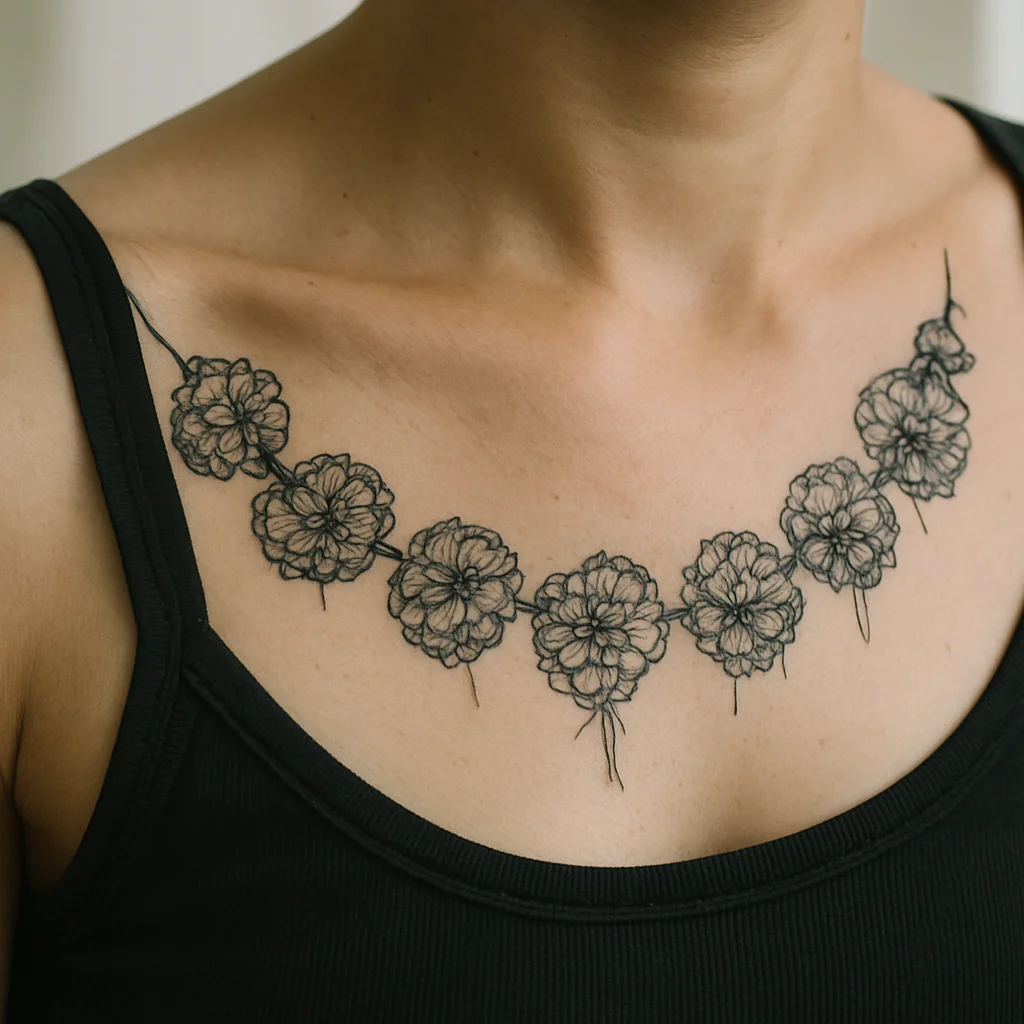
17. Marigold garland across the chest
A full-scale strung garland swagging from shoulder to shoulder across the upper chest, blooms the size of walnuts, with the thread rendered as a fine line. It borrows directly from temple and wedding garlands and it commands the space. This is a long, tender sitting near the sternum and collarbones.
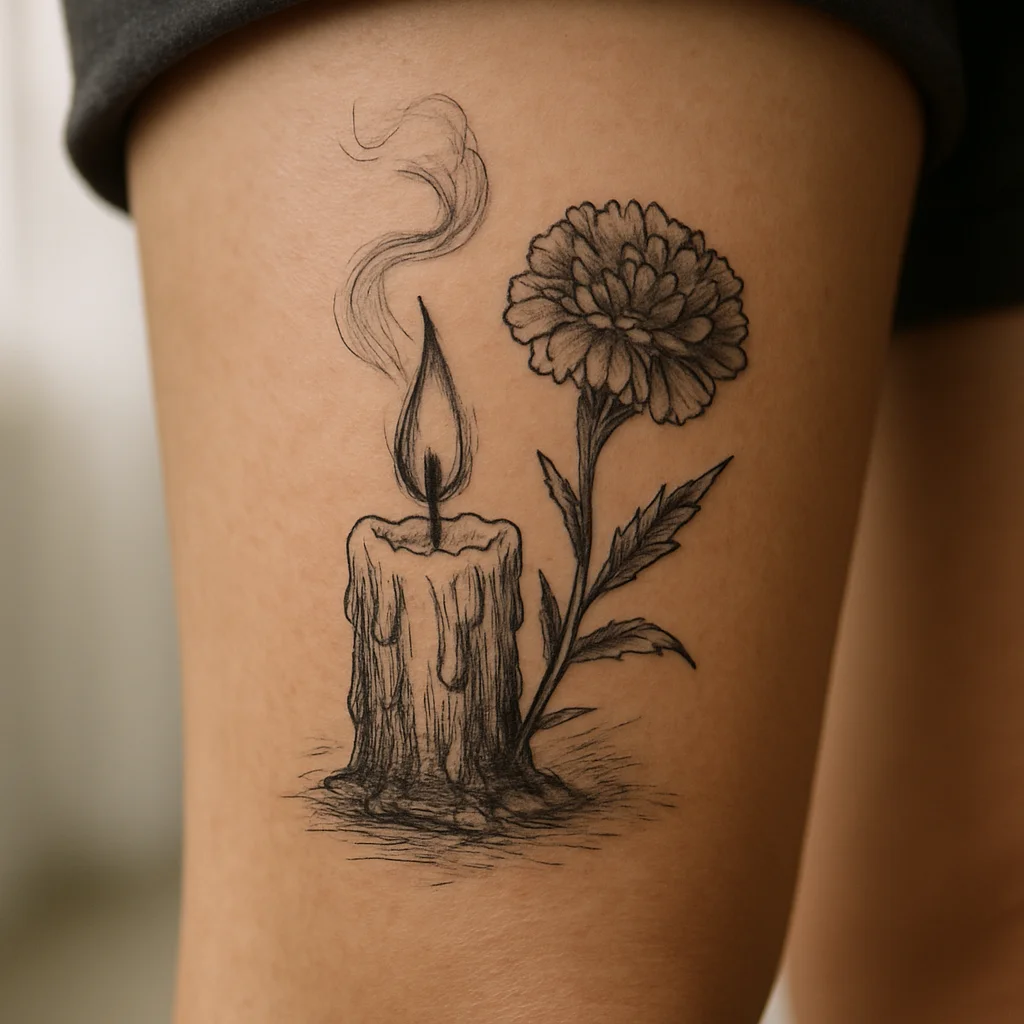
18. Marigold and lit candle on the calf
An ofrenda vignette: a stub candle with a warm flame, one marigold leaning in and a curl of smoke. Illustrative style with soft glow shading suits it better than hard black. Six to eight inches on the outer calf, which is a comfortable area with plenty of muscle padding.
Marigolds Built Into Bigger Pieces
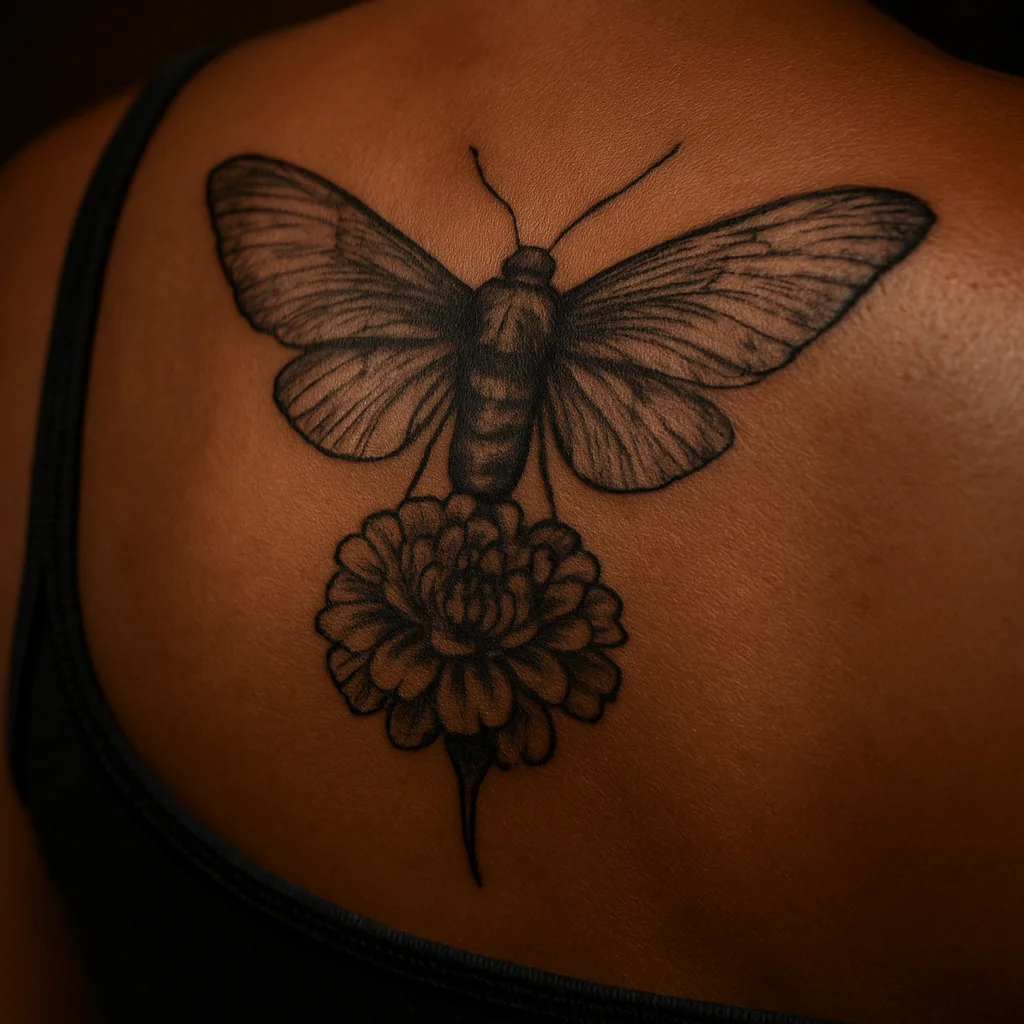
19. Marigold and moth memorial
A moth with soft grey wings, wings spread, carrying a marigold head below it, all in black and grey. The moth handles the symbolic heavy lifting while the flower keeps the date attached to a person. Five inches on the shoulder blade sits well under most necklines.
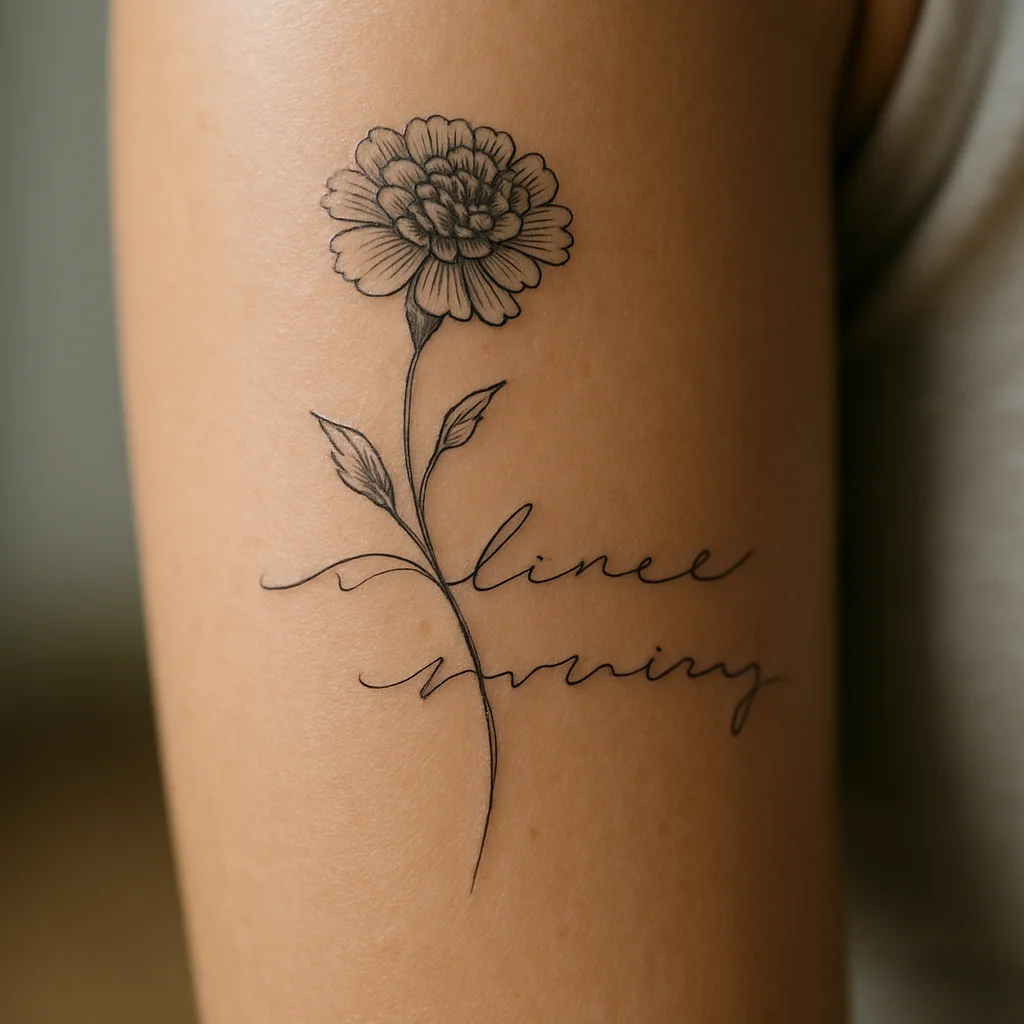
20. Marigold wrapped around handwriting
Take a line in a loved one's real handwriting and let a marigold stem curve underneath or through it, petals overlapping one or two letters so the elements feel woven rather than stacked. Bring a clean, high-contrast scan, not a phone photo of a photo. Our notes on handwriting memorial tattoos that age well explain how to prep the script.
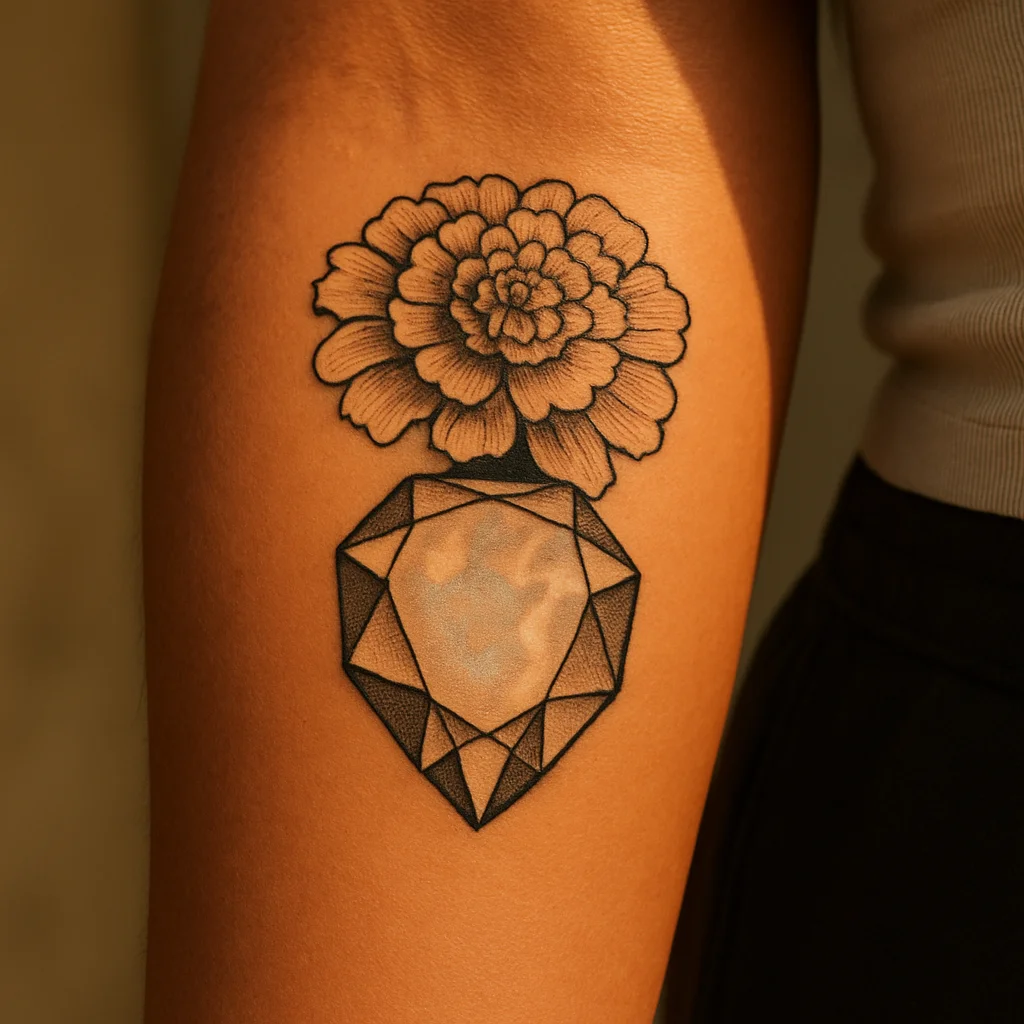
21. Marigold with an opal birthstone facet
Pair October's flower with October's stone: a faceted gem rendered in geometric line and soft opal shimmer, with the marigold blooming beside or behind it. The hard-edged crystal against soft petals is a strong contrast. Works at three to four inches on the inner forearm.
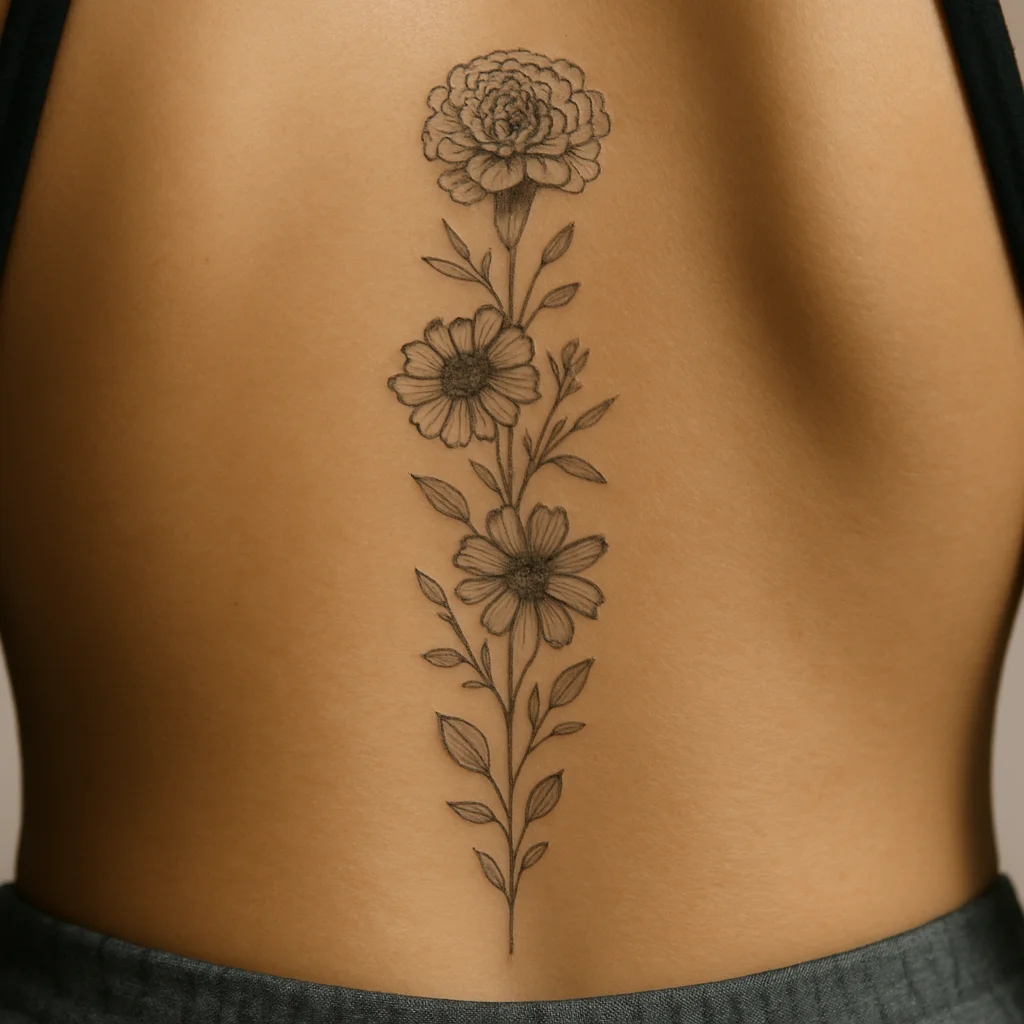
22. Sibling birth-flower stack
Marigold for the October sibling, then one bloom per brother or sister running down the spine or up the forearm in matching line weight. Keep every flower the same size and style so no one looks like an afterthought. Plan the full layout before the first session, even if you add them over years.
23. Marigold field wrapping the upper arm
Rather than one hero bloom, a cluster of six or seven marigolds at varying stages, buds through full pompoms, arcing around the arm with leaves filling the gaps. This is half-sleeve-adjacent work and usually takes two sessions. Ask for varied bloom sizes so the eye has somewhere to travel.
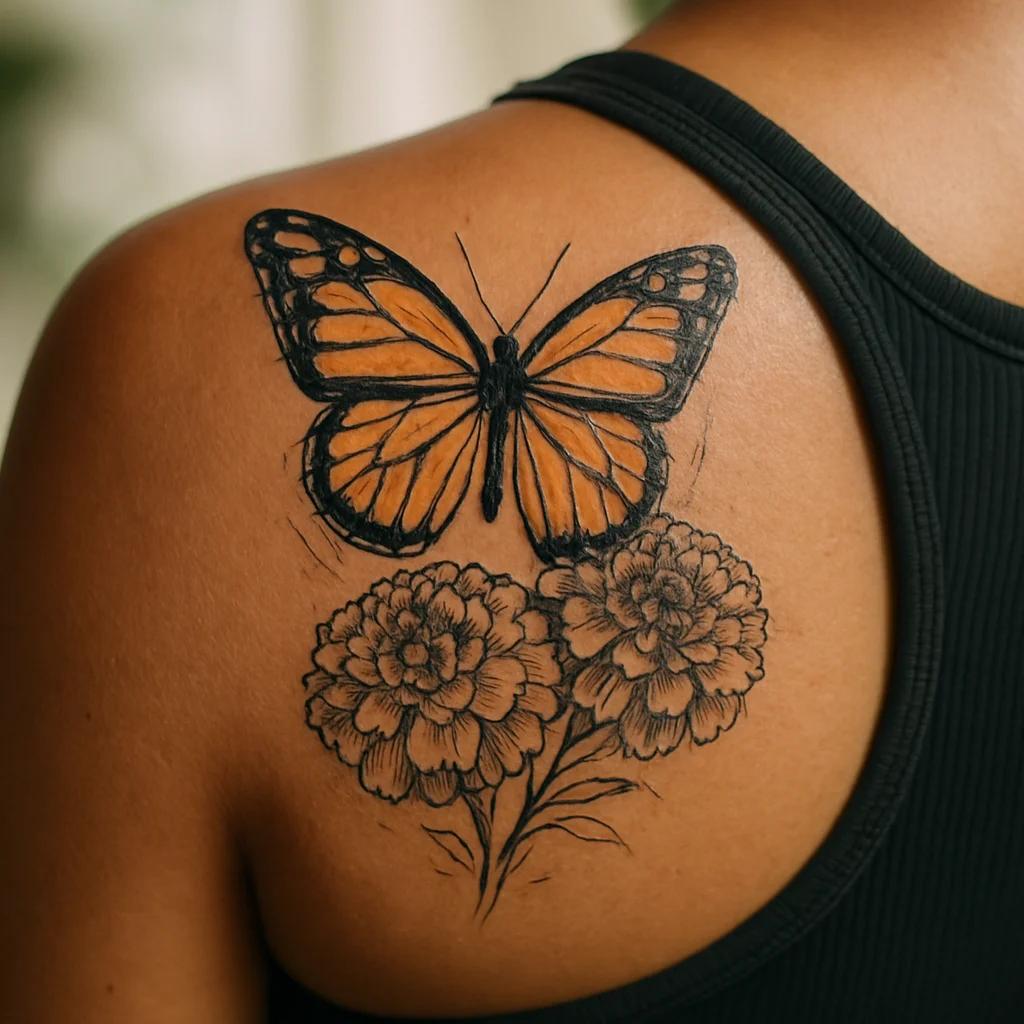
24. Marigolds and a monarch butterfly
Monarchs reach Mexico around the beginning of November, and pairing one with cempasuchil blooms makes a quietly layered piece about return and remembrance. Keep the butterfly in warm orange with strong black veining so it does not compete with the flowers. Shoulder blade or outer thigh both hold the composition.
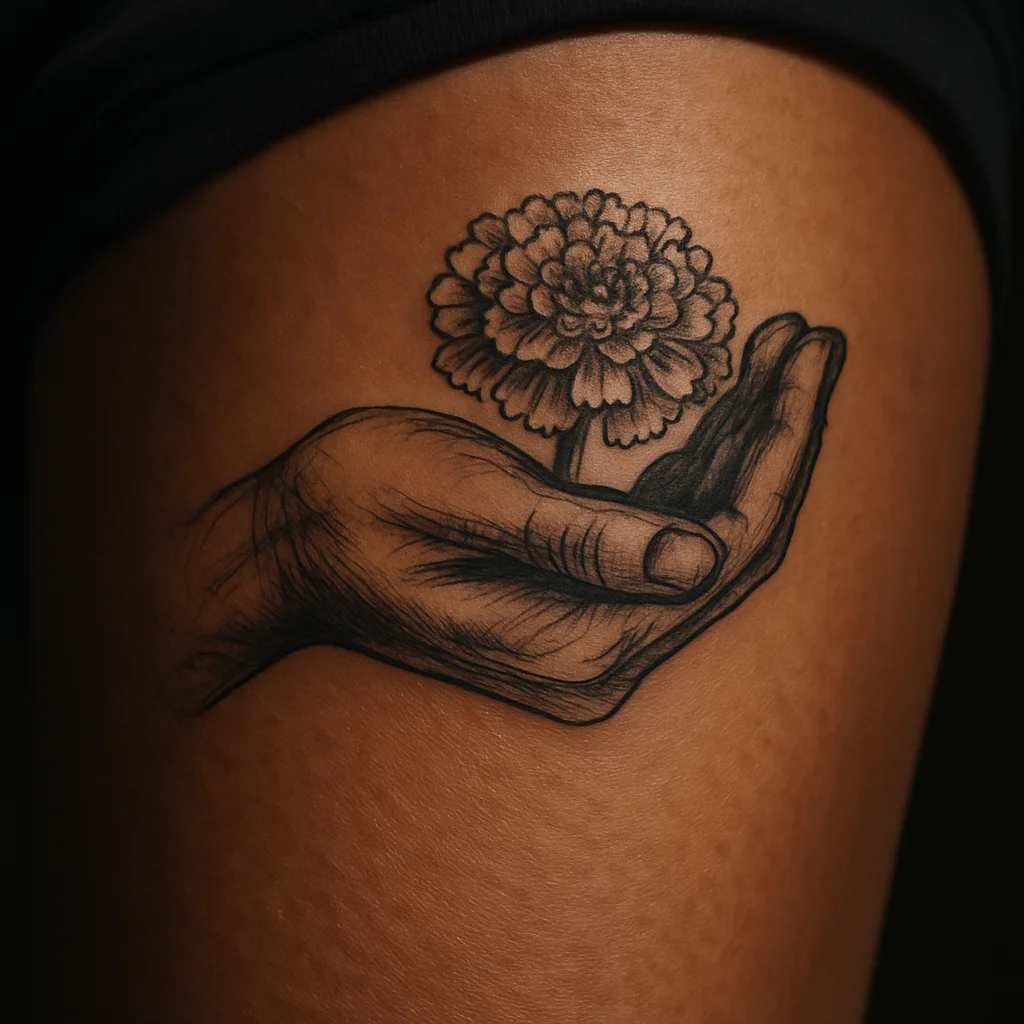
25. Marigold in an open hand
A cupped hand holding a single marigold head, drawn in illustrative black and grey with the flower as the only color. It is an offering image, which fits the flower's ofrenda role without leaning on skulls. Six inches on the thigh or outer forearm.
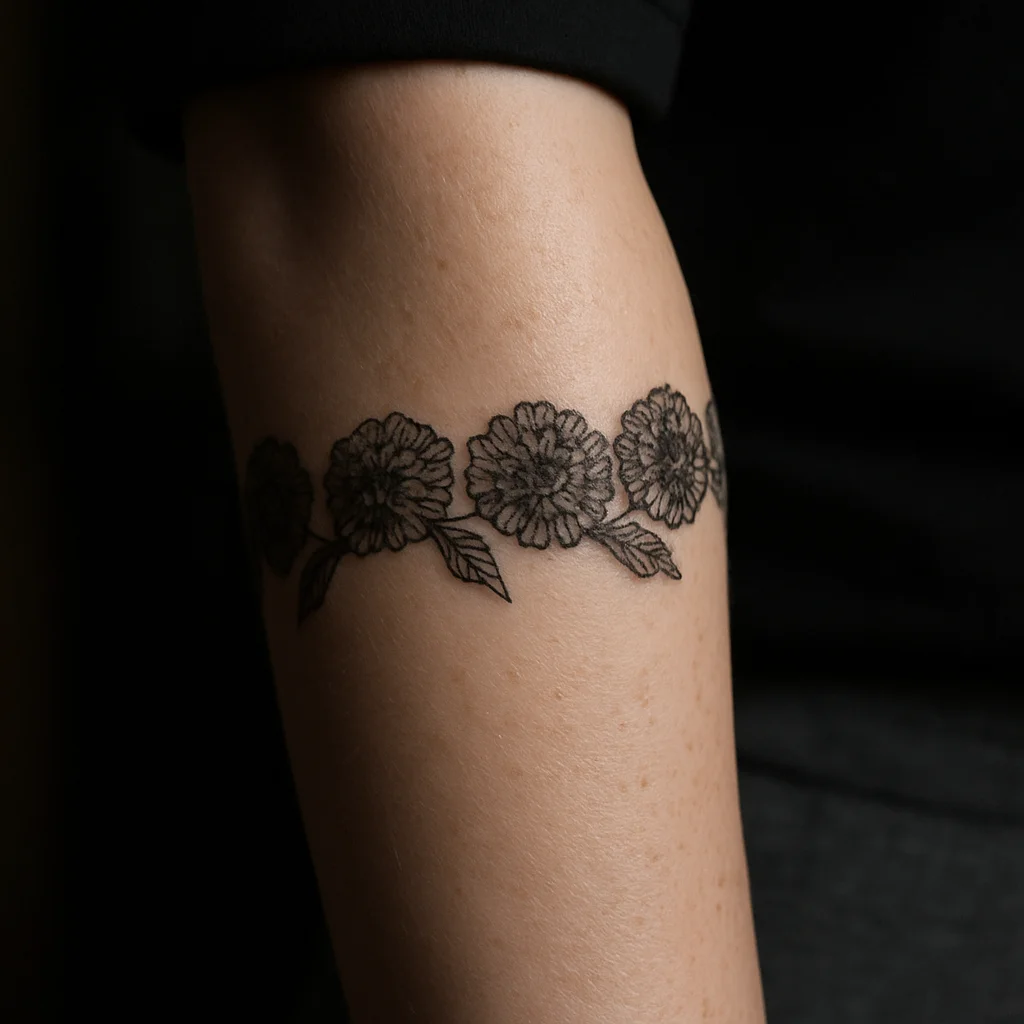
26. Marigold band around the forearm
A continuous garland circling the forearm just below the elbow like a bracelet, blooms alternating with leaf clusters and no visible seam where the ends meet. Wraparound work needs an artist who plans on the body with a marker rather than a flat stencil. Expect a full-day sitting for a clean, unbroken band.
Placement, Pain, Cost and Keeping Orange Orange
Where it ages best. Flat, low-friction, mostly covered skin is kindest to layered florals: inner and outer forearm, upper arm, shoulder blade, thigh, calf. Fingers, hands, feet and the ribs directly over bone all move, rub or turn over faster, so detail there needs simplifying and touching up. If you want a marigold to still read at ten years, oversize it slightly and insist on gaps of clean skin between petal layers.
Pain, honestly. Outer forearm, thigh and calf are the easy end. Upper arm and shoulder blade are moderate. Ribs, sternum, collarbone, spine, ankle bone and the tops of feet are the sharp ones, mostly because the needle is working over bone with little padding. Behind the ear is quick but buzzy and loud. A three-inch fine-line bloom is often under an hour; a color pompom with packed background runs two to four; a wrap band or garland can eat a full day.
Cost. Small single blooms usually land at or just above a shop minimum. Palm-sized fine-line work sits in the low hundreds, a saturated color piece with shading in the mid hundreds, and full-day wraps or chest garlands in the high hundreds to low thousands depending on city and artist demand. Rates vary widely by region, so treat any number you read online as a rough shape, not a quote.
The orange problem. Warm oranges and yellows are the pigments most vulnerable to sun and, over years, to lightening. Three things help: ask your artist to build the flower on a solid black or dark-red structure so the design survives even if color softens, choose deeper rusts and burnt oranges over pastel tones, and wear sunscreen on it for life. Blackwork and fine-line versions dodge the issue entirely.
Briefing your artist. Say whether you want Tagetes or calendula, bring two or three real photographs of the plant rather than other tattoos, and name the mood: ofrenda, temple garland, dried and wistful, or bright and botanical. Ask them to place the stencil while you stand naturally, then move your arm or turn your shoulder to check the flower still sits right. Aftercare is the usual: clean with unscented soap, thin layer of ointment for a few days, no soaking or sun for two to three weeks, and no picking at the flakes that form over dense petal shading.
Frequently asked questions
Is marigold really the October birth flower?
Yes, marigold is the flower most commonly assigned to October, and cosmos often appears as a second option in modern lists. Some people tattoo both on one stem to cover the pair. If your birthday sits at the very start or end of the month, you can also blend in September's aster or November's chrysanthemum for a two-flower piece.
How small can a marigold tattoo go?
A flat calendula-style bloom works down to about an inch and a half, and a closed bud can go smaller. The dense Tagetes pompom really needs two and a half to three inches, otherwise the petal layers blur into a solid blob as the lines settle. If you want tiny, choose a bud, a seed head or a simplified silhouette rather than a full open flower.
Will the orange fade badly?
Warm oranges and yellows are among the first pigments to soften, especially on sun-exposed skin. Ask your artist to build the design on strong black linework or dark red shadow so the shape survives regardless, choose deeper rust tones over pale ones, and keep it under sunscreen. Blackwork or fine-line black versions avoid the problem altogether.
Does a marigold tattoo have to be about Day of the Dead?
No. The flower carries several meanings at once: cempasuchil at ofrendas in Mexico, devotion and celebration in Indian garlands, grief in Victorian flower language, and simply an October birthday. Tell your artist which reading you want, because it changes the styling, the palette and the elements you pair it with.
What placement suits a first marigold tattoo?
Inner or outer forearm and upper arm are the best all-rounders: comfortable to sit through, flat enough for detail, easy to keep out of the sun, and simple to view yourself. Ankles, ribs and behind the ear are more painful and harder on fine detail over time. If you are unsure about visibility, the shoulder blade hides under most clothing while giving you plenty of room.
The conversation
No comments yet. Got a thought about these designs? Start us off.
Want to weigh in? Join the community to comment, save designs and try them on your skin.