26 Inner Thigh Tattoos, From Crease to Knee
The inner thigh is soft, private and quietly demanding — it chafes, it stretches, and it swallows thin lines if you get the design wrong. Here are 26 pieces that suit the space, mapped from the crease down to the knee.
What the inner thigh does to a tattoo
This is one of the most forgiving placements for privacy and one of the least forgiving for technique. The skin here is thin, mobile and rarely sun-exposed, which means colour and black both stay rich for years — but it also sits over soft tissue, so a heavy hand can push ink sideways and leave you with a blurred halo around fine lines.
Three things shape every good inner thigh design:
- Friction. The upper inner thigh rubs against its twin every time you walk. During healing that friction lifts scabs early and can patch out colour. During the long term it doesn't erase a tattoo, but hairline single-needle work in the highest, softest zone tends to soften faster than the same design on a forearm.
- Curvature. The thigh is a cylinder, and the inner face curves away from the viewer. Anything wider than roughly a hand span disappears around the edges unless the artist designs for the wrap.
- Angle of view. You'll see this tattoo standing up in a mirror, from above, at a foreshortened angle. Ask your artist to stencil it and then check it standing, not lying on the table — a composition that looks perfect while you're reclined can read crooked when you're upright.
Practical translation: ask for slightly heavier outlines than you'd choose for a wrist, keep the densest detail on the mid-thigh where skin is flatter and less mobile, and leave a few millimetres of breathing room between elements so they don't merge as the tattoo settles. If you want the full leg mapped out, our wider guide to thigh tattoo ideas for women covers front and outer placements too.
High and hidden: designs that sit at the crease
The top few inches — where thigh meets hip — is the most private real estate on the body and the sharpest sting on the list. Keep these pieces compact and simple; this is the zone with the most movement and the most rub.
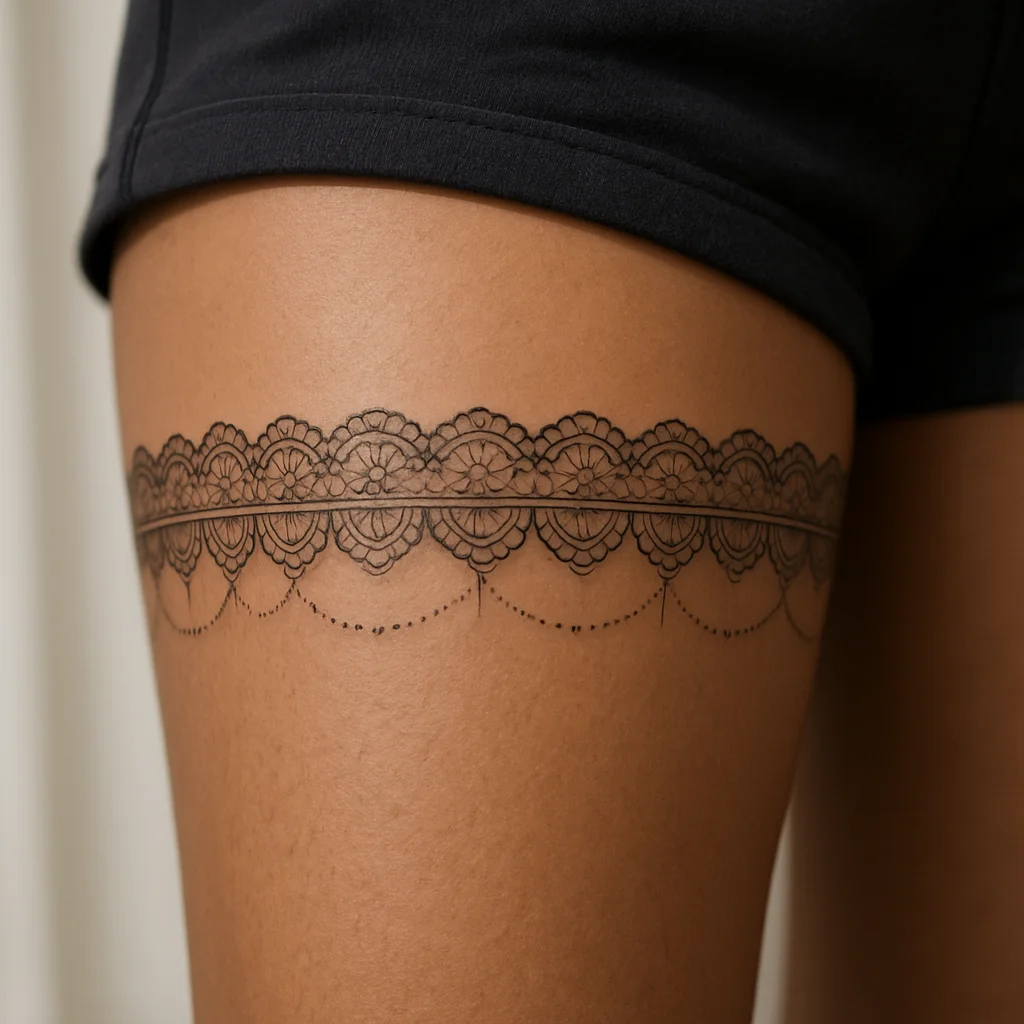
1. Fine-line lace garter band
A narrow band of scalloped lace and tiny pearl dots wrapping the upper inner thigh, usually two to three fingers wide. It flatters the roundness of the leg because the scallops follow the curve instead of fighting it. Ask for a defined bottom edge and slightly open lacework in the middle so it doesn't grey into a solid strip over time.
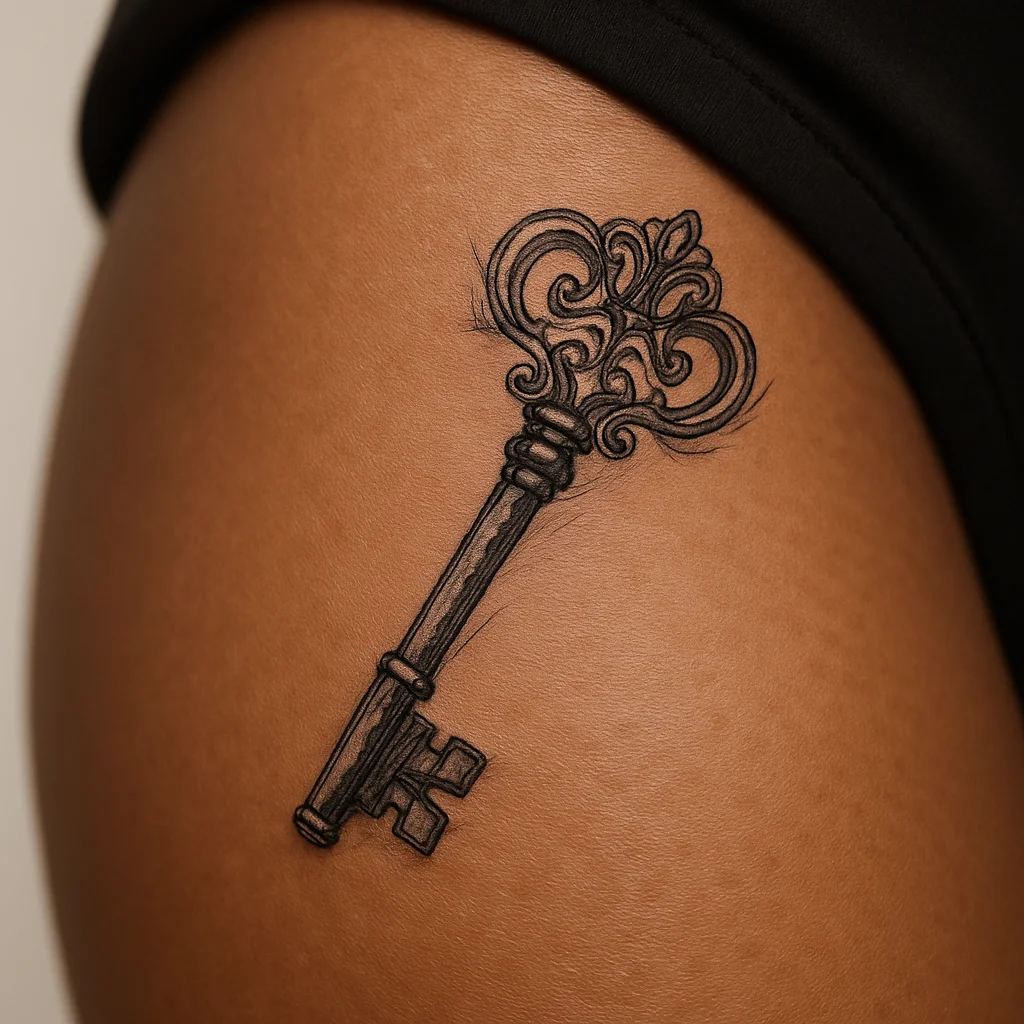
2. Small key tucked into the crease
An ornate skeleton key, three to four inches, angled with the bow pointing toward the hip. It's a classic private-placement motif that reads as a wink rather than a statement, and the vertical shape suits the narrow space. Works beautifully with a matching padlock on the opposite thigh.
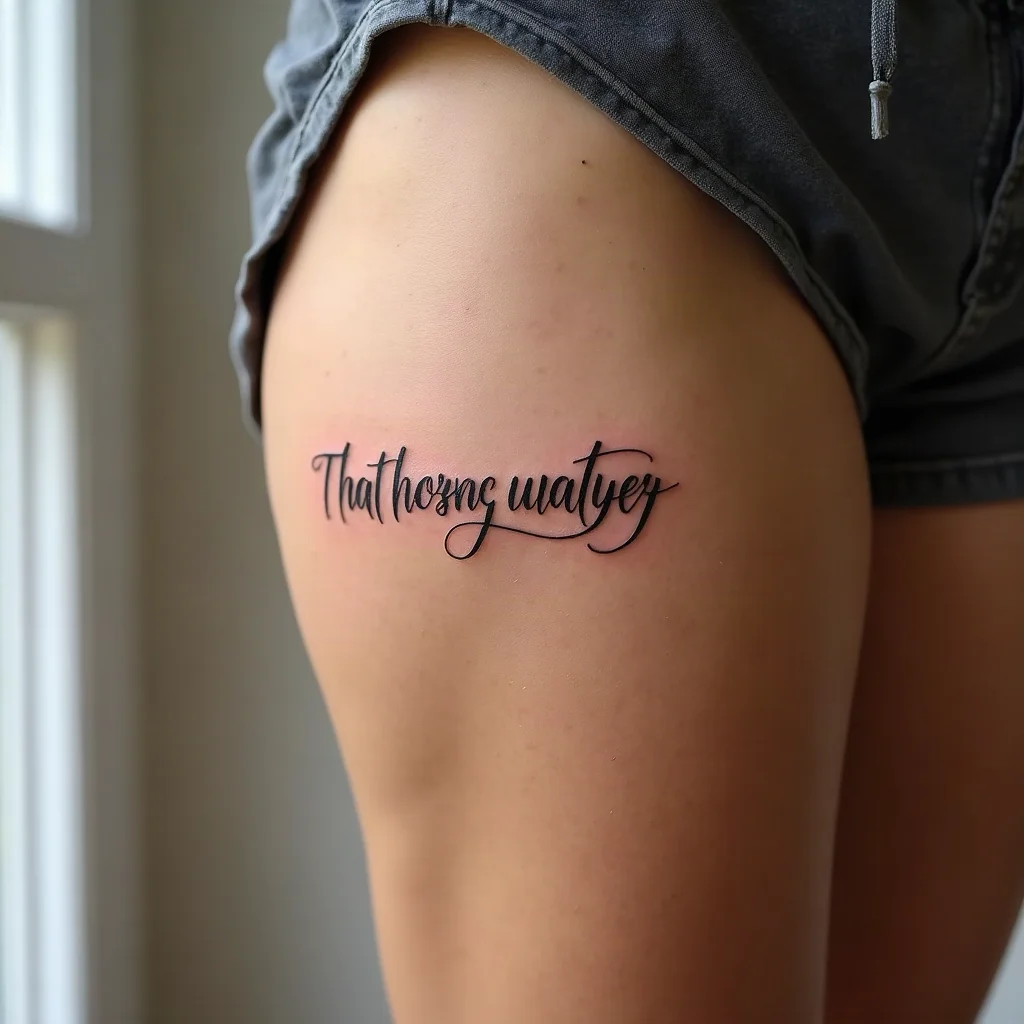
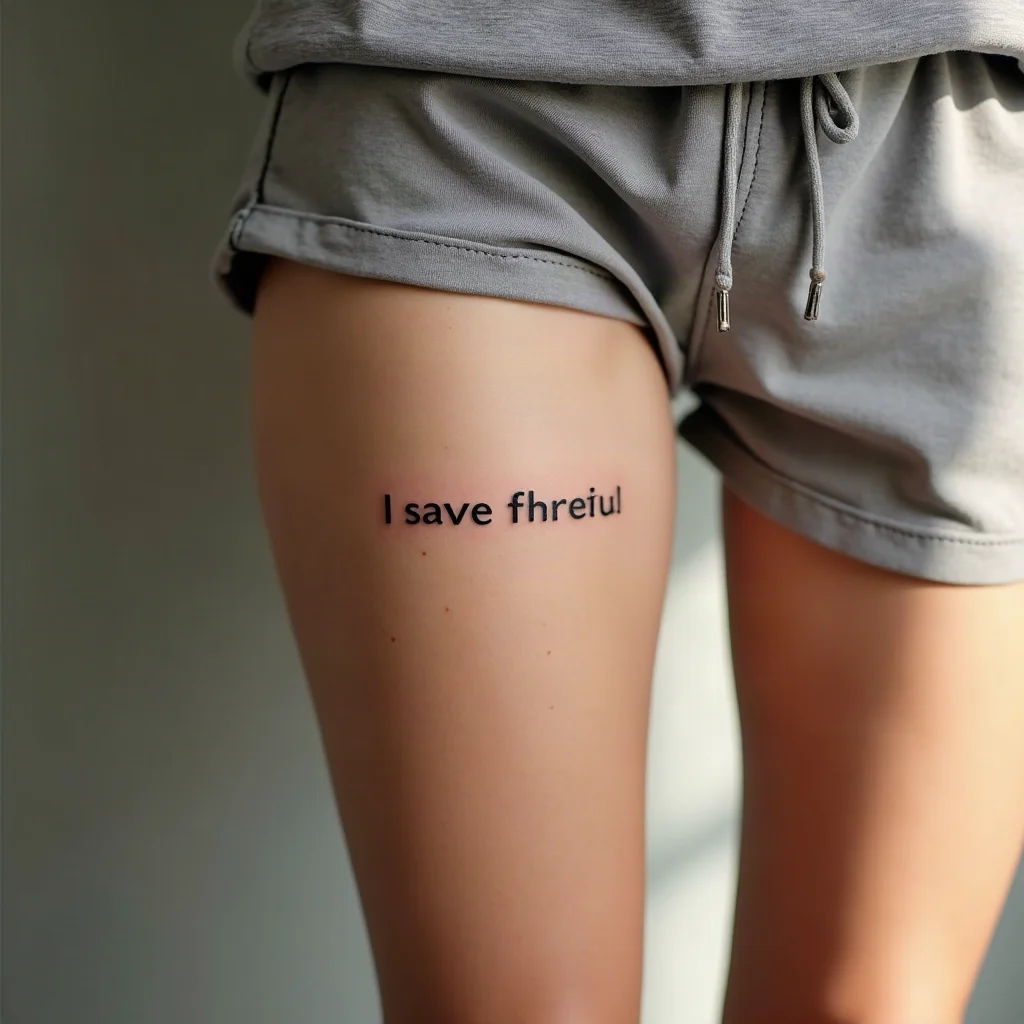
3. Curved script along the bikini line
A short phrase — three or four words, no more — set on a gentle arc that follows the crease rather than running straight. Choose a font with connected strokes and a bit of weight; hairline copperplate at this angle can close up. Keep it to a length you can read in one glance in the mirror.
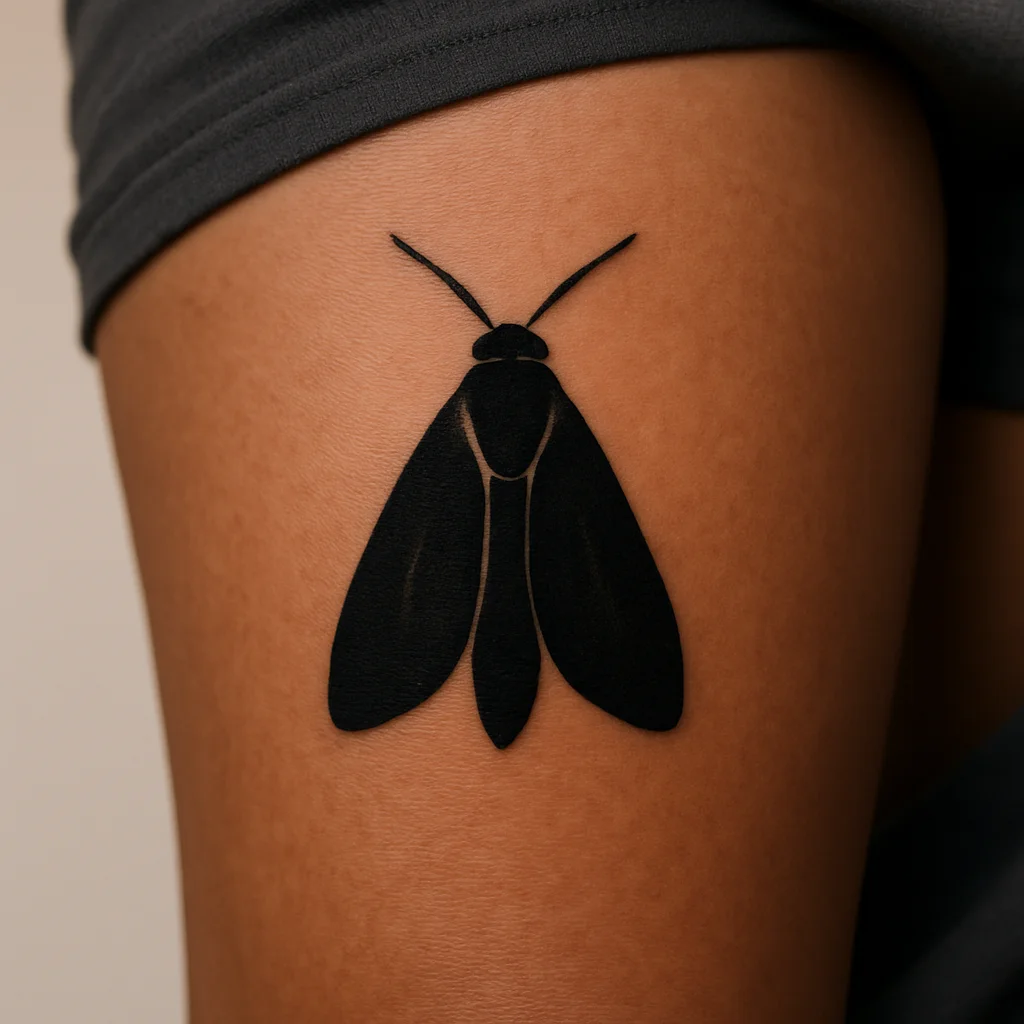
4. Moth with folded wings
A small blackwork moth sitting high and vertical, wings tucked rather than spread so the silhouette stays narrow. The dense body and stippled wing texture hold up well against friction, unlike open filigree. Around four inches tall is the sweet spot.
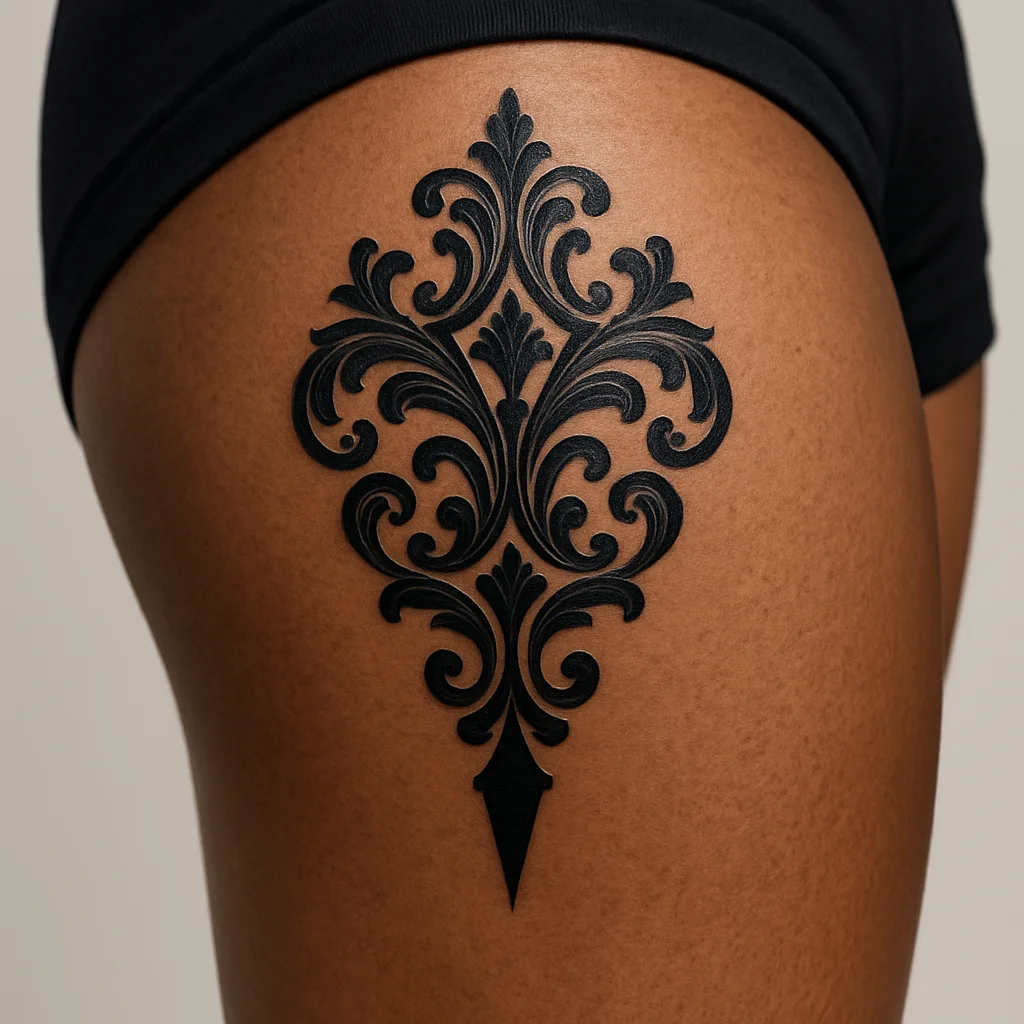
5. Ornamental filigree teardrop
A symmetrical baroque flourish that tapers downward, like a chandelier drop, with one small stone or dot at the base. Because it's built from repeating curls, it forgives a little softening as it ages. Good for anyone who wants decoration without a subject.
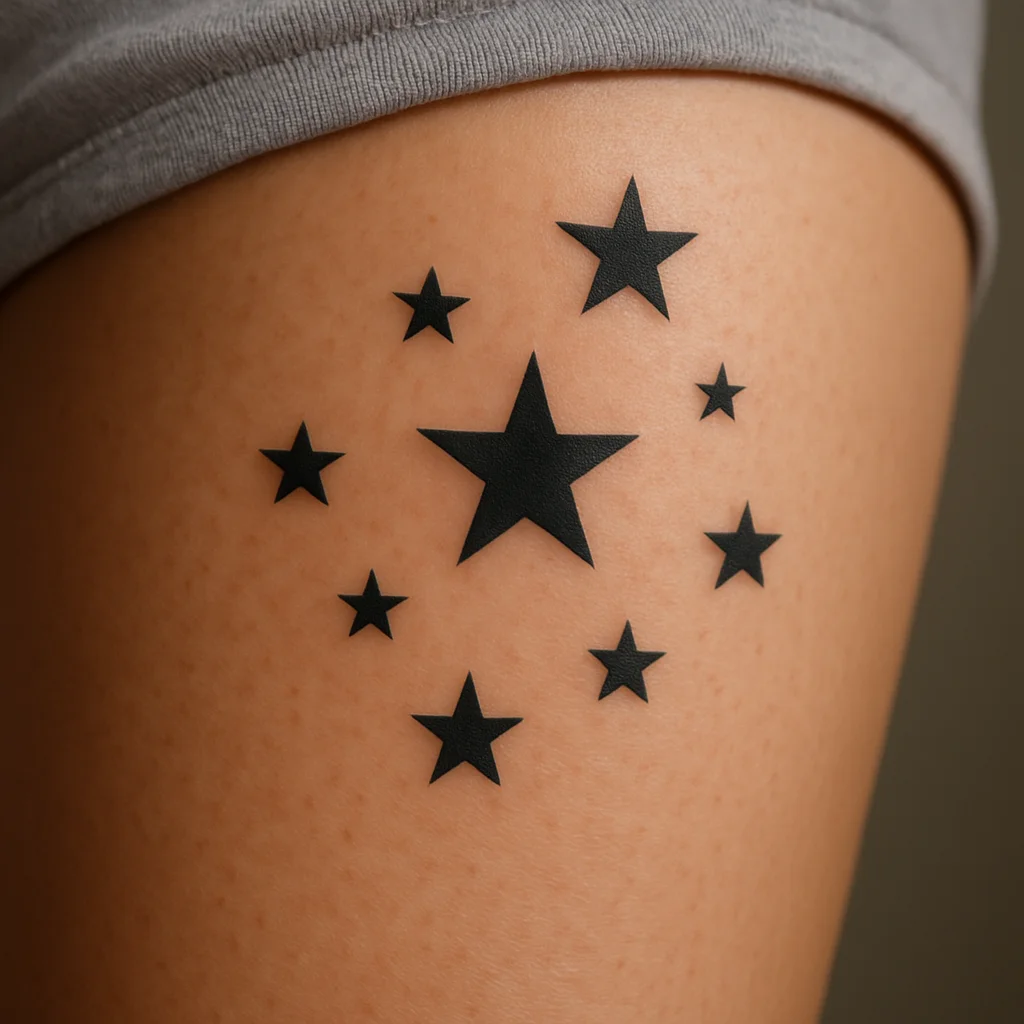
6. Scattered stars and pinpricks
A loose constellation of solid five-point stars in three sizes, drifting from the crease toward mid-thigh. Cheap, fast, and endlessly extendable — many people add a few more each visit. Ask for the dots to be at least 2mm so they don't vanish; true pinpricks fade out in soft skin.
The mid-thigh panel: your best canvas
Halfway down, the skin flattens out, the friction drops and you get a genuine panel roughly the size of two open hands. This is where detail survives, and where most people should put their statement piece.
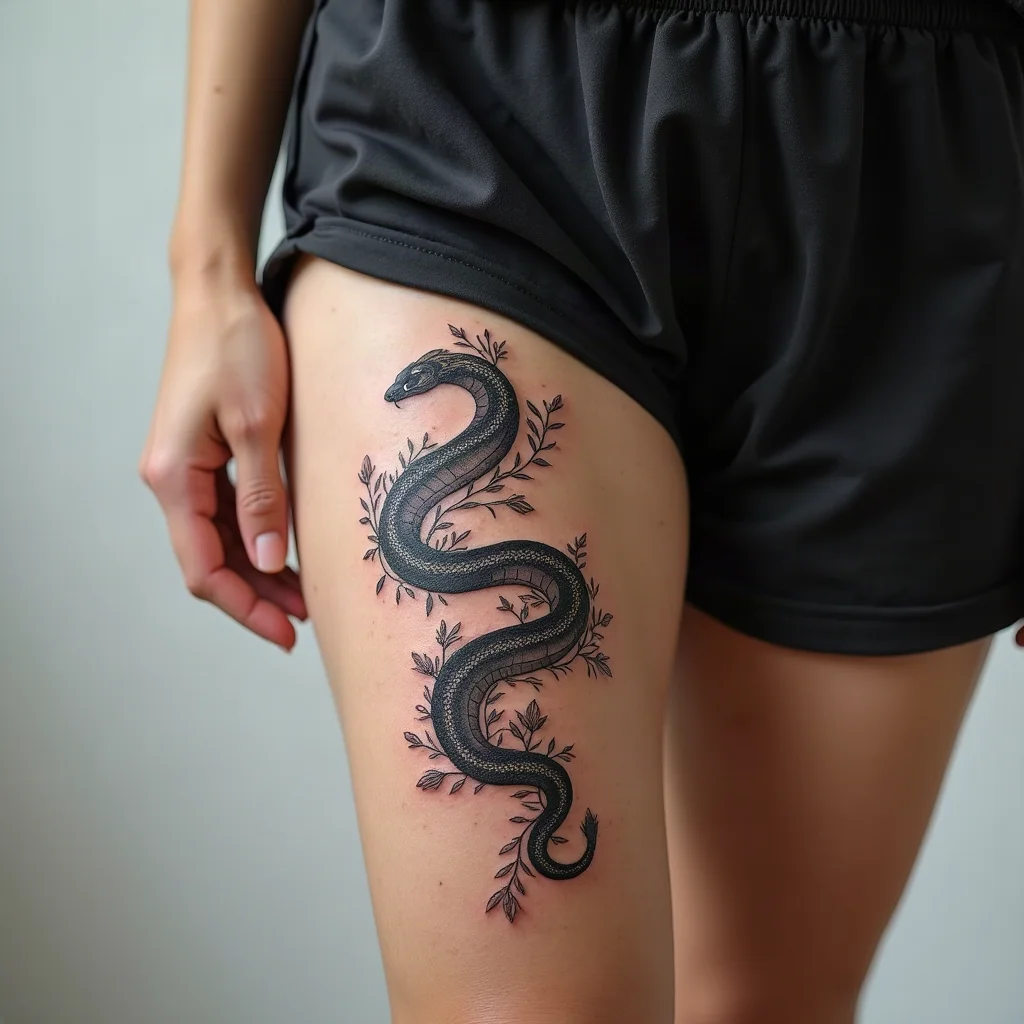
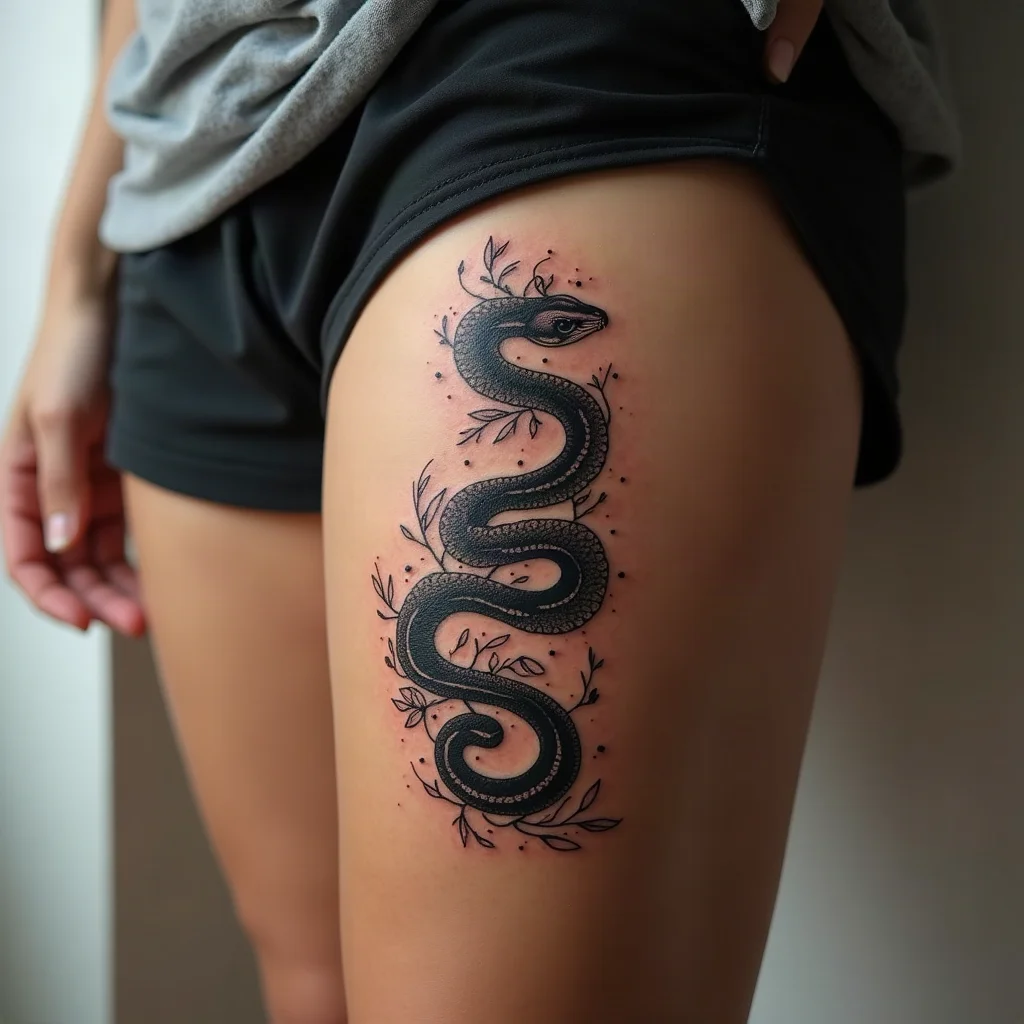
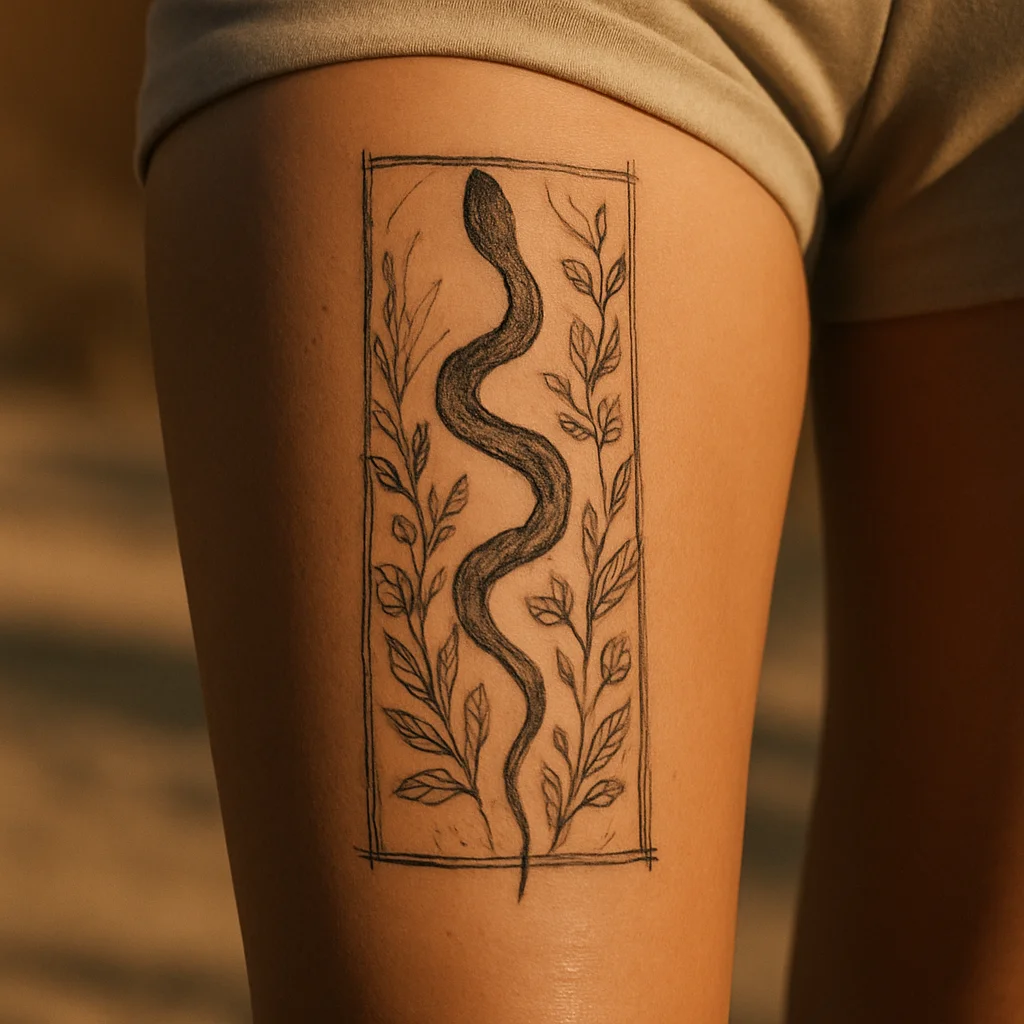
7. Descending snake with botanical accents
A serpent entering at the top of the panel and winding down toward the knee, with a few sprigs of nightshade or wheat filling the negative space at the curves. The vertical S-shape is made for this placement — it uses the length without spilling around the leg. Six to ten inches tall, with solid black belly scales for contrast.
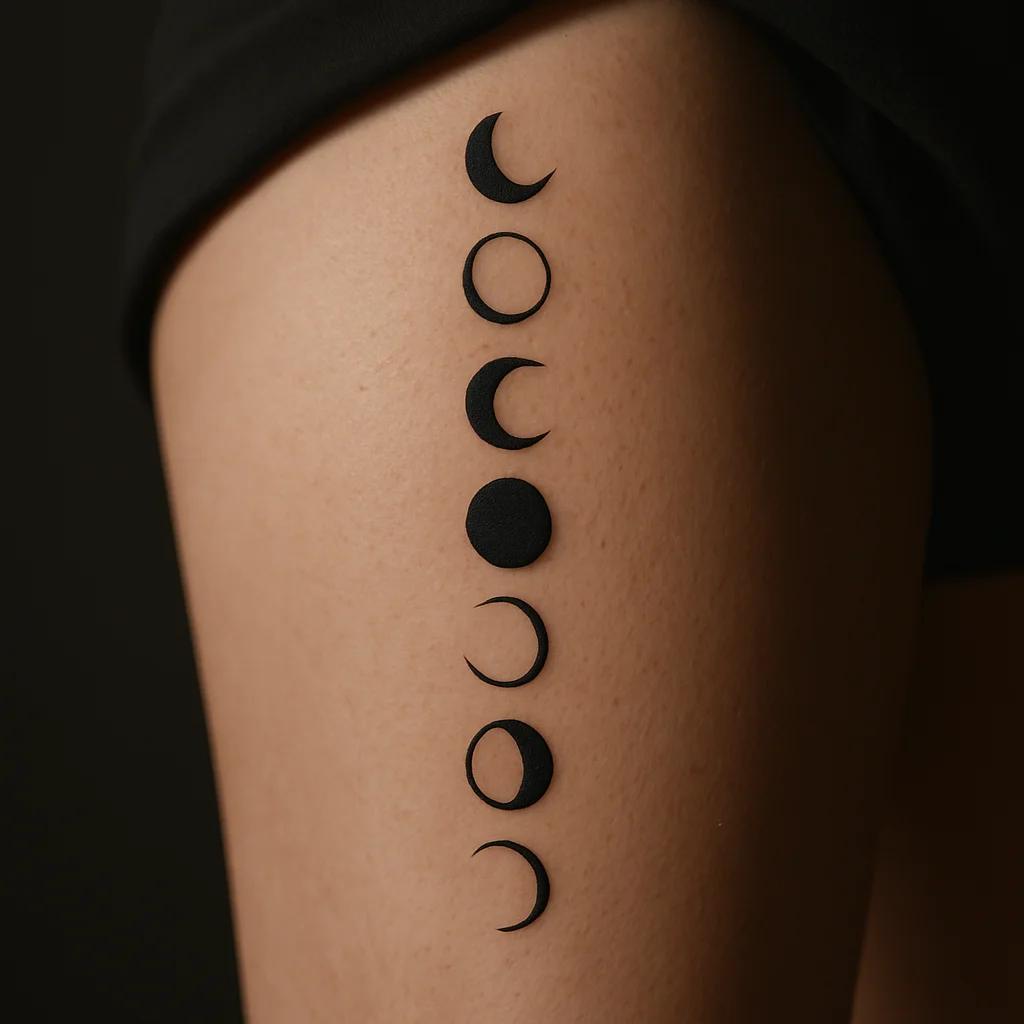
8. Stacked moon phases
Five to seven moons running in a straight vertical line down the centre of the panel, alternating between solid black and fine crescent outlines. Simple, symmetrical and easy to align with a plumb line so it stays true when you're standing. Add a thin connecting line if you want it to read as one object rather than a row.
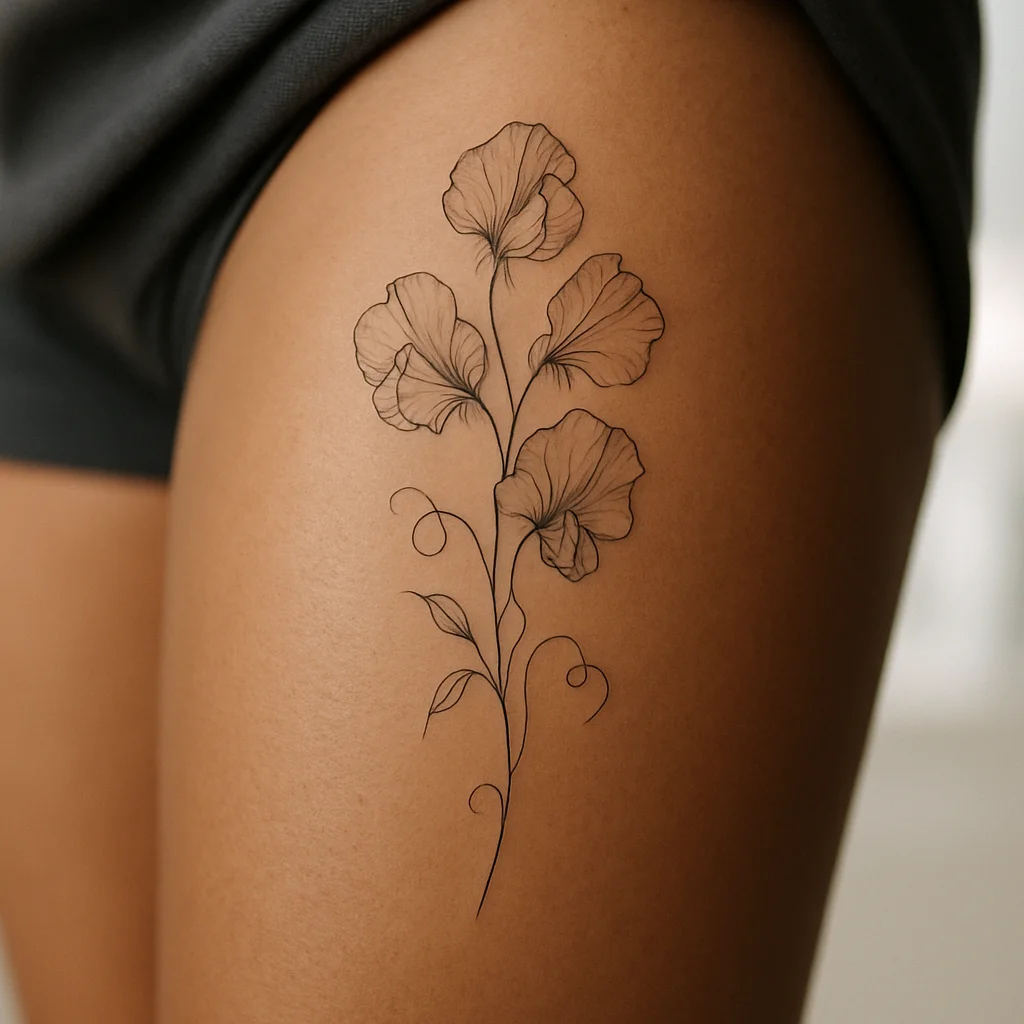
9. Sweet pea vine trailing downward
Delicate curling tendrils and two or three open blooms, drawn as though the vine is falling rather than climbing. Choose a flower with real silhouette variety — sweet pea, foxglove, cosmos — so the shape stays legible when the petals soften. Grey wash shading gives depth without the density of solid black.
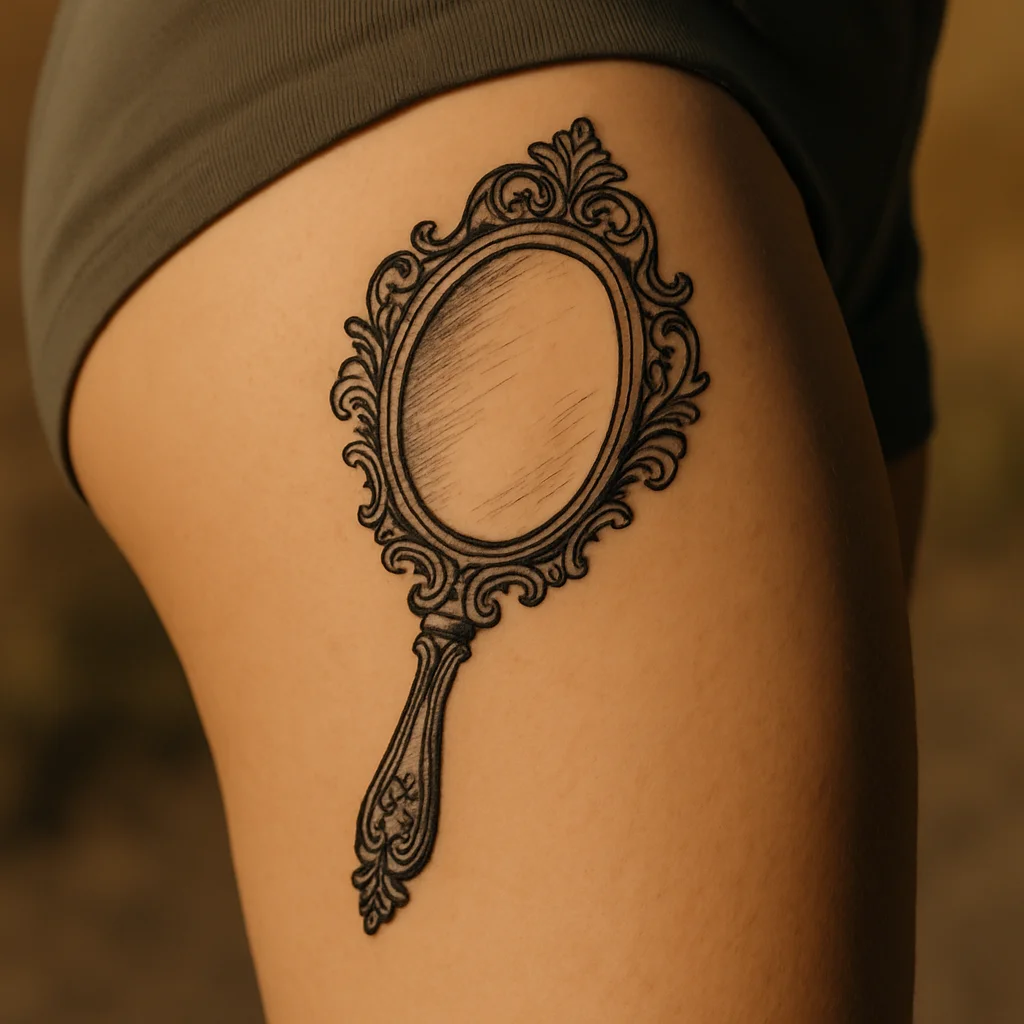
10. Ornamental hand mirror
An antique mirror with a scrolled frame, held vertically, with the glass rendered in smooth grey wash or left as clean negative space. It plays with the idea of the placement being seen only by you. Around seven inches gives the frame room to show its detail.
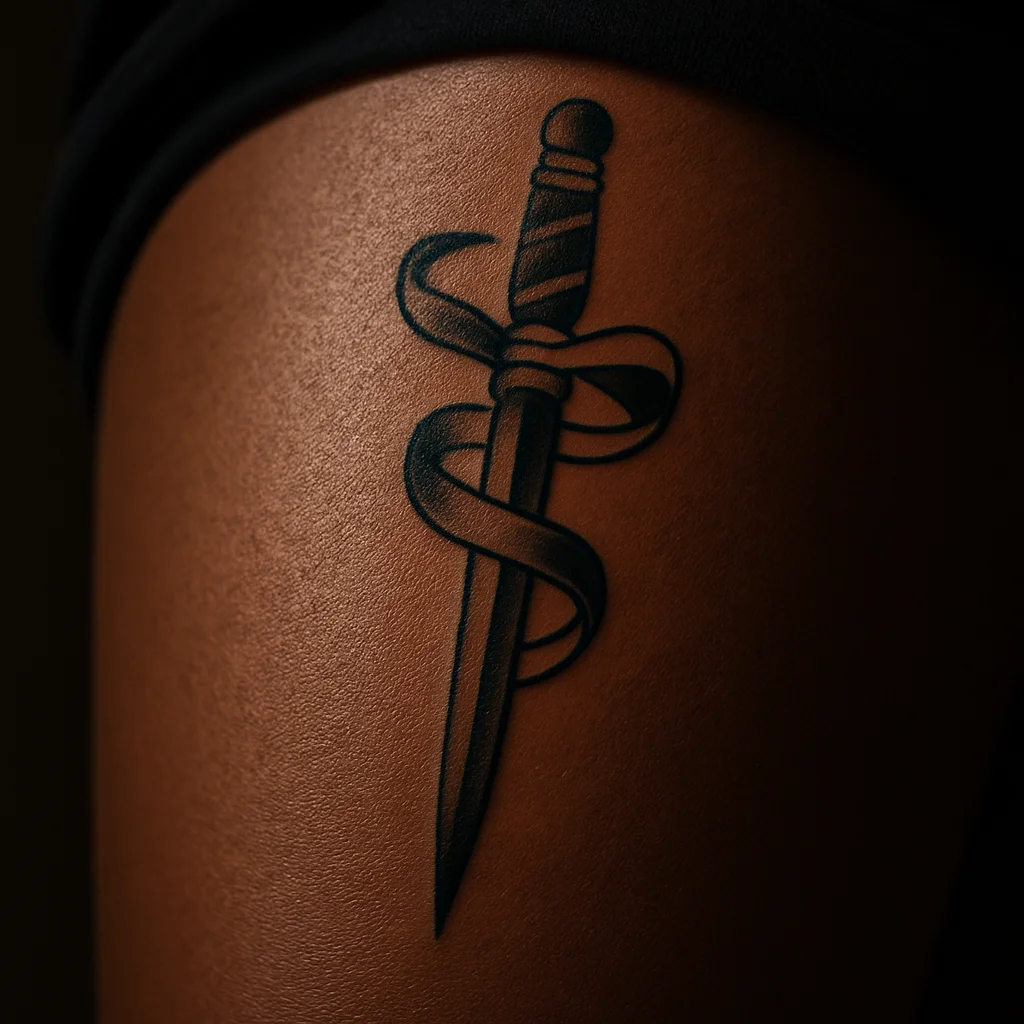
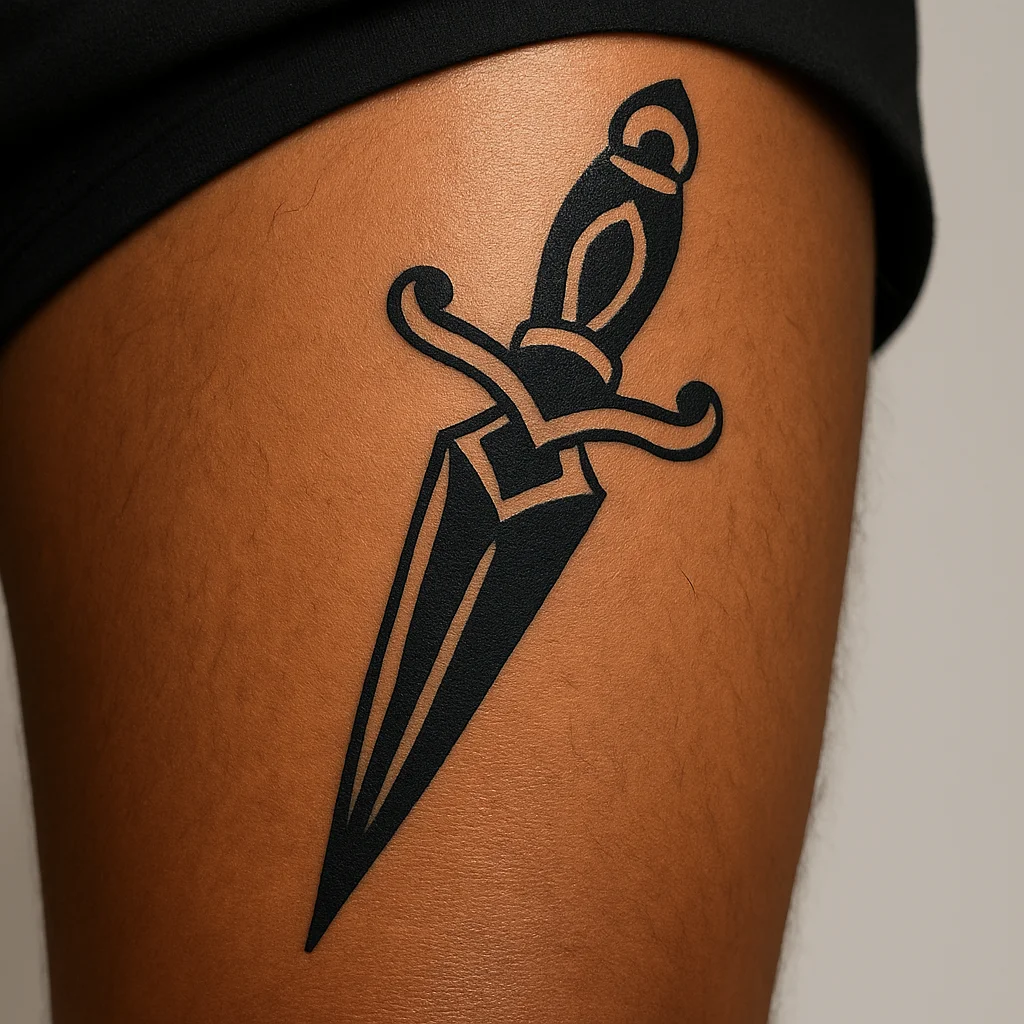
11. Dagger with a wrapped handle
A slim blade pointing down toward the knee, hilt at the top, with a ribbon or snake coiling around the grip. The straight vertical line is the most flattering shape you can put on the inner thigh, and it suits both traditional bold-line work and fine-line grey.
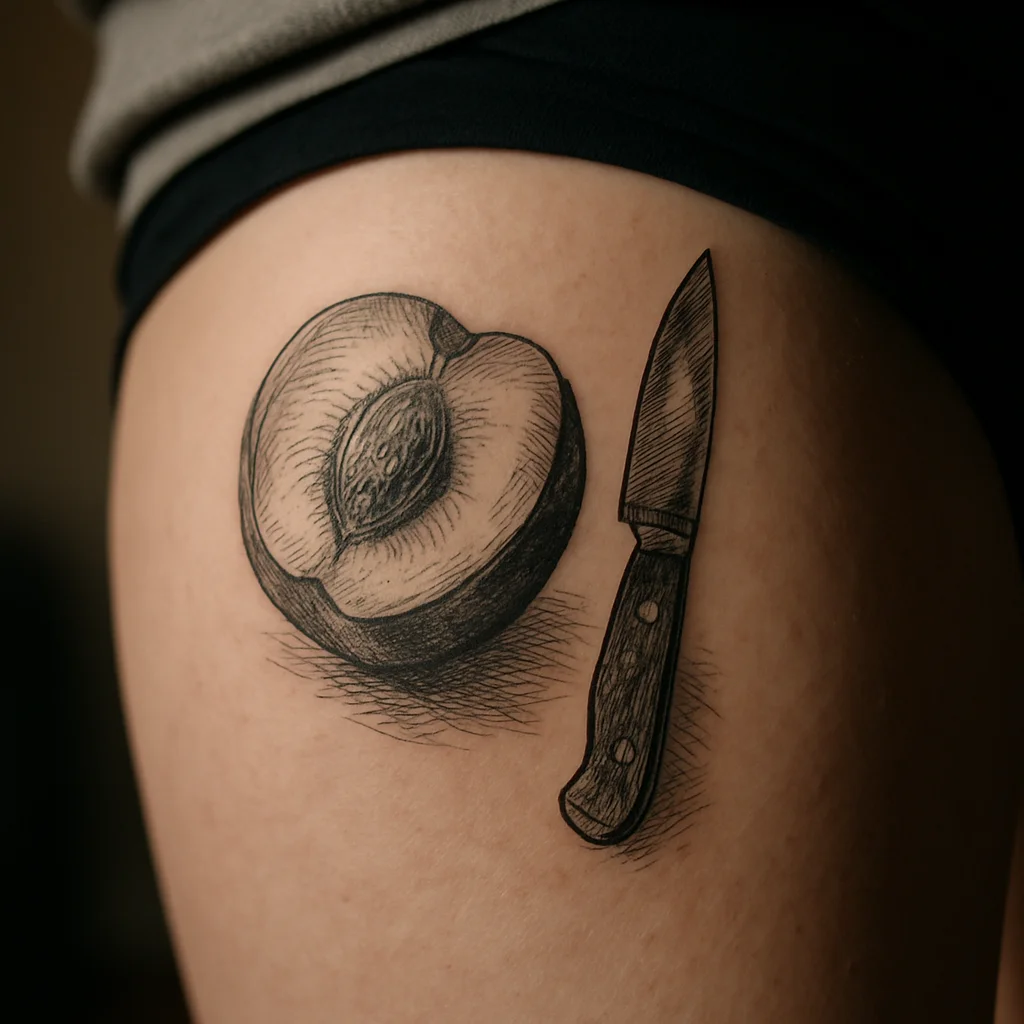
12. Still life with fruit and a knife
A halved peach or fig with a small paring knife beside it, drawn with etched cross-hatching. It's a sensual, slightly art-historical alternative to florals and it fills the panel's width nicely. Ask for strong shadow under the fruit so it sits on an implied surface.
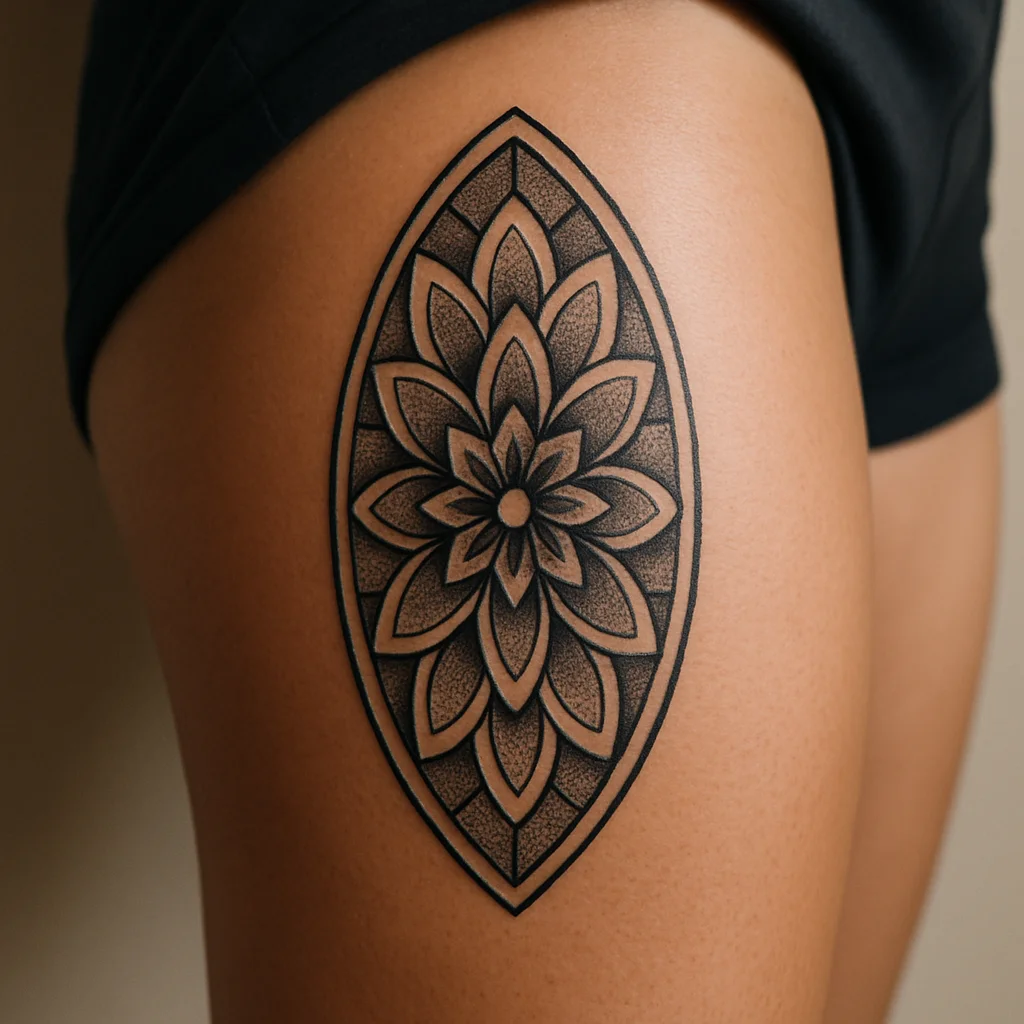
13. Geometric oval mandala
Not a circle — an elongated mandala stretched into an oval so it matches the shape of the leg rather than distorting on the curve. Concentric petals, dotwork shading and a defined outer border keep the geometry crisp. Eight inches tall is common; go smaller and the inner rings crowd.
Lower inner thigh: the quiet zone above the knee
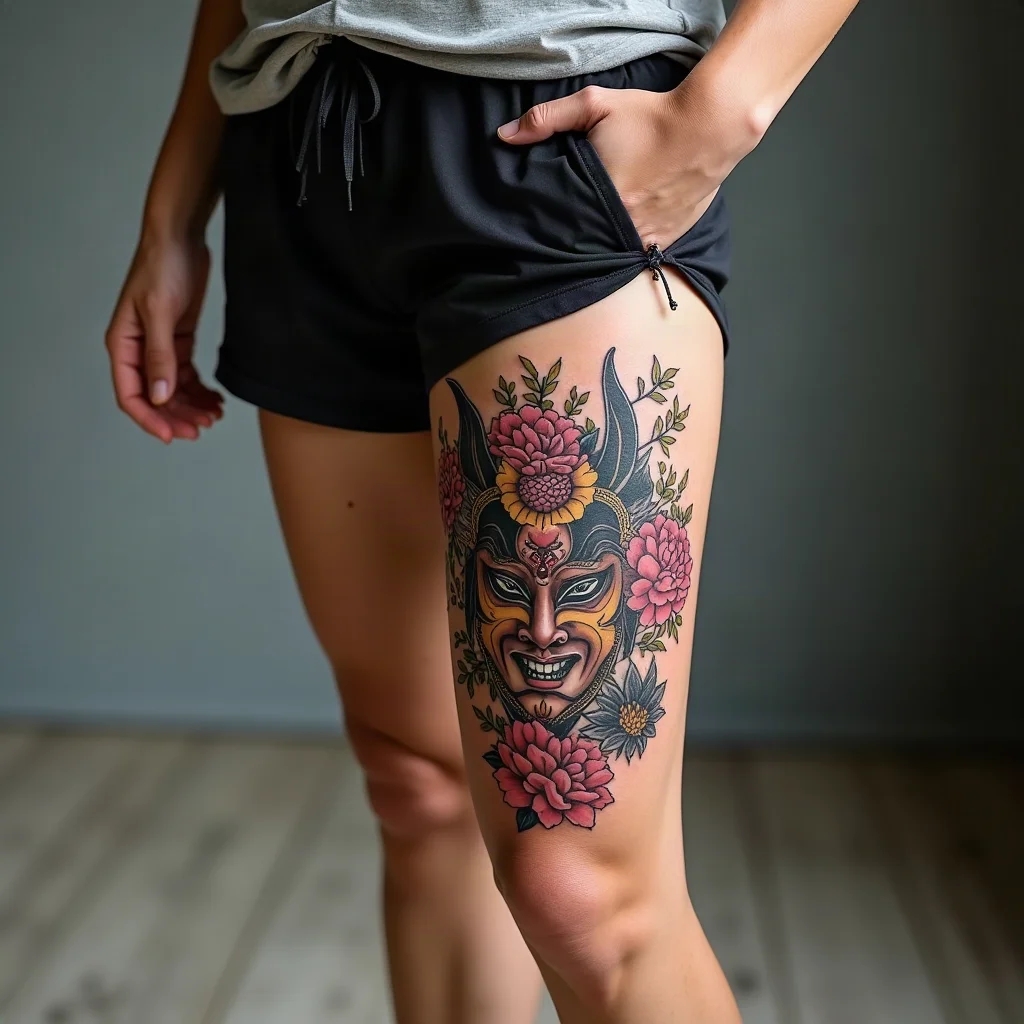
Closer to the knee the skin tightens, the fat layer thins and the pain shifts from raw to bony-sharp. It's the most visible part of an inner thigh tattoo in shorts or a slit skirt, so it suits small pieces you don't mind revealing.
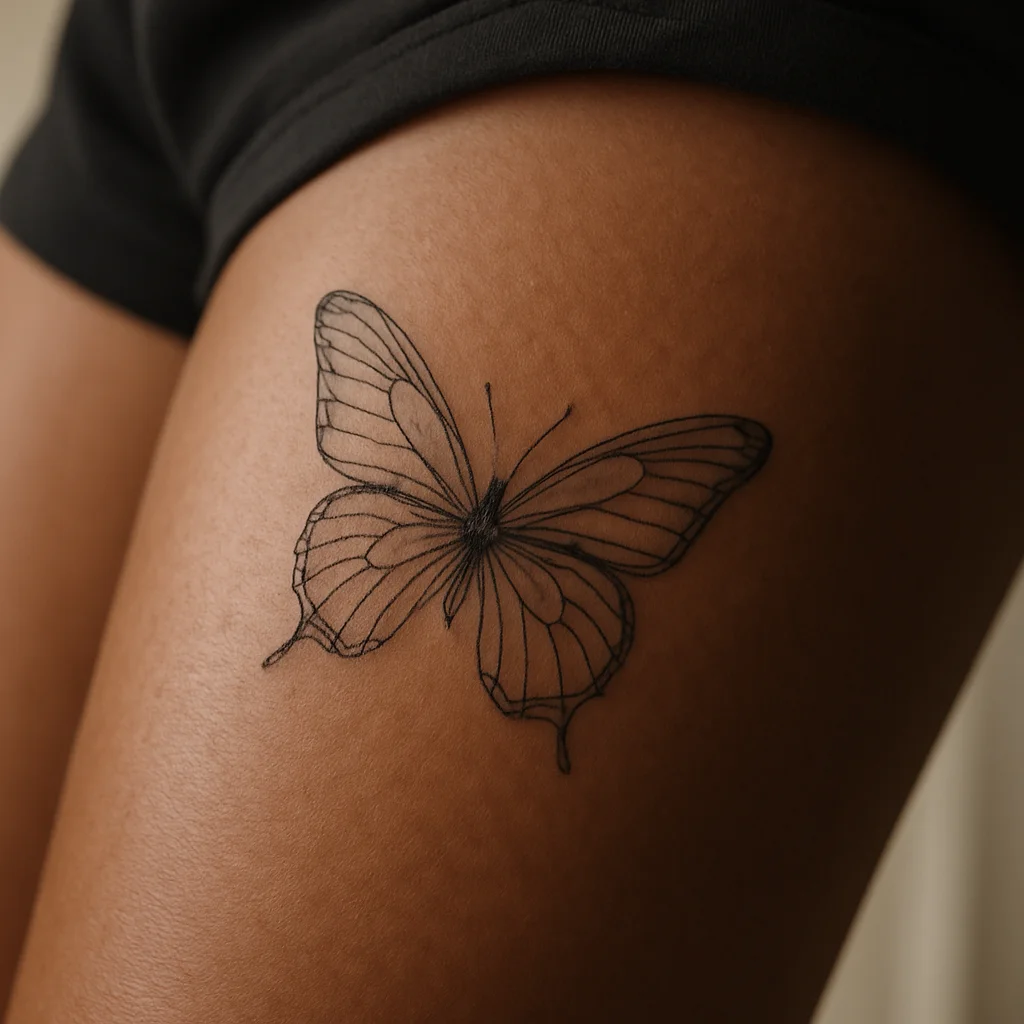
14. Butterfly just above the knee
A single butterfly, three to four inches, wings open and angled slightly so it isn't perfectly flat-on. The tightening skin here holds fine antenna lines better than the softer zone above. Grey wash wing detail ages more gracefully than heavy black fills at this size.
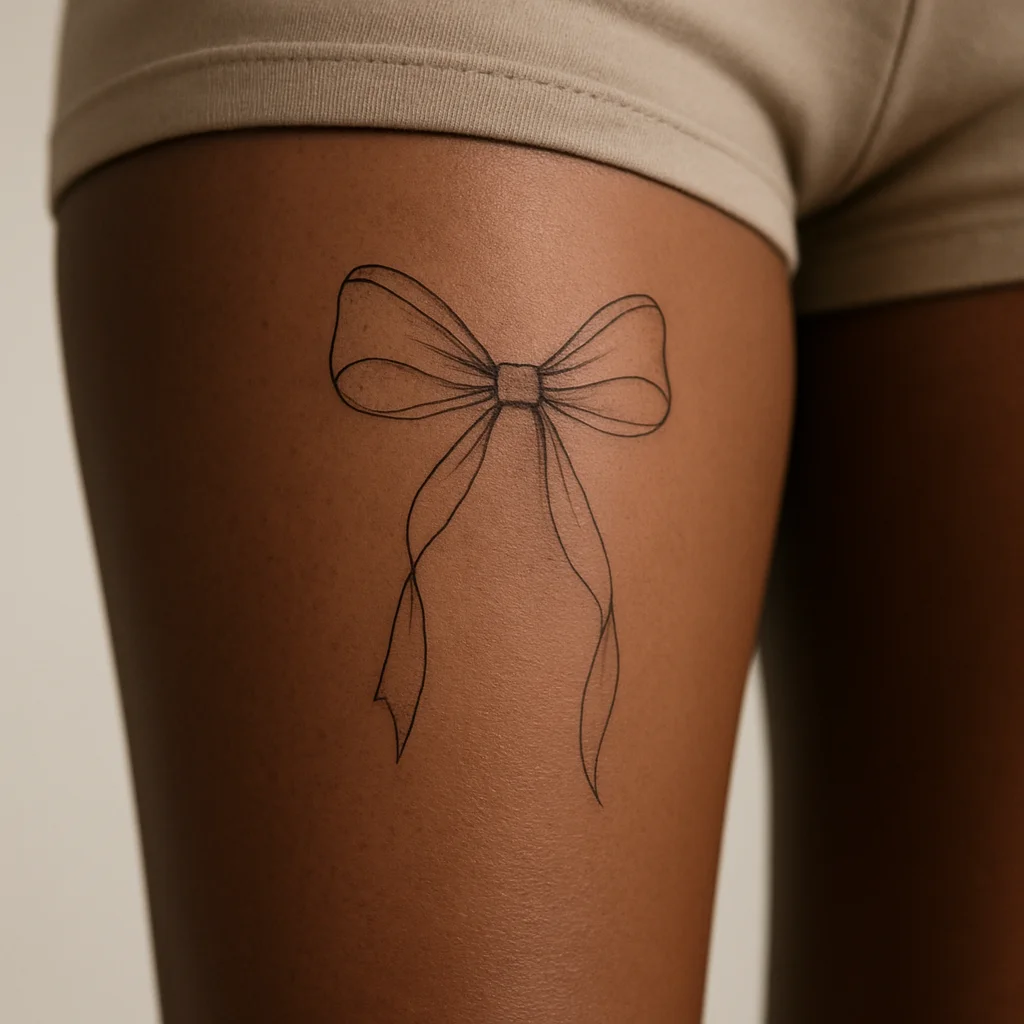
15. Bow with trailing ribbons
A tied bow with two ribbon tails falling toward the knee — coquette in the best sense, and technically easy to place because the tails follow gravity. Works at anything from two inches to palm-sized. Ask for a little shading inside the loops so it doesn't flatten into a symbol.
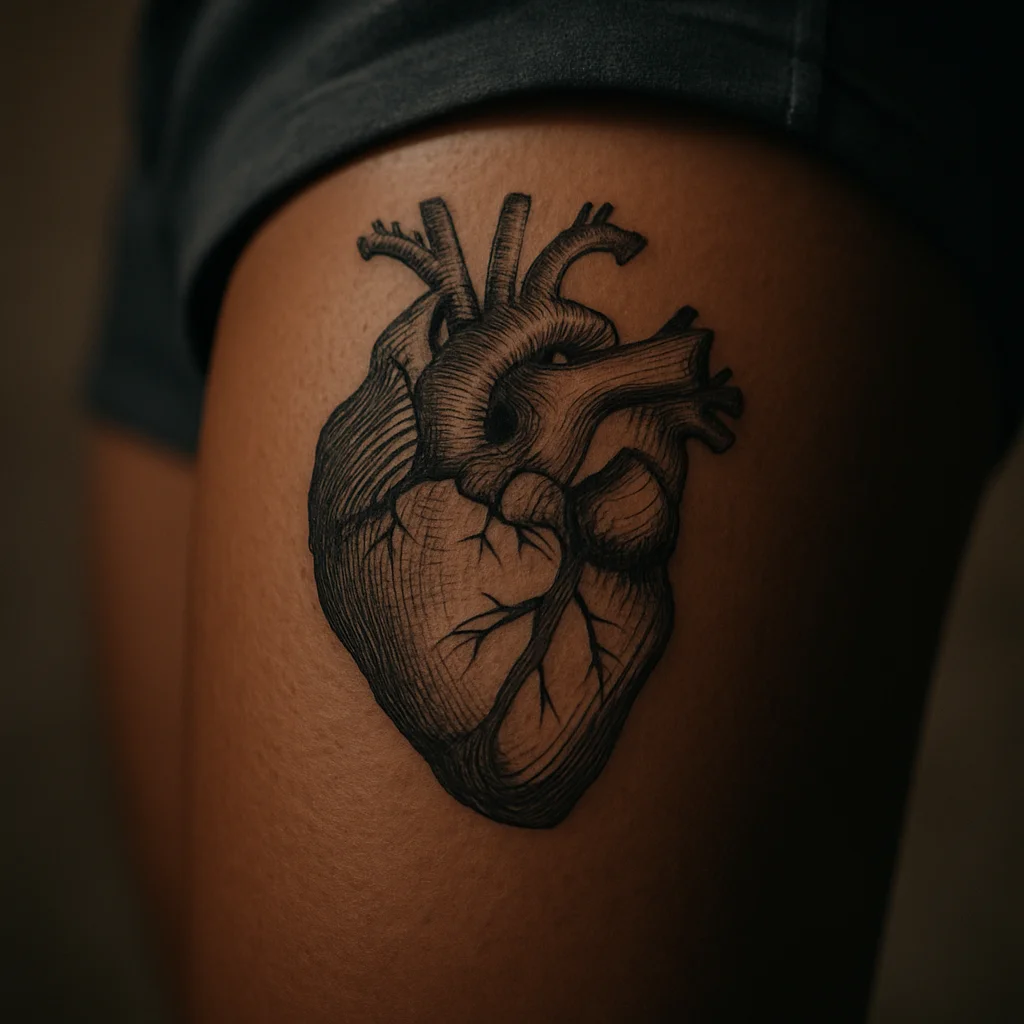
16. Small anatomical heart
A realistically drawn heart with its vessels sketched in fine hatching, sitting low and slightly forward of centre. The anatomical version keeps it from reading as cute, and the placement gives it a deliberate proximity to the femoral line. Four inches is plenty.
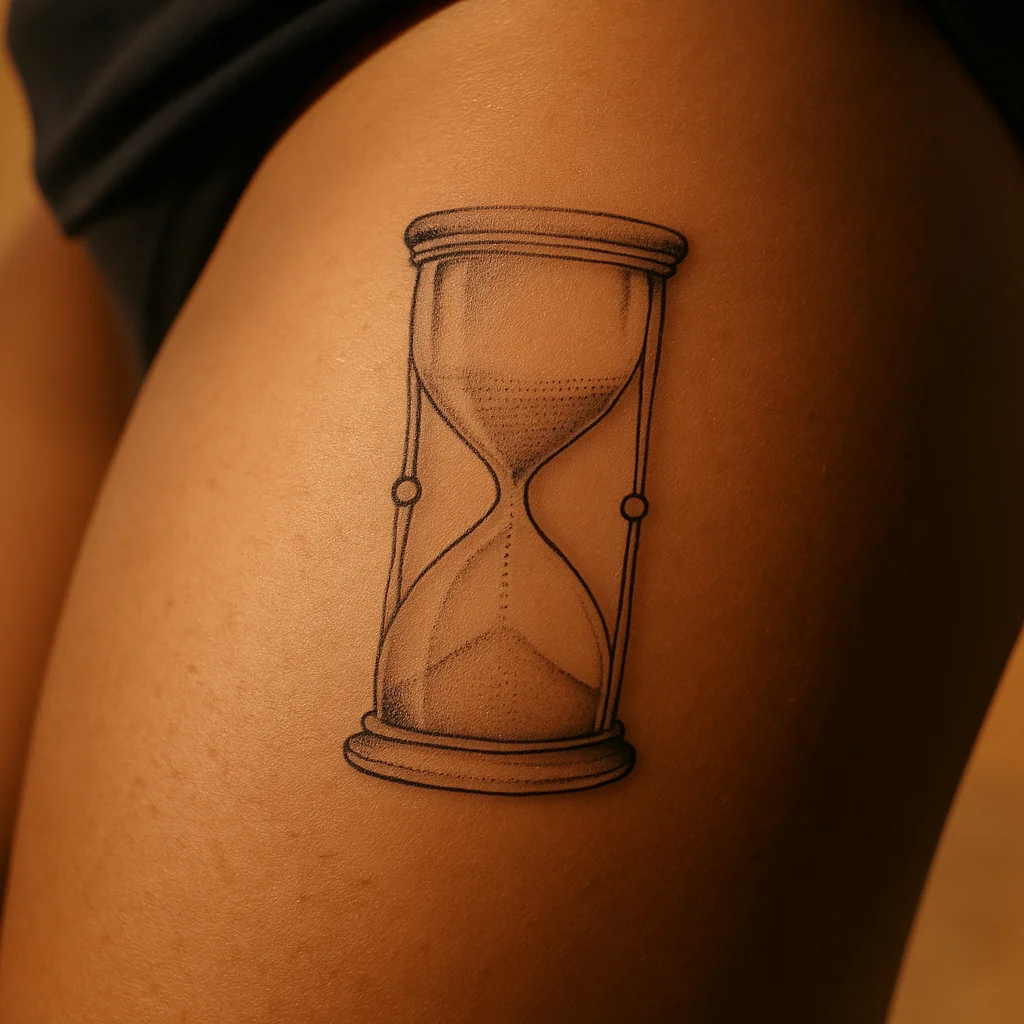
17. Fine-line hourglass
An hourglass with sand mid-fall, the falling grains drawn as a dotted stream. Vertical, narrow, and symbolically loaded without being literal. Keep the frame lines a touch heavier than the sand so the structure survives ten years of wear.
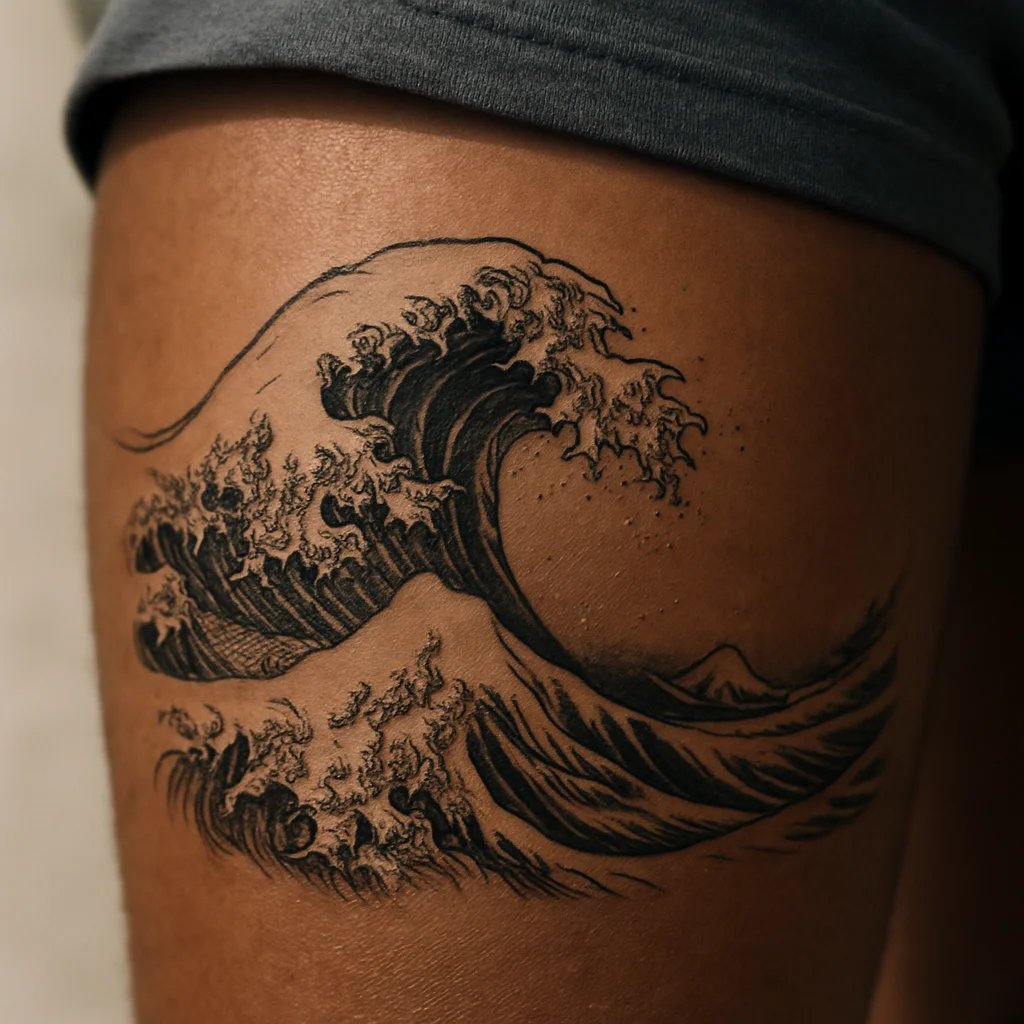
18. Rolling wave band
A single Hokusai-style wave curling horizontally around the lower inner thigh, ending in fine spray dots. Because it's horizontal, it visually widens the leg slightly — worth knowing before you commit. Best kept to two or three inches tall.
Wrap-arounds and mirrored pairs
Two ways to think bigger: let the design travel around the leg, or split it across both thighs so it only completes when you stand with your legs together. Both need a stencil session with you upright and walking — this is where placement errors show.
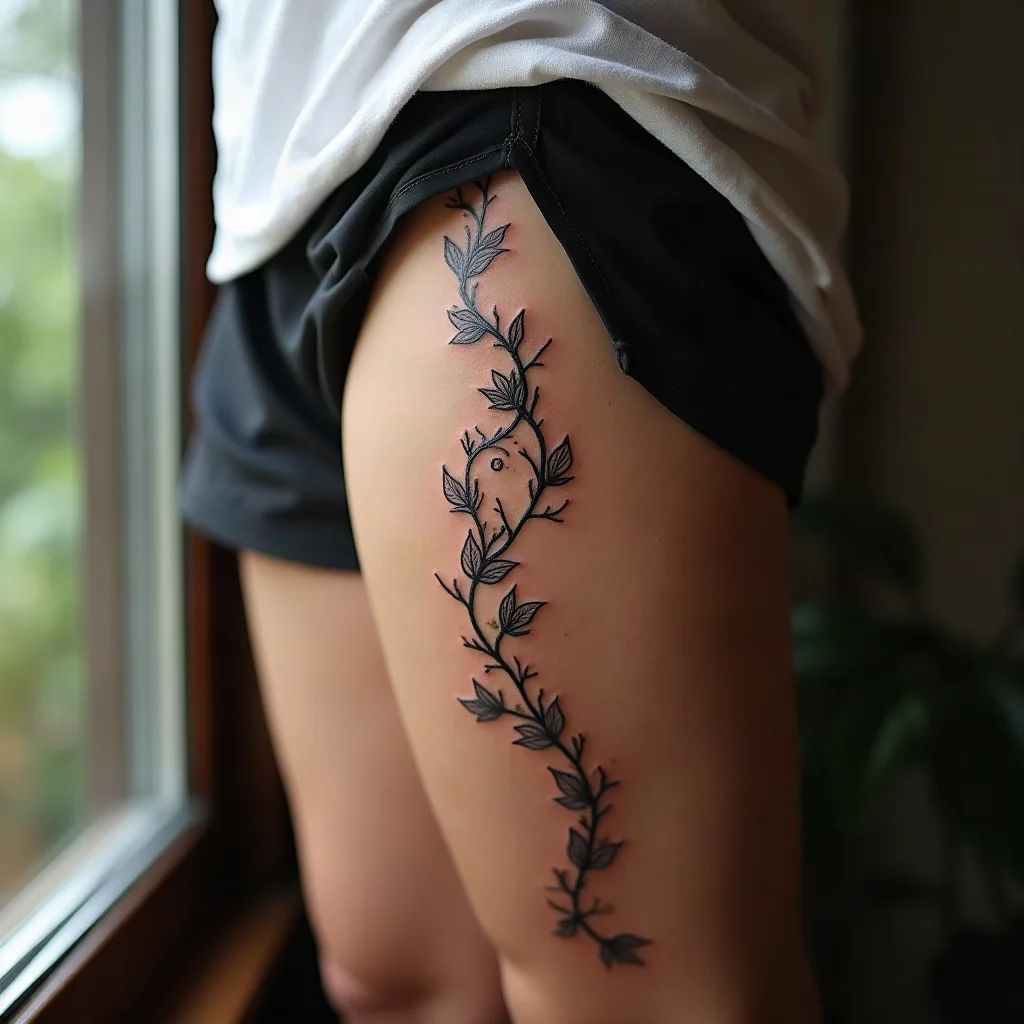
19. Ivy vine from inner to back of thigh
A trailing vine that starts at the inner mid-thigh and disappears around the back, so it reveals and hides depending on how you're standing. Ask for the leaves to reduce in size as they wrap, which sells the illusion of depth. Expect two sittings.
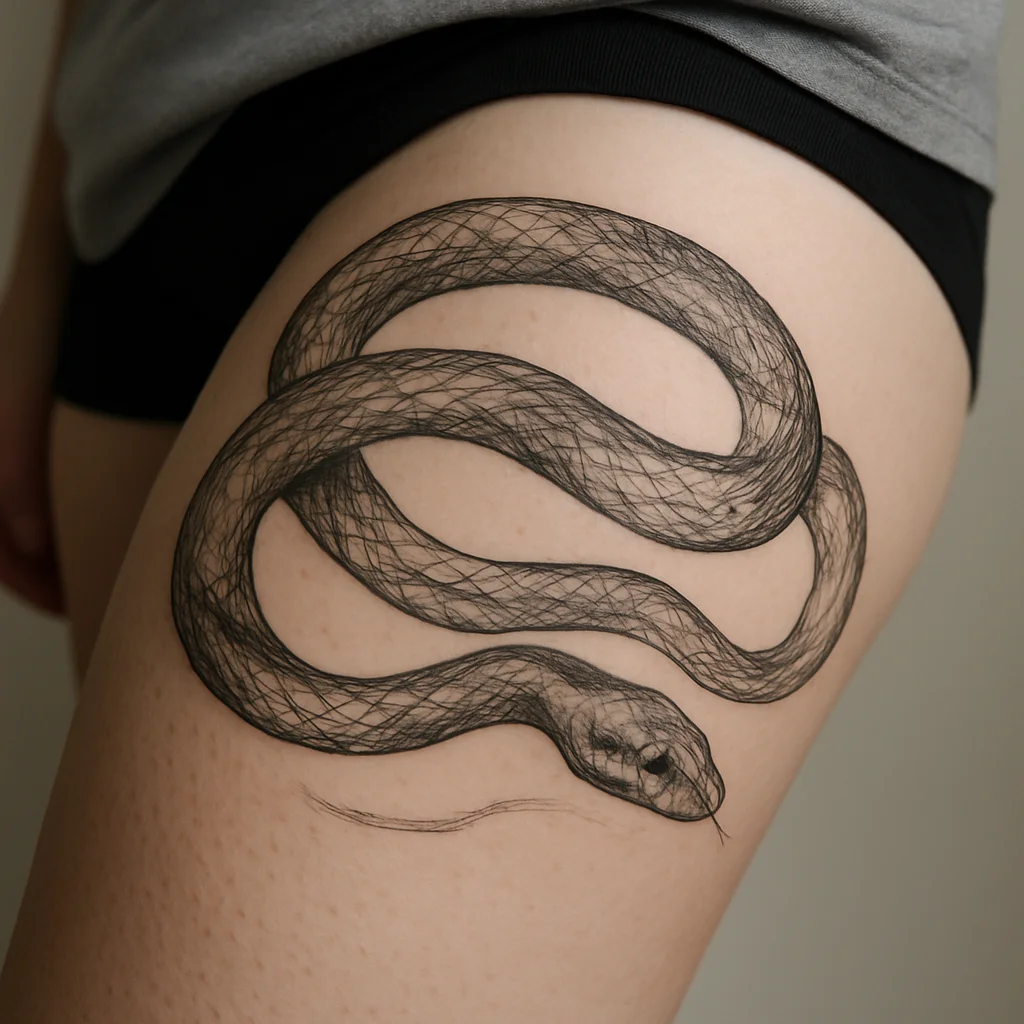
20. Full-circumference snake
A snake that coils the whole thigh, with the head resting on the inner face and the body crossing the outer leg. It's a commitment — usually eight to fifteen hours — but the inner-thigh head placement makes the piece feel intentional rather than decorative.
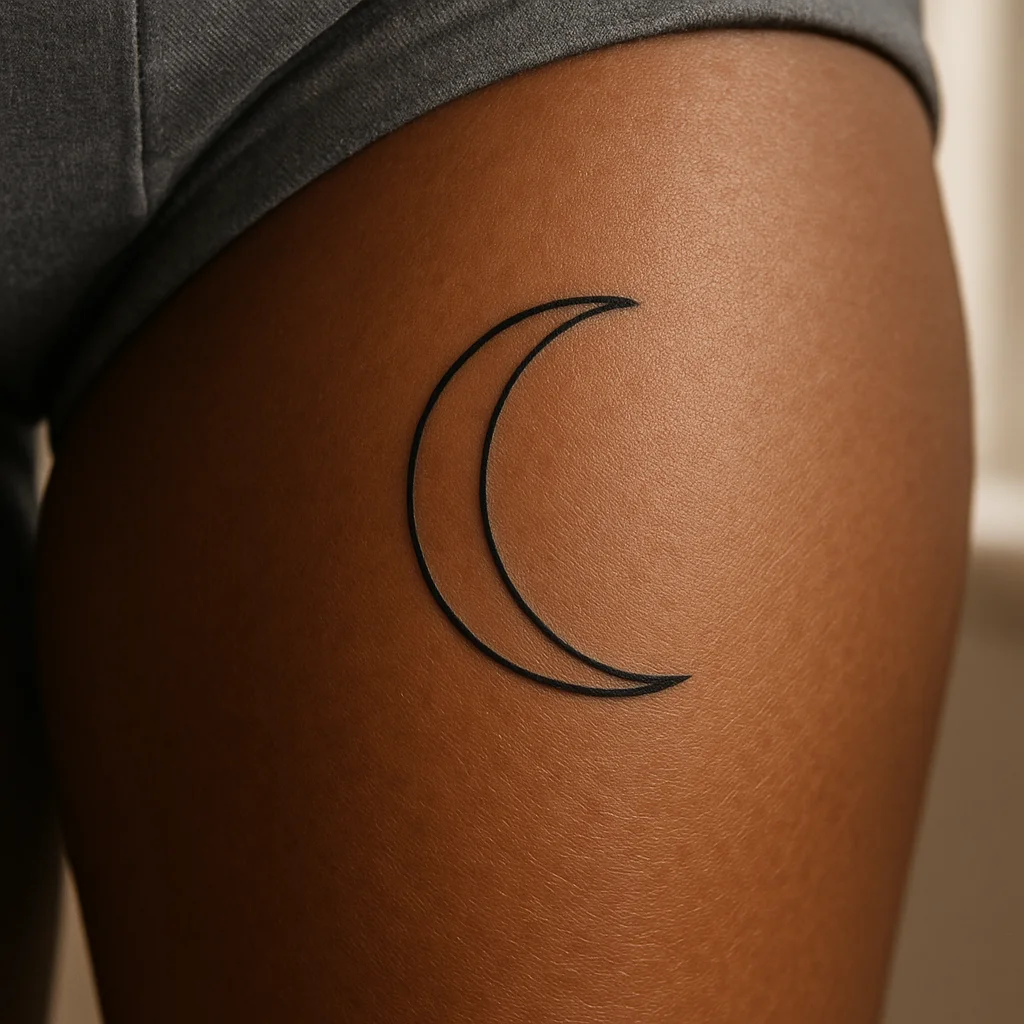
21. Mirrored crescent moons
A slim crescent on each inner thigh, cupping inward, so they form a broken circle when your legs are together. Small, fast, low-cost and surprisingly striking. Match the tilt carefully; a few degrees off and the symmetry reads as a mistake.
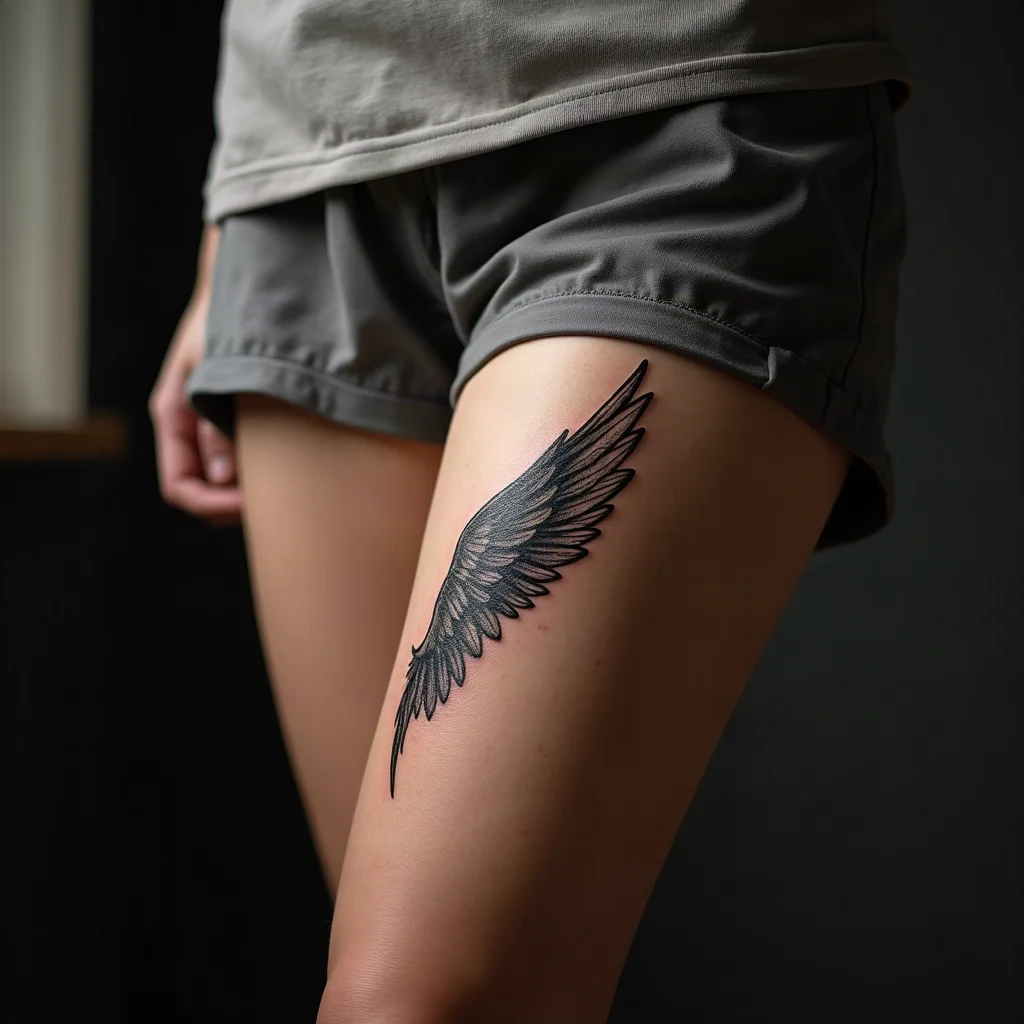
22. Facing wing panels
Two feathered wings, one per thigh, angled as if the space between them is a body. Best drawn with an open, airy feather structure so the two panels don't turn into black slabs. This is a full-day project per side.
23. Twin daggers pointing to the knees
Matching blades in bold traditional line, hilts high, one on each inner thigh. Symmetry plus repetition makes them read as armour rather than ornament. A very good choice for anyone who wants weight without fine detail.
24. A phrase split in two halves
The first half of a line on the left thigh, the second on the right, legible only when your legs close. Keep the type large and simple — this trick fails with delicate script. Discuss letter spacing so the halves visually balance.
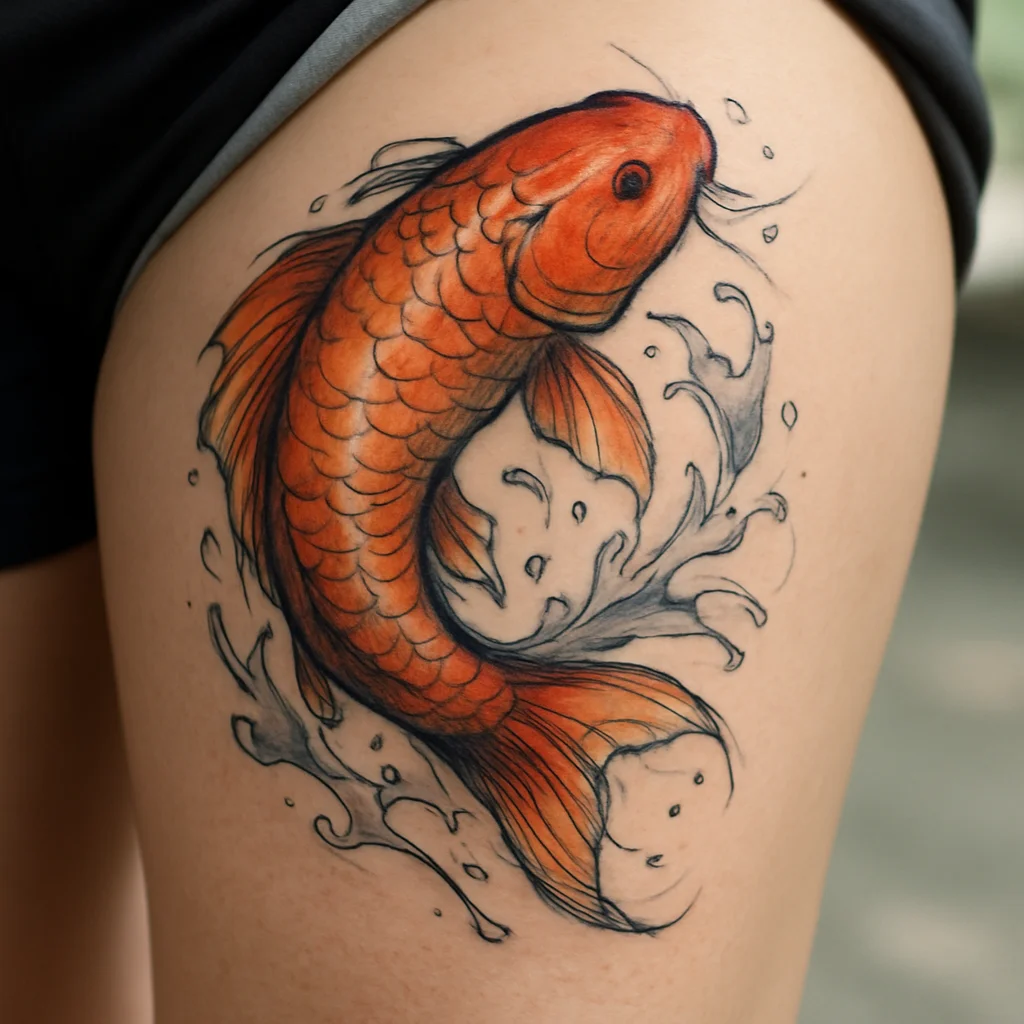
25. Koi swimming toward each other
One koi per inner thigh, bodies curved so they face inward, with water spray filling the gaps. Colour survives well in this low-sun placement, so this is one of the few spots where a full-colour piece stays vivid for decades. Budget multiple sessions.
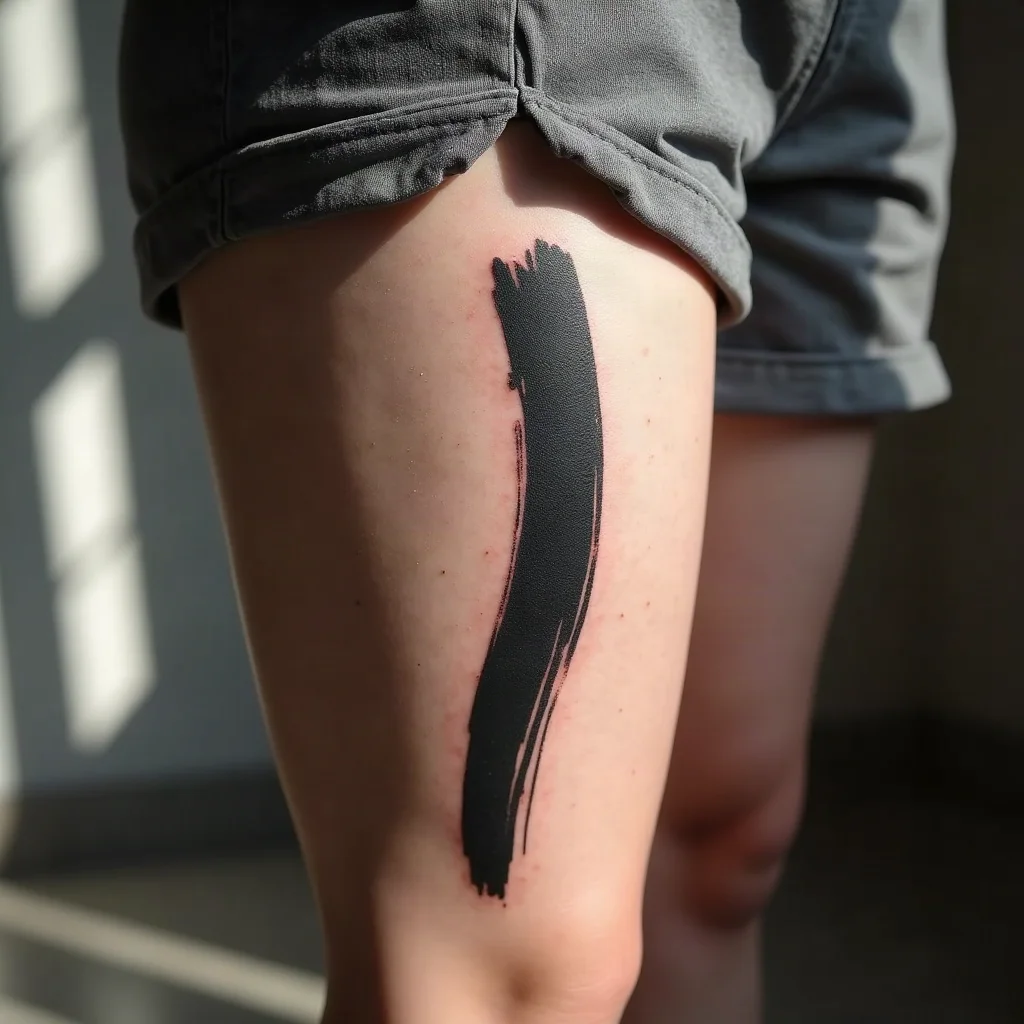
26. Mirrored brushstroke abstracts
Two sweeping sumi-e style strokes, one on each thigh, tapering from thick to hairline. It's the most modern option here and the least literal, and it sits well on people who want scale without a subject. Ask for the tapers to point in the same direction on both legs so the pair looks composed, not random.
Pain, healing and the friction problem
Let's be honest about the sting. The inner thigh is thin-skinned, nerve-rich and rarely touched, which puts it in the upper range of tattoo discomfort — comparable to the ribs for most people, and worse the higher you go. The mid-thigh panel is genuinely tolerable; the crease and the area directly above the knee are the two spots where people ask for a break. Numbing cream can help if your artist permits it, but tell them before the session, not after they've started, because it changes how the skin takes ink.
Healing is where this placement earns its reputation. Your thighs touch each other constantly, and a fresh tattoo plus sweat plus friction is the recipe for patchy healing. What actually works:
- Wear loose skirts, dresses or wide shorts for the first week. Leggings and skinny jeans press directly on the wound and lift the film.
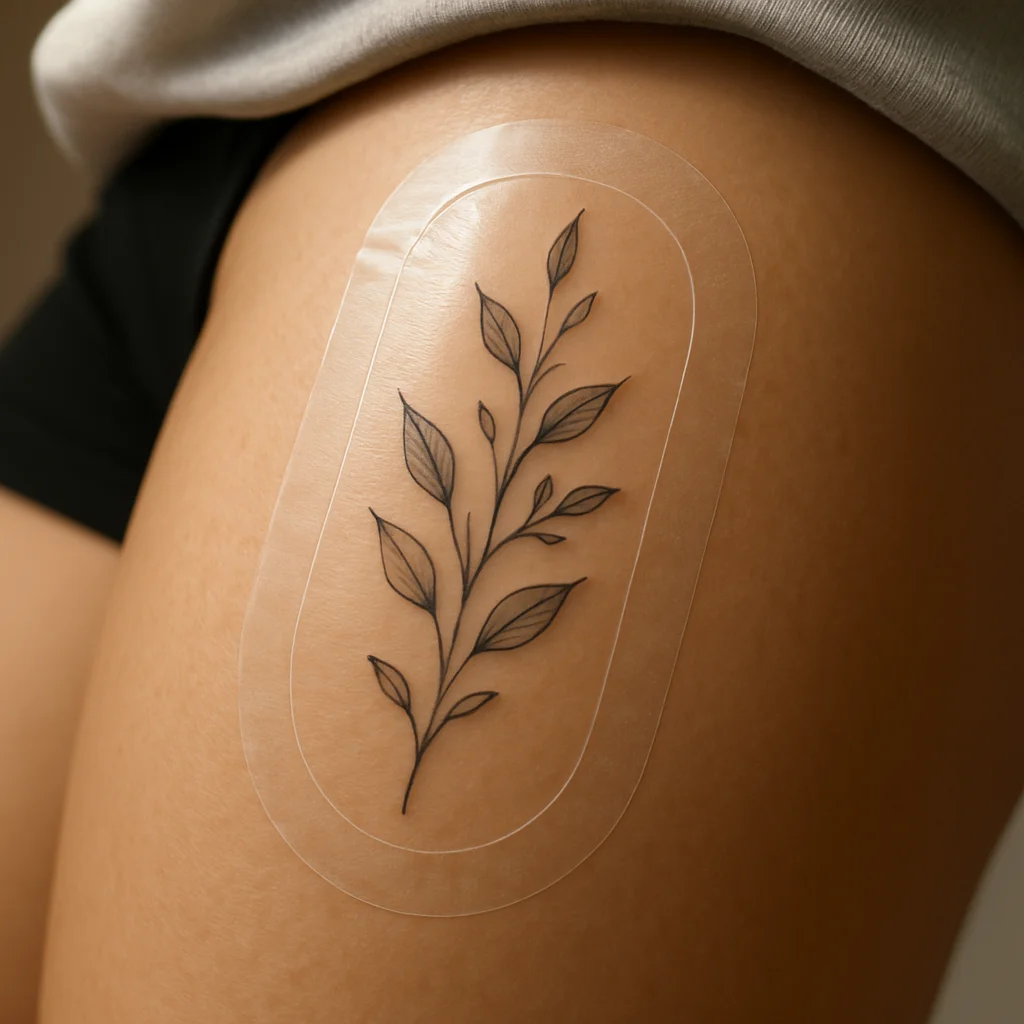
- Ask about a long-wear adhesive bandage. On this placement it's arguably more useful than anywhere else, because it forms a barrier against rubbing. Change it as your artist instructs and don't stretch it tight over a joint.
- Keep it thin on ointment. A heavy layer plus trapped sweat between the thighs equals irritation and sometimes small pimple-like bumps.
- Skip the gym, cycling, and long walks in warm weather for the first 7 to 10 days. Sweat and repetitive rub are the two biggest causes of patchy heals here.
- Sleep with a pillow between your knees for the first few nights. It sounds fussy; it prevents your thighs from sticking together overnight.
Expect one touch-up to be more likely than average on this placement, and don't panic if a small area heals lighter — most artists include a free or low-cost touch-up at the three-month mark. Our full 30-day aftercare guide covers the general timeline in more depth.
Sizing, cost and how to brief your artist
Size in body landmarks, not inches. A small piece is anything that fits inside the width of your palm — think the key, the crescents, the butterfly. A medium fills the mid-thigh panel and reads at conversational distance: the snake, the mandala, the mirror. A large piece wraps or runs from crease to knee and needs at least two sessions. Because the inner thigh curves, a design that measures eight inches flat will look closer to six from any single viewing angle, so people routinely go a size up after seeing the stencil.
On cost, work in ranges rather than fixed numbers. Small single-session pieces usually land at a studio's minimum charge up to a couple of hundred, medium panel work runs a few hundred to the low four figures depending on detail and city, and full wraps or mirrored pairs are multi-session projects priced by the day. Colour, dense black fill and photorealism all push you up; clean line work and negative space keep you down. Always ask whether the quote includes a touch-up — on this placement it's a fair question.
What to say when you book
- Tell them the exact upper and lower boundary you're comfortable with, in relation to where your shorts or swimwear sit.
- Say whether you want it fully hidden, partly visible in shorts, or visible in swimwear — that single sentence determines the zone.
- Ask for the stencil to be checked standing and walking, and look at it in a full-length mirror before you agree.
- Mention if you're a runner, cyclist or gym regular so they can advise on line weight and timing.
- Bring reference for line weight and shading density, not just subject matter — that's the part that determines how it ages here.
One last practical note: wear or bring something loose to the appointment, and expect to be draped and positioned in a way that keeps things professional. Any reputable studio does this daily and will handle it without fuss. If a shop's approach to a private placement makes you uneasy, that's information — book elsewhere.
Frequently asked questions
How painful is an inner thigh tattoo?
It's on the higher end — thin skin, plenty of nerve endings and very little sun-toughened surface. The mid-thigh panel is manageable for most people, while the crease at the very top and the strip just above the knee are the sharpest spots. Sessions here often feel more intense over time than at the start, so plan breaks rather than trying to power through a long sitting.
Will an inner thigh tattoo blur or fade from thigh rubbing?
Friction won't erase a tattoo, but it can cause patchy healing in the first two weeks and it does soften very fine lines over years in the highest zone. The fix is design-side: slightly heavier outlines, a little more space between elements, and detail concentrated on the flatter mid-thigh. Loose clothing and no gym for the first 7 to 10 days makes the biggest difference to how it heals.
How much does an inner thigh tattoo cost?
Small pieces typically fall between a studio's minimum charge and a couple of hundred, medium panel work runs from a few hundred into the low four figures, and full wraps or mirrored pairs are priced by the day across multiple sessions. Colour, heavy black fill and realism raise the price; clean line work keeps it lower. Ask upfront whether a touch-up is included, since this placement needs one more often than most.
Can I get both inner thighs tattooed in the same session?
You can, but most artists advise against it for anything beyond small matching pieces. Two healing wounds that rub against each other complicate aftercare and make sitting, sleeping and walking uncomfortable for a week. Space mirrored pairs at least three to four weeks apart so the first side is settled before you start the second.
Does an inner thigh tattoo show in swimwear?
It depends entirely on the zone. Anything at the crease stays hidden under almost all swimwear, mid-thigh pieces will show below most cuts, and lower designs above the knee are visible in shorts and skirts too. Decide your visibility level before you brief the artist, and mark your comfortable top and bottom boundary during the stencil stage.
The conversation
No comments yet. Got a thought about these designs? Start us off.
Want to weigh in? Join the community to comment, save designs and try them on your skin.