Chest Tattoos for Men: 30 Ideas That Fit the Frame
The chest is the most sculptural canvas on the male body, and it punishes designs that ignore its shape. Here are 30 ideas built around the pec line, the sternum and the collarbone, with honest notes on pain, healing and cost.
What the Chest Does to a Design
A chest tattoo is not a flat drawing on a flat wall. You are working over two pec muscles that swell and flatten, a bony sternum in the middle, two collarbones running diagonally outward, and a surface that moves every time you breathe or reach overhead. Designs that were drawn on paper without that in mind end up looking pinched at the centre and stretched at the outside edge.
Three anatomical rules matter more than style choice:
- Follow the pec fold. The lower curve of the chest muscle is a natural arc. Compositions that arc with it — a koi, a wave, a mountain ridge — sit right at rest and still read when you flex.
- Respect the centre line. The sternum is a vertical axis. Either commit to symmetry across it or deliberately break it, but do not let a design drift half an inch off centre. Everyone will see it.
- Leave the nipple out of the story. Good chest work either frames it inside negative space or routes detail around it. Skin there takes ink unevenly and heals slower.
On practicalities: chest skin is generous with space, so this is a placement that rewards going bigger than you first plan. A single pec panel usually wants 5–8 inches of height to hold detail; a full plate spans the entire upper chest and reads as one image from across a room. Chest hair does not stop you from getting tattooed — the artist shaves the area — but heavy hair will visually soften fine grey wash and thin single lines over time, so bold outlines and clear contrast hold up better if you do not shave. Weight change matters more than muscle gain: adding gym mass generally spreads a design evenly, while significant weight loss around the chest can slacken skin and blur very tight detail.
Single Pec Panels: Ideas 1–8
One pec is the smartest entry point for a first chest tattoo. It is a contained shape, it can be covered by any shirt, and it leaves the option of mirroring or extending later. Aim for a design with one clear focal point rather than a crowded scene.
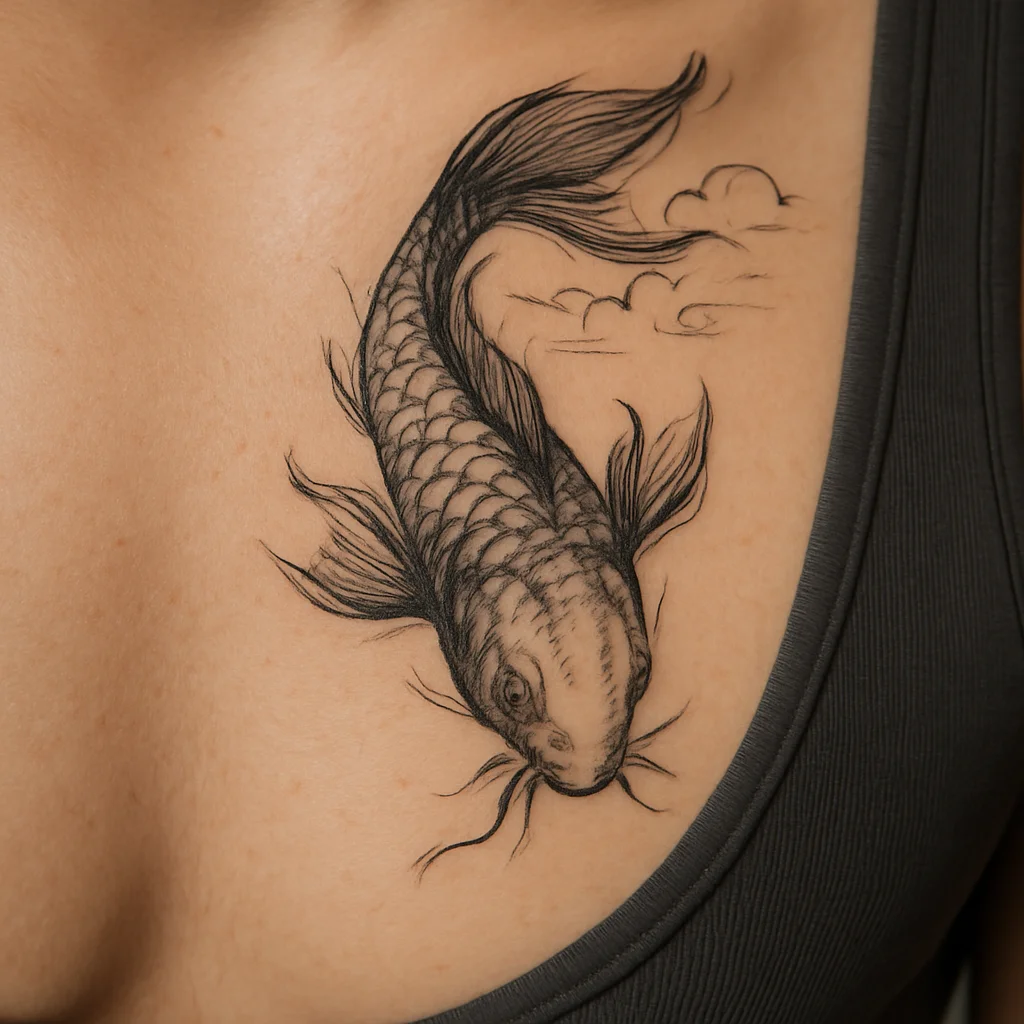
1. Koi arcing across one pec
A single koi drawn head-down at the outer chest, body curving inward along the pec fold, with a few cut-off clouds or water lines filling the tail end. The arc of the fish and the arc of the muscle do the same job, so it looks intentional at rest and dramatic when you flex. Best at 7–9 inches; plan it now if you might ever want a Japanese sleeve on that side.
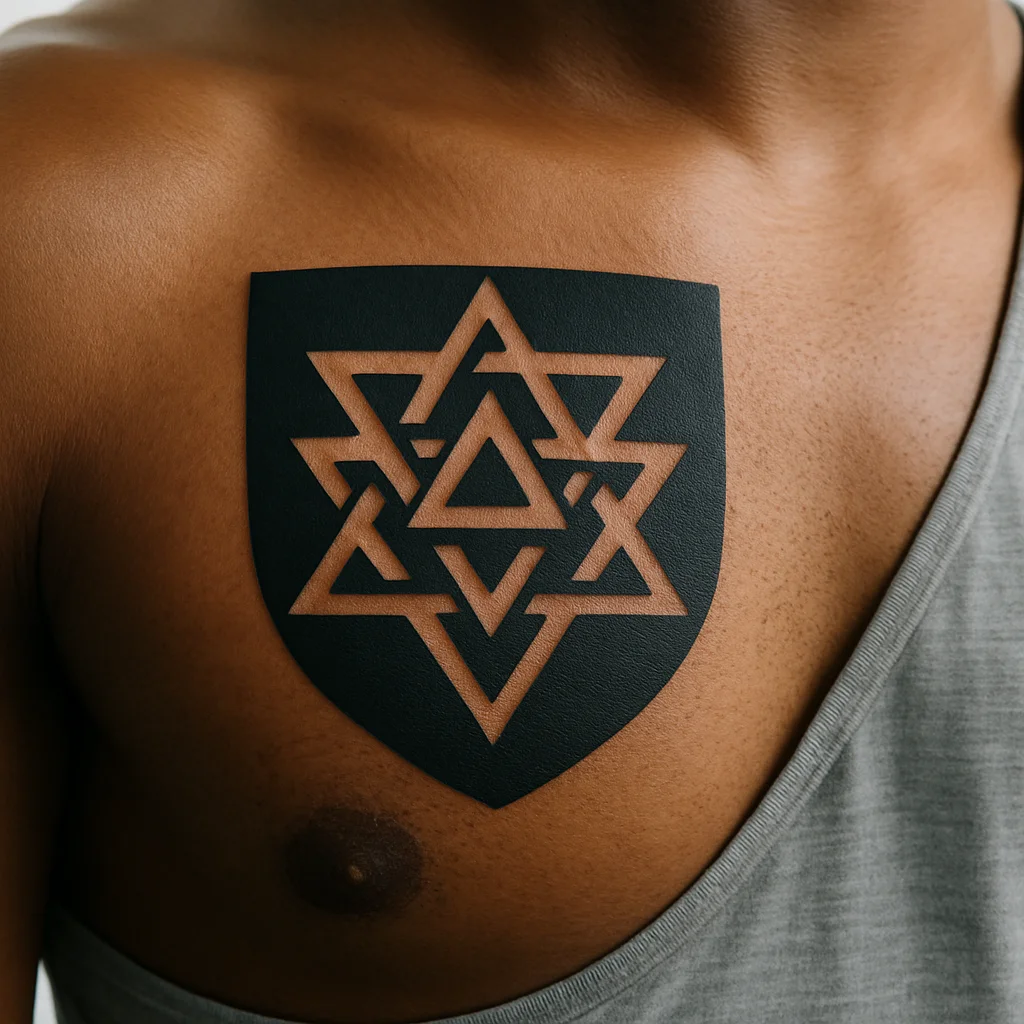
2. Blackwork shield of interlocking triangles
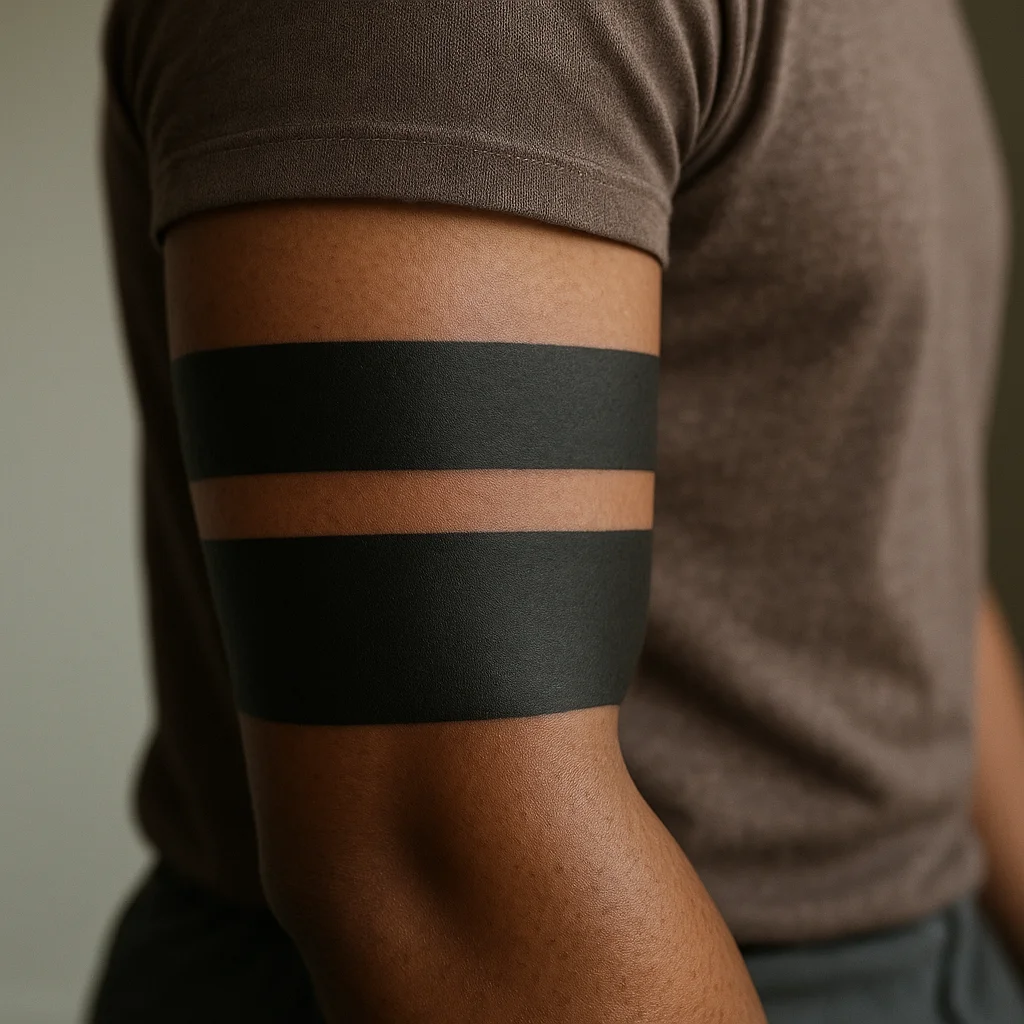
A solid geometric slab — nested triangles, hard negative-space gaps, one clean outer boundary — sitting square on the pec like a plate of armour. Heavy black on the chest ages beautifully because there is no fine detail to soften. It suits men who want presence without any narrative meaning attached.
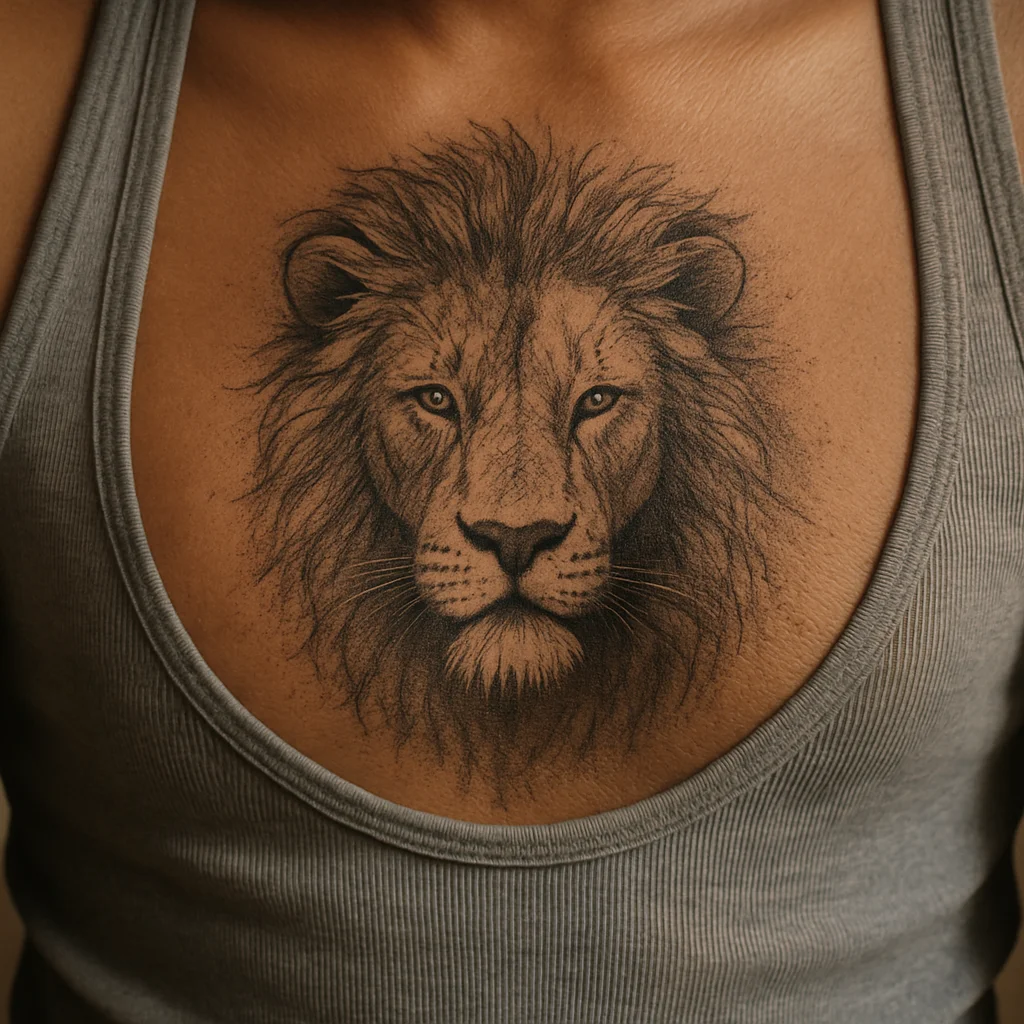
3. Lion's head with dotwork shading
A frontal lion head filling the pec, mane rendered in stippled shading that fades out rather than ending in a hard border. Facing outward from the sternum reads stronger than facing down. Give it size — under 6 inches the eyes and mane lose separation and it turns into a grey smudge in ten years.
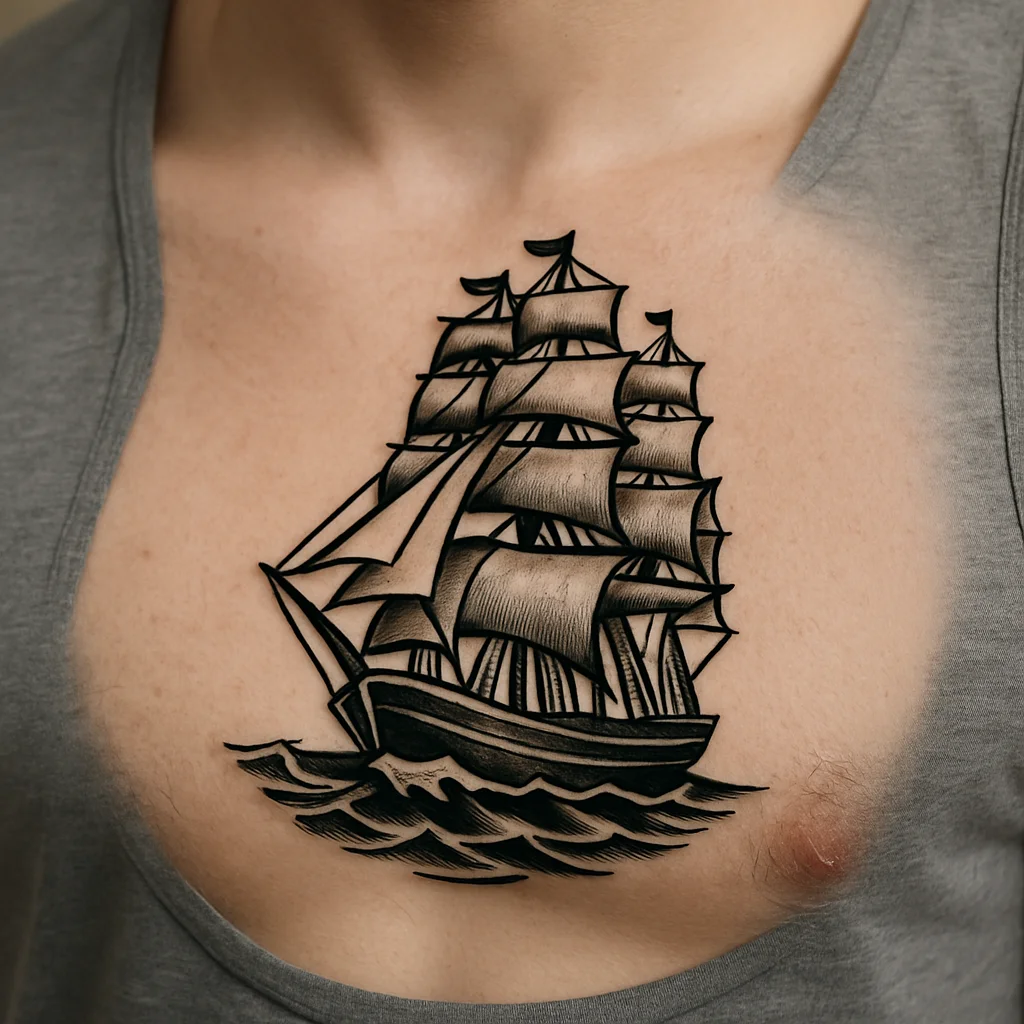
4. Traditional clipper ship on rough water
Full sails, black outlines, a low band of waves cutting across the bottom of the pec, sunburst rays optional behind the rigging. Old-school ship tattoos were designed for exactly this kind of curved chest real estate and they hold their reading distance forever. Colour palette stays limited: red, yellow ochre, deep green.
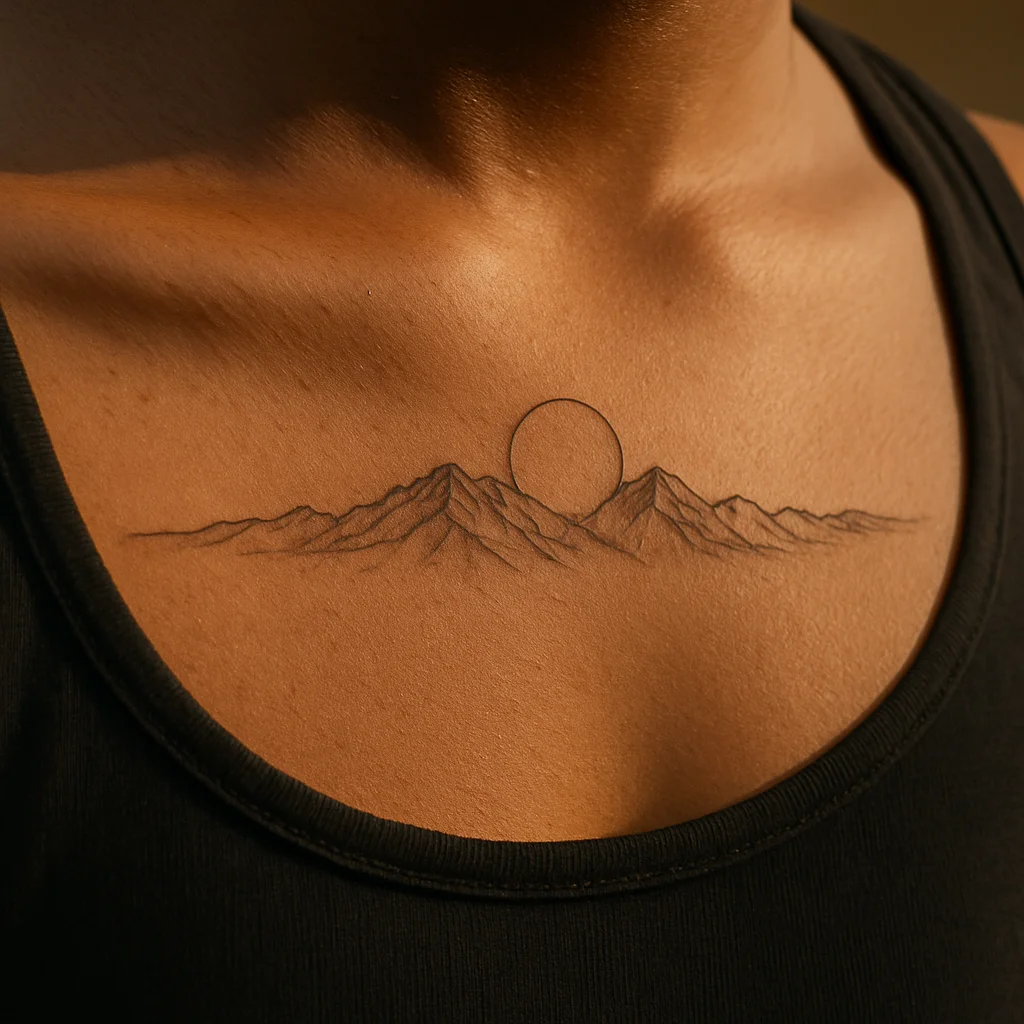
5. Fine-line mountain ridge along the pec fold
A thin, wide ridgeline that runs horizontally under the collarbone or along the lower pec curve, with a single sun disc behind the peaks. It is quiet, shirt-friendly, and works for guys who want landscape imagery without a full scenic panel. Ask for slightly heavier line weight than you would on a forearm — chest skin softens thin lines faster.
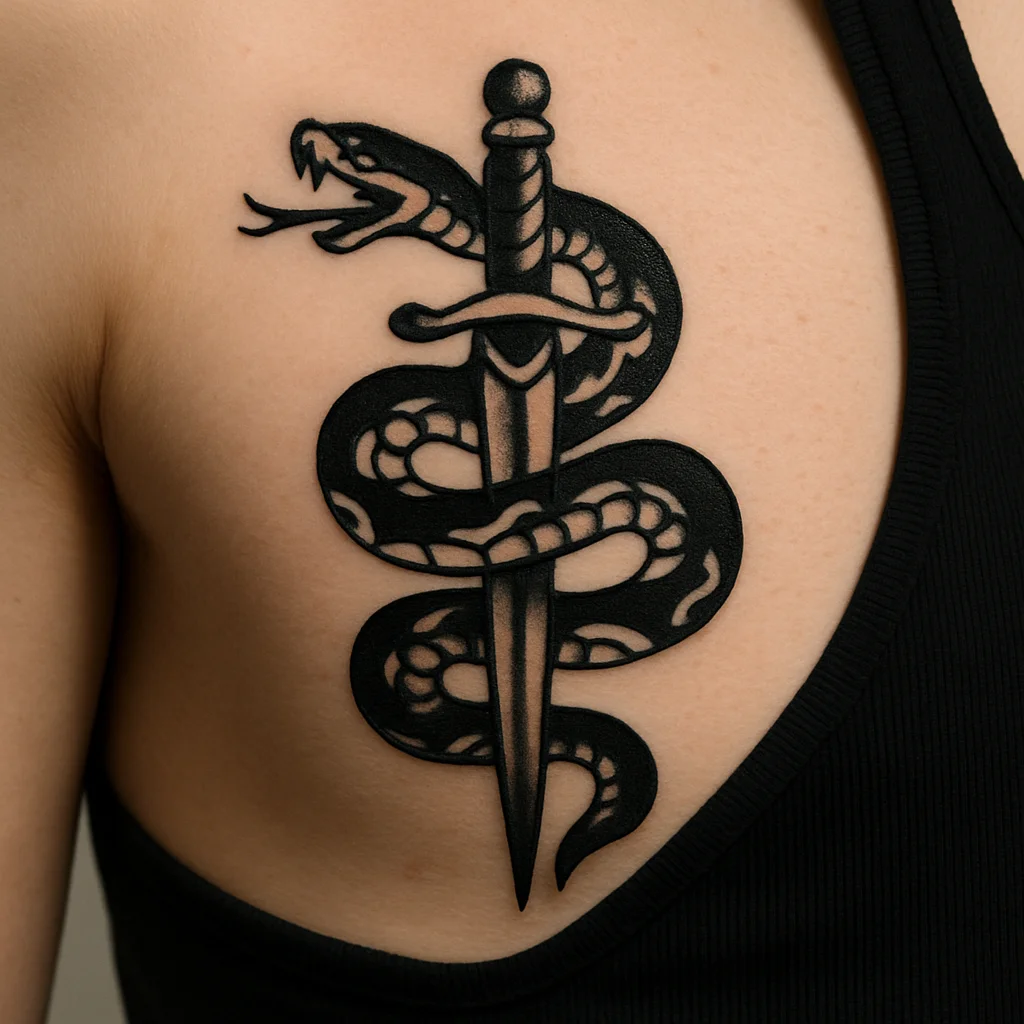
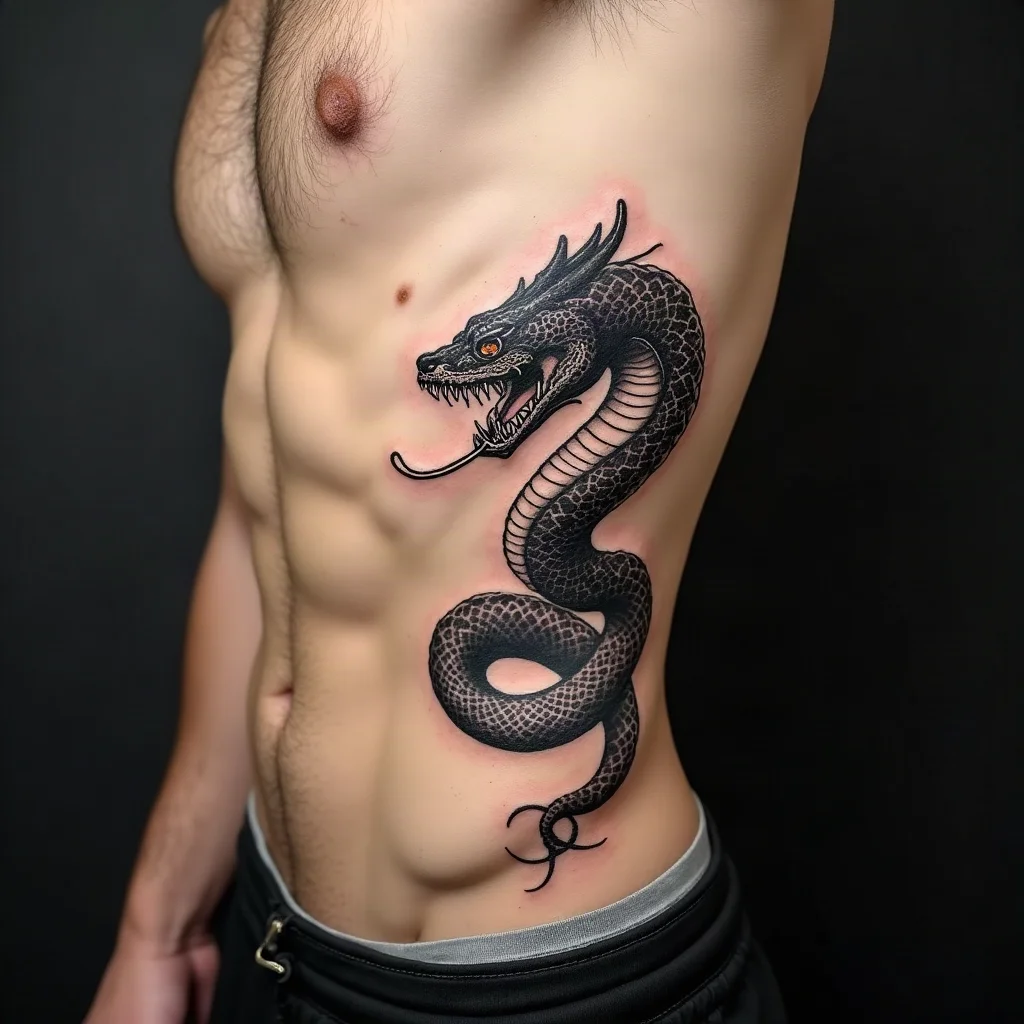
6. Snake coiled around a dagger, vertical
Blade tip pointing down toward the ribs, snake body wrapping the handle in two or three loops, mouth open at the top near the collarbone. The vertical format uses the height of the chest instead of fighting the width, so it flatters slimmer builds. Works in traditional bold line or in etched blackwork.
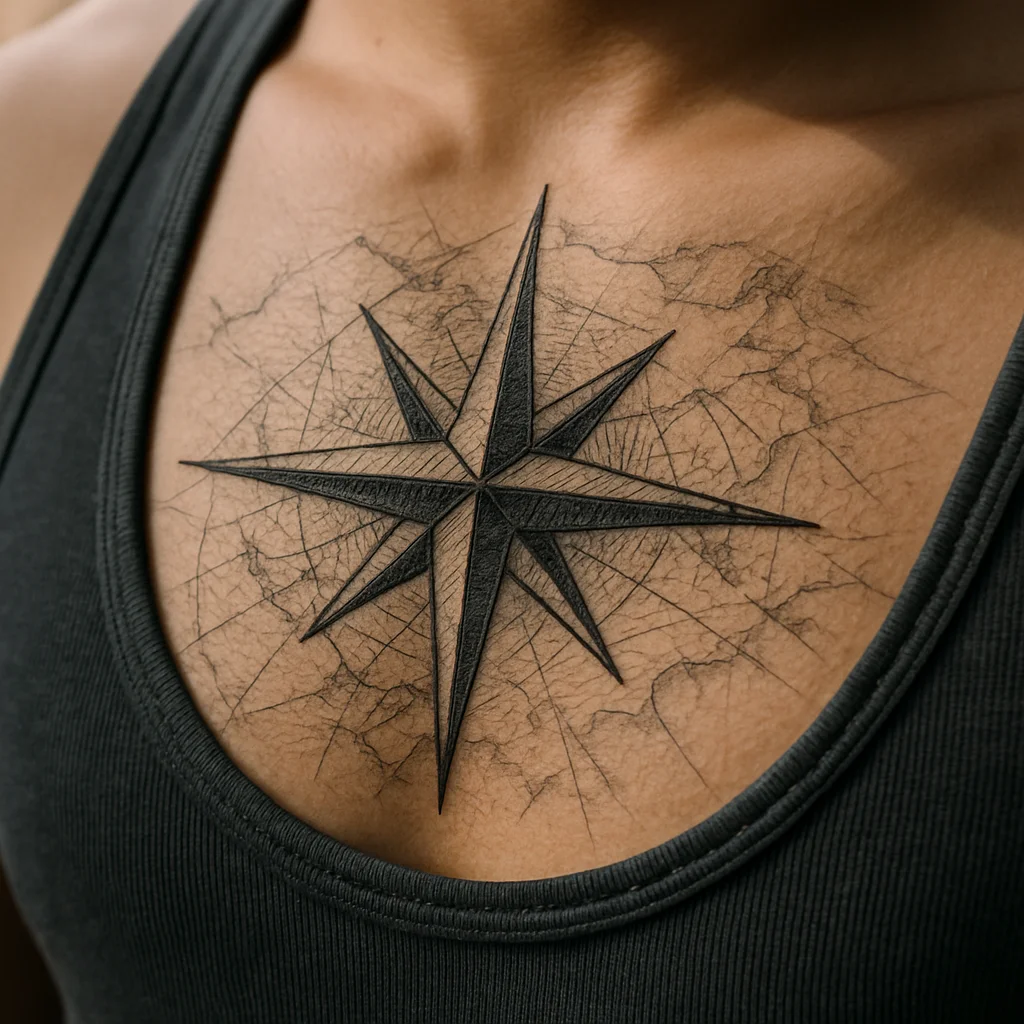
7. Compass rose over hatched map lines
An eight-point compass with fine cross-hatching behind it suggesting old chart contours, sized to fill the pec but stopping short of the sternum. Keep the hatching light so it does not turn into a solid grey block. A good option for travel and direction symbolism that has not been done to death on the forearm.
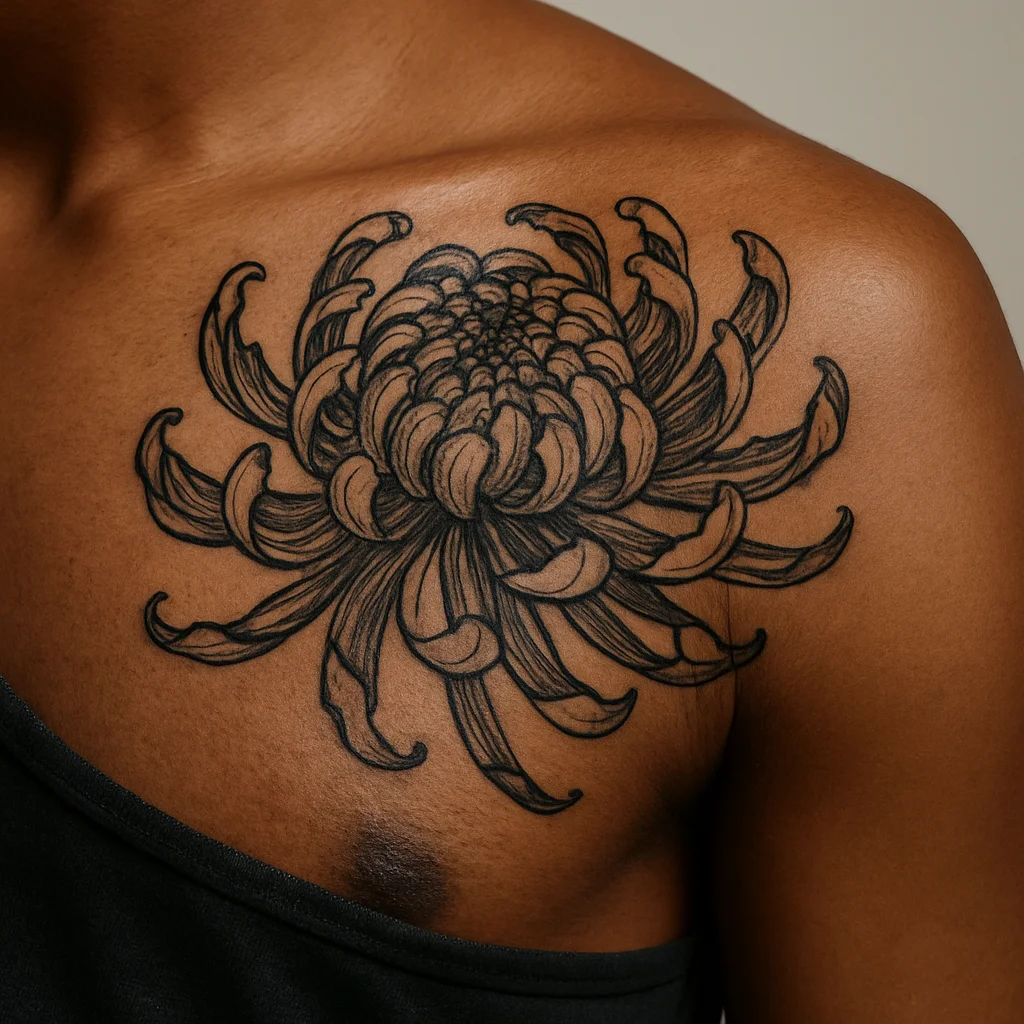
8. One oversized chrysanthemum
A single Japanese flower head, petals unfurling from a slightly off-centre core, filling the pec edge to edge with black outline and grey petal shading. Botanical work at this scale looks deliberate and masculine in a way small flowers on the arm often do not. It also stitches easily into future chest-to-arm work.
Sternum and Centre Chest: Ideas 9–15
The centre strip is the boldest choice on the chest and the most painful. Bone sits directly under thin skin, and there is nowhere for the vibration to go. In exchange you get perfect symmetry and a piece that anchors everything you add later.
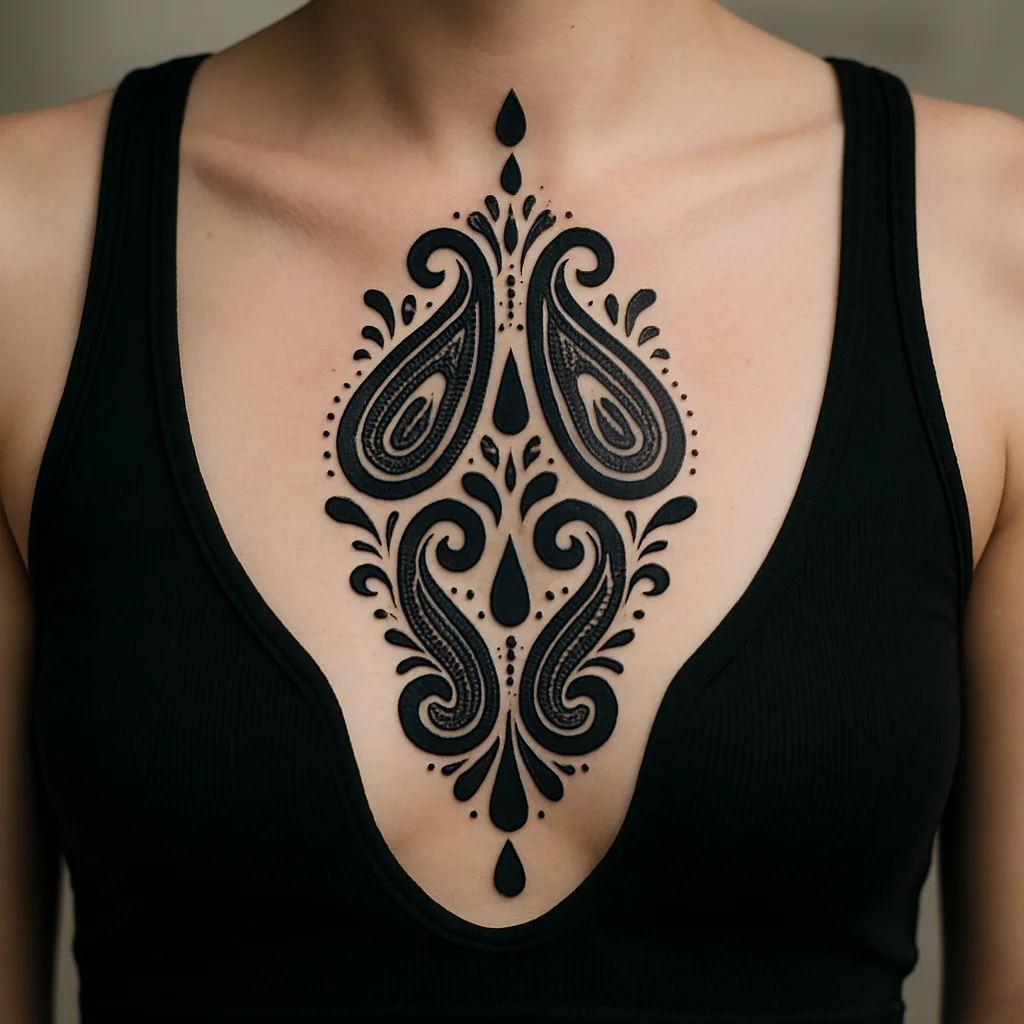
9. Ornamental sternum column
A vertical ornamental panel — paisley shapes, teardrops, fine dot fills — running from the sternal notch down toward the solar plexus, mirrored precisely on both sides of the centre line. It reads as jewellery rather than illustration and it makes a lean chest look intentionally decorated. Sizing is typically 6–10 inches tall and only 3–4 inches wide.
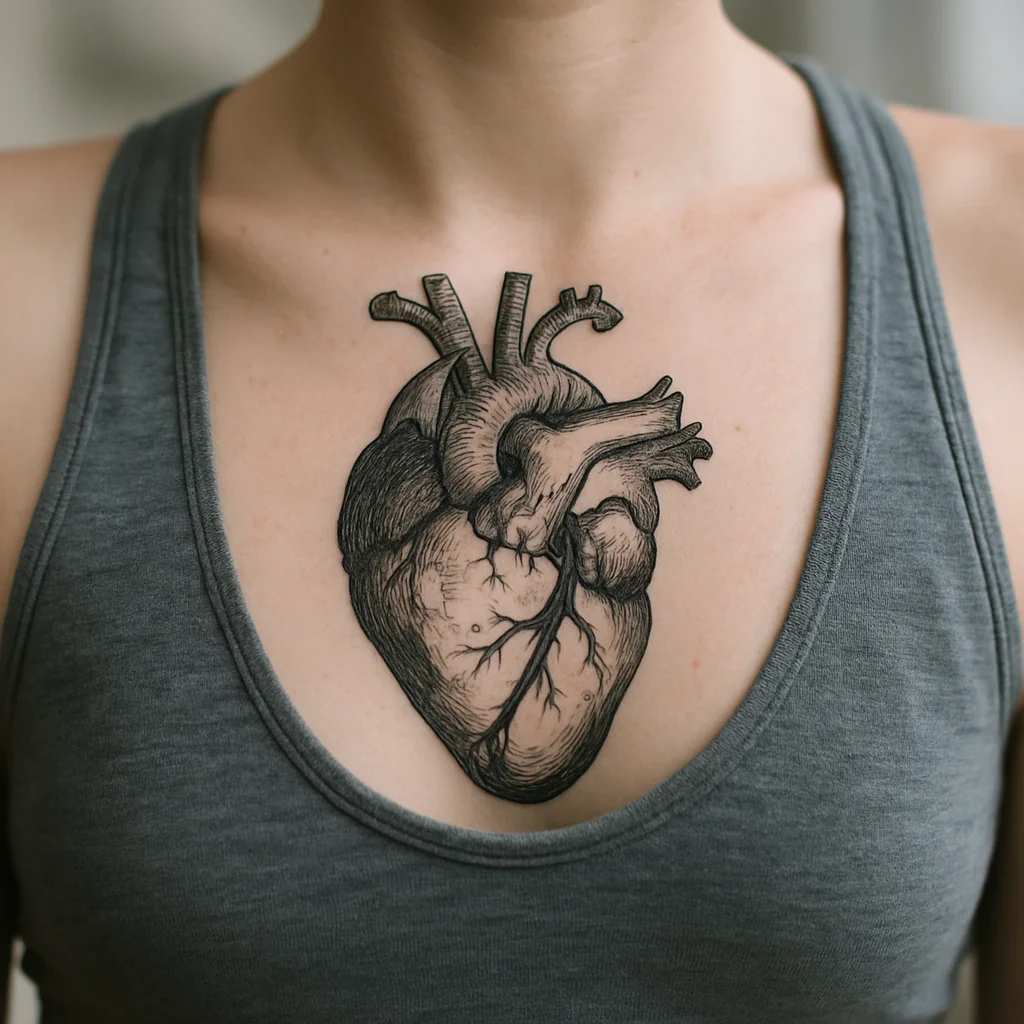
10. Anatomical heart at the sternum
The real organ, not the symbol: chambers, aorta arcing to one side, vessels trailing off in soft grey. Placed dead centre so the arteries can later branch out toward both pecs if you extend the piece. Ask for confident heavy shadow under the vessels or it will flatten as it heals.
11. Vertical script down the centre line
A short phrase, surname or single word set in one column of lettering, reading top to bottom along the sternum. Keep it to a few words — long sentences in a narrow vertical space become unreadable. Serif and blackletter both work; the letters must be spaced generously because bone-area lines tend to spread slightly.
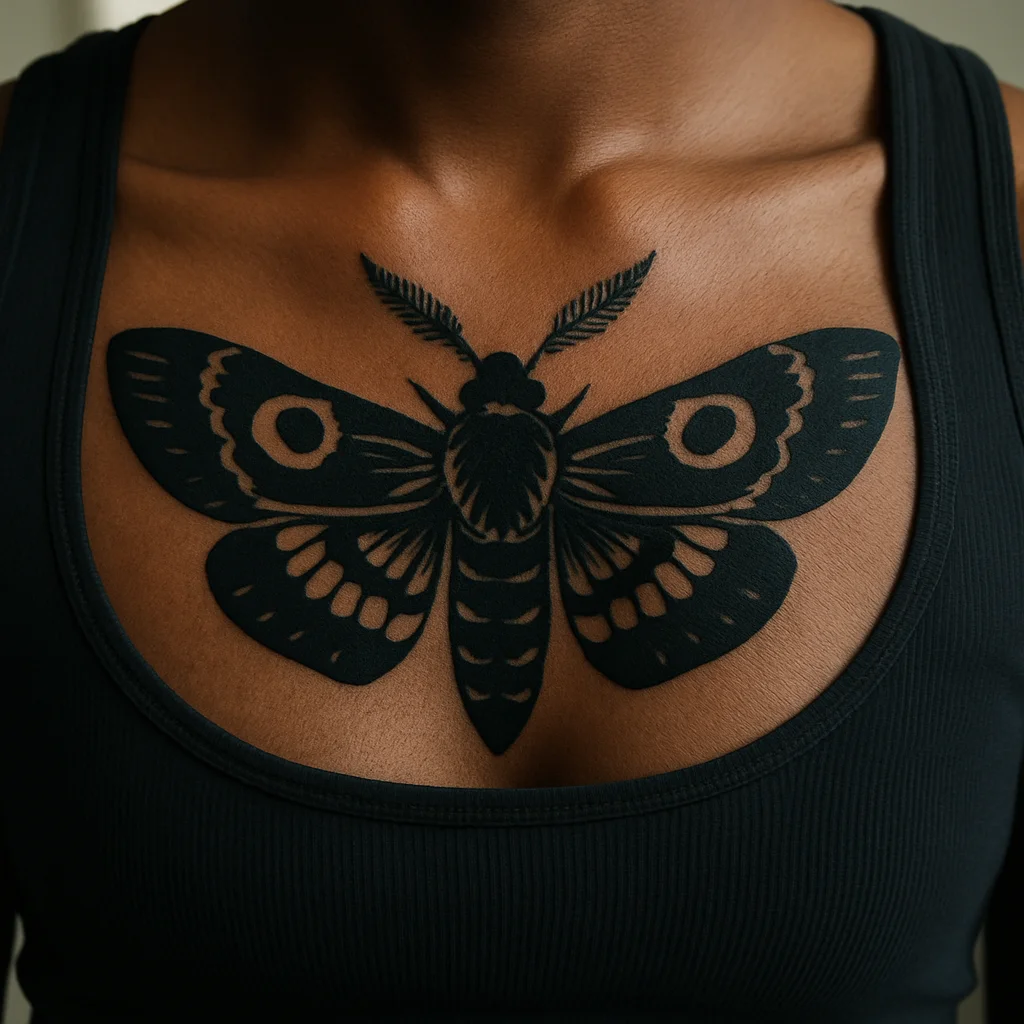
12. Moth with wings spread across the sternum
Body along the centre line, wings opening symmetrically over the inner edges of both pecs, patterns rendered in dense blackwork with negative-space eyespots. The natural symmetry of a moth is a gift for this placement. Expect a longer sitting than the size suggests, because the wing tips run over the sensitive inner chest.
13. Geometric linework column with negative space
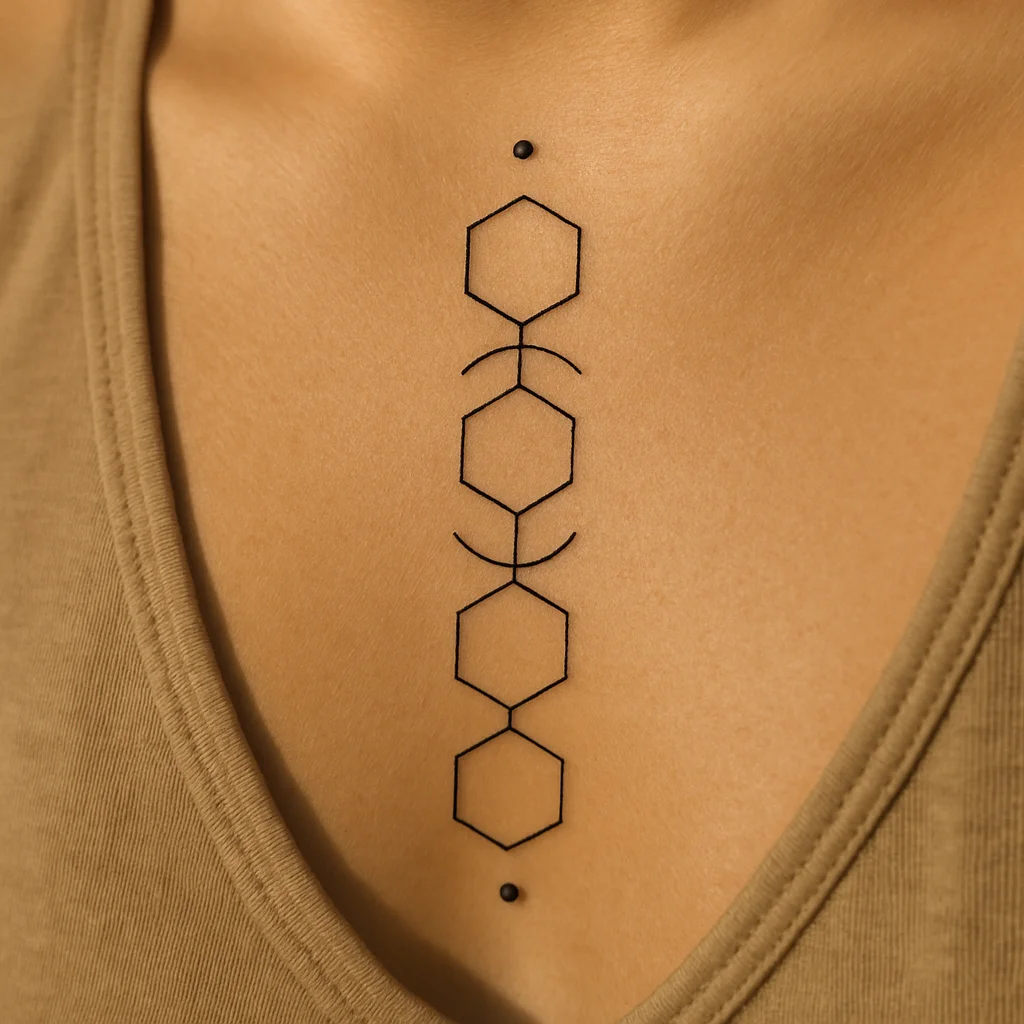
A stacked sequence of thin-line hexagons, arcs and single dots running vertically, designed to continue down onto the stomach later. Because it is mostly open skin, it heals fast and hurts less than solid fill in the same spot. Very effective on slimmer frames where a full plate would swamp the chest.
14. Traditional sacred heart with rays and banner
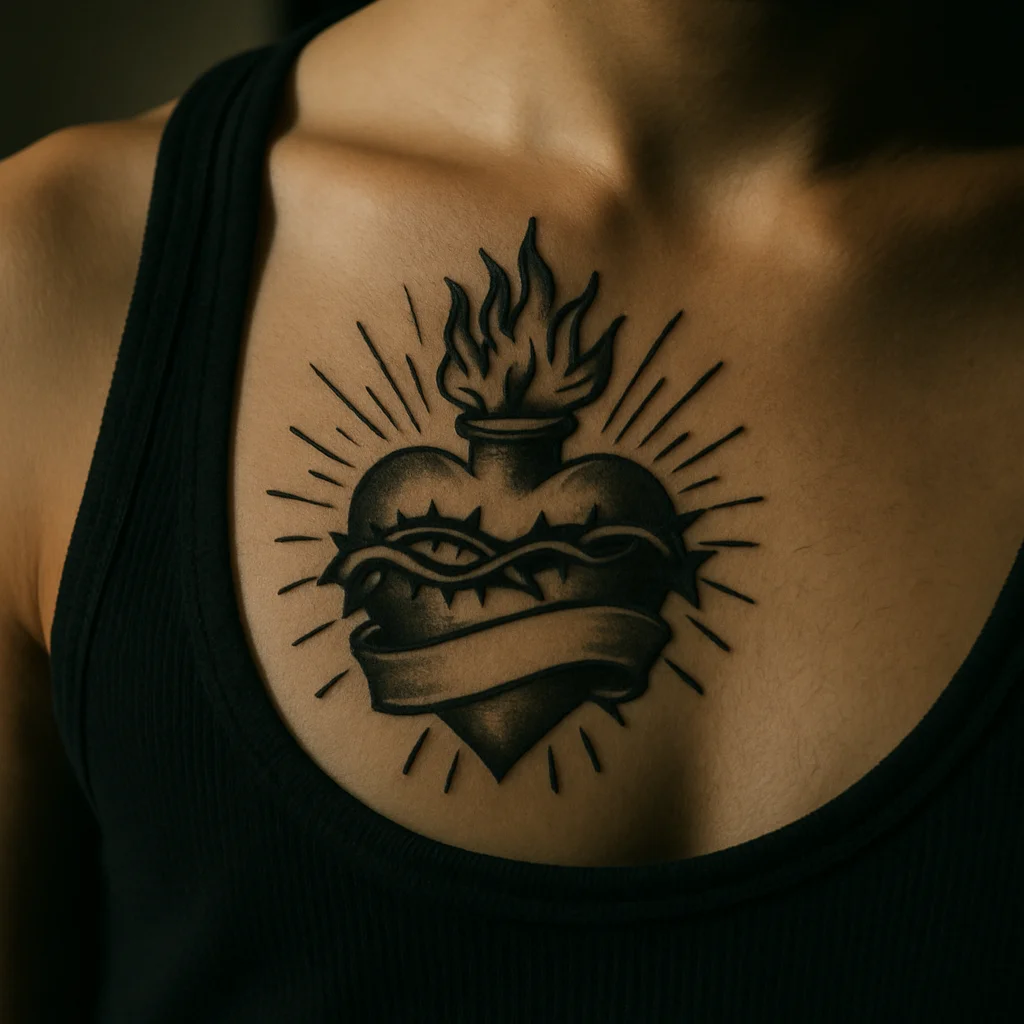
A flaming heart wrapped in thorns, radiating lines behind it, a banner underneath for a name or date. Bold black line and a limited red-and-yellow palette keep it legible for decades. It is one of the few centre-chest designs that looks equally right on its own or as the keystone of a full plate.
15. Small crest at the sternal notch
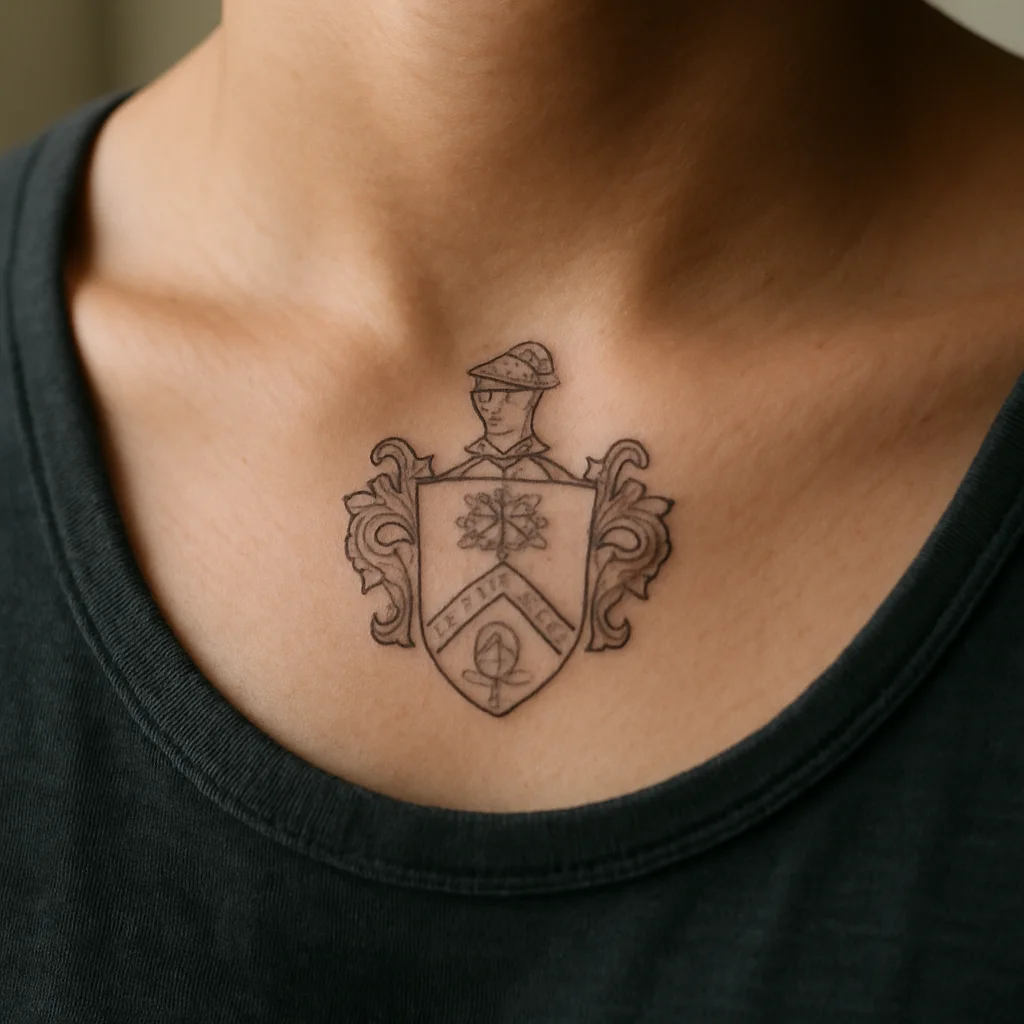
A monogram, family crest or single symbol no more than two inches across, sitting in the hollow just below the throat. Minimal, easily hidden by a collar, and a good test run if you are unsure how you handle bone pain. It is also a natural centre point if you later mirror designs on both collarbones.
Full Chest Plates: Ideas 16–22
A plate spans both pecs and treats the whole upper torso as one canvas. This is multi-session work, usually outlined in one sitting and shaded across two to four more. Before you start, decide whether it will stay a standalone chest piece or eventually flow into a sleeve or back — that decision changes where the outer edges land.
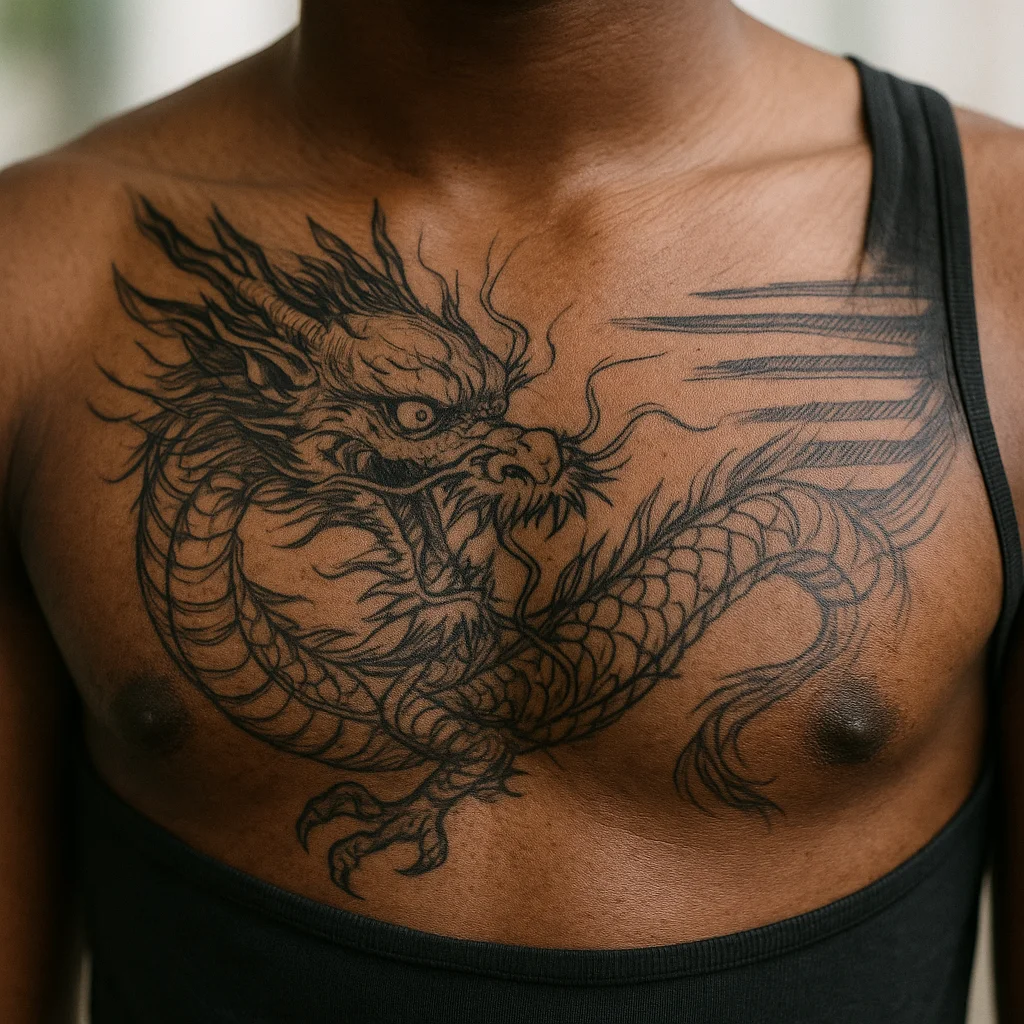
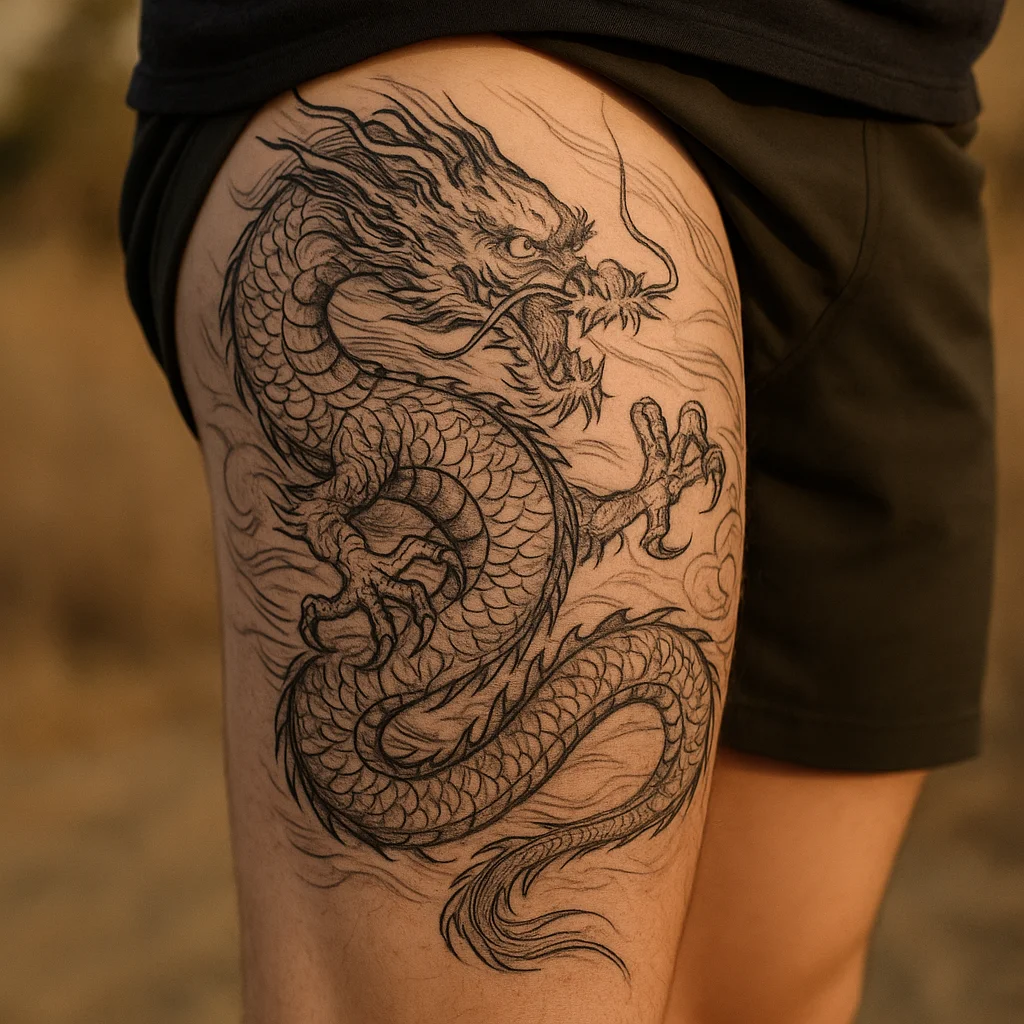
16. Japanese dragon head with wind bars
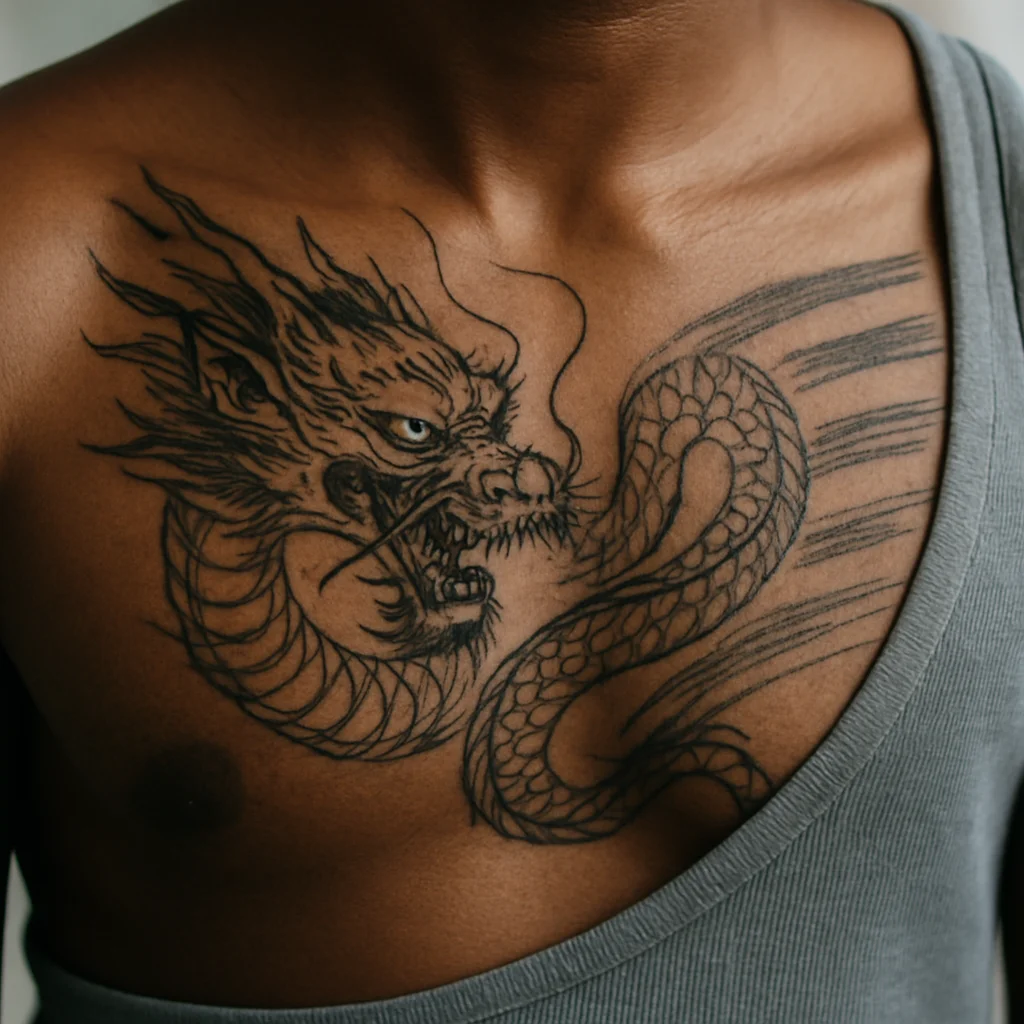
The head dominating one pec, body and claw crossing the sternum, wind bars and clouds filling the opposite side and running out toward the shoulder. It is the classic chest-to-sleeve foundation and it is designed to be extended. Colour or straight black-and-grey both work; black-and-grey needs fewer sessions and heals more evenly.
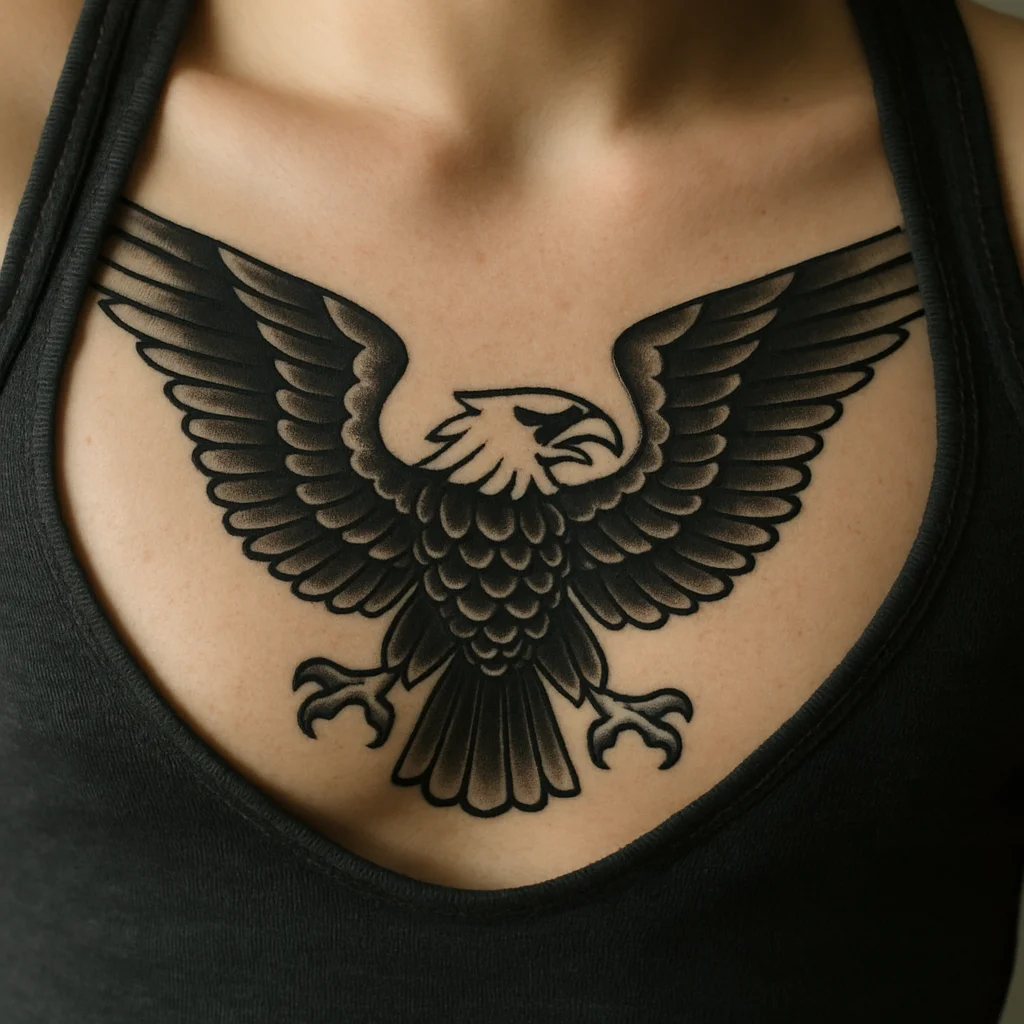
17. Eagle with wings spanning both pecs
Body and head at the sternum, wingspan reaching the outer edge of each pec, tail feathers dropping toward the solar plexus. Symmetry is the whole point, so ask to see the stencil on your skin standing up and sitting down before the first line goes in. Bold traditional linework makes this one of the longest-lasting chest designs there is.
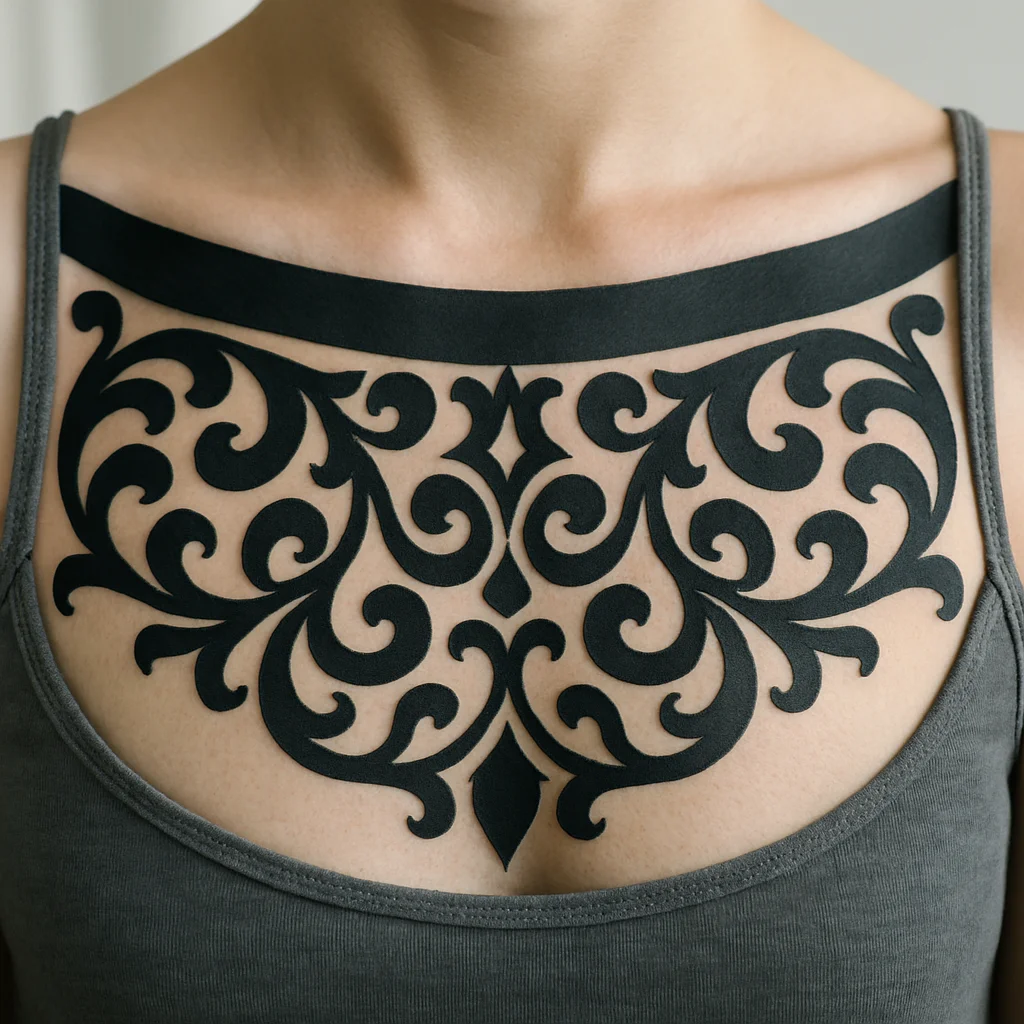
18. Ornamental blackwork breastplate
Solid black bands, ornamental filigree and geometric borders arranged like armour across the collarbones and both pecs, with negative-space skin used as the pattern. It is heavy on saturation, so expect several sessions and a genuinely sore recovery. The payoff is a piece that looks the same in twenty years as it does at three months healed.
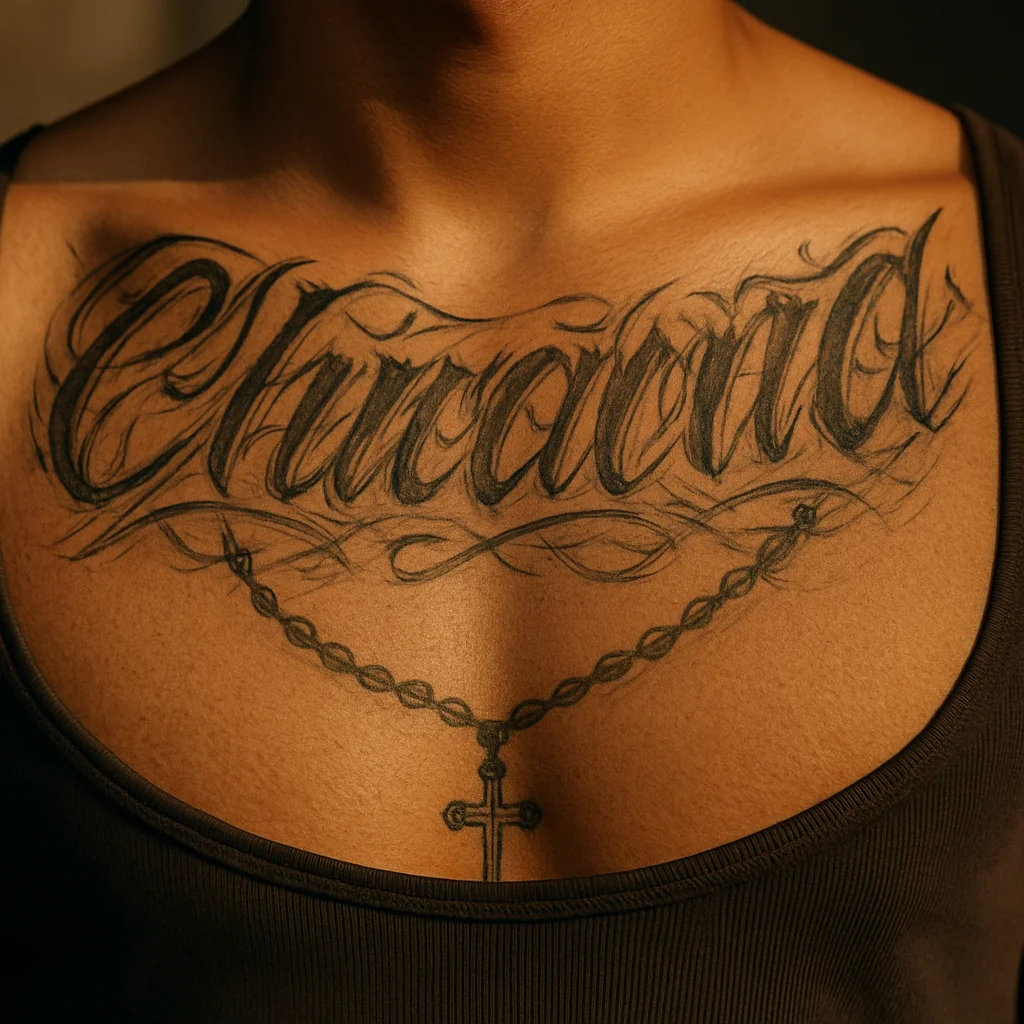
19. Chicano lettering plate with a rosary
Fine black-and-grey script arcing across the top of the chest, a rosary draping over the collarbones, and a small portrait or praying hands centred at the sternum. Restraint is what makes this style read: lots of open skin, soft smooth grey, no heavy black. Bring reference for the exact lettering hand you want, because it varies enormously between artists.
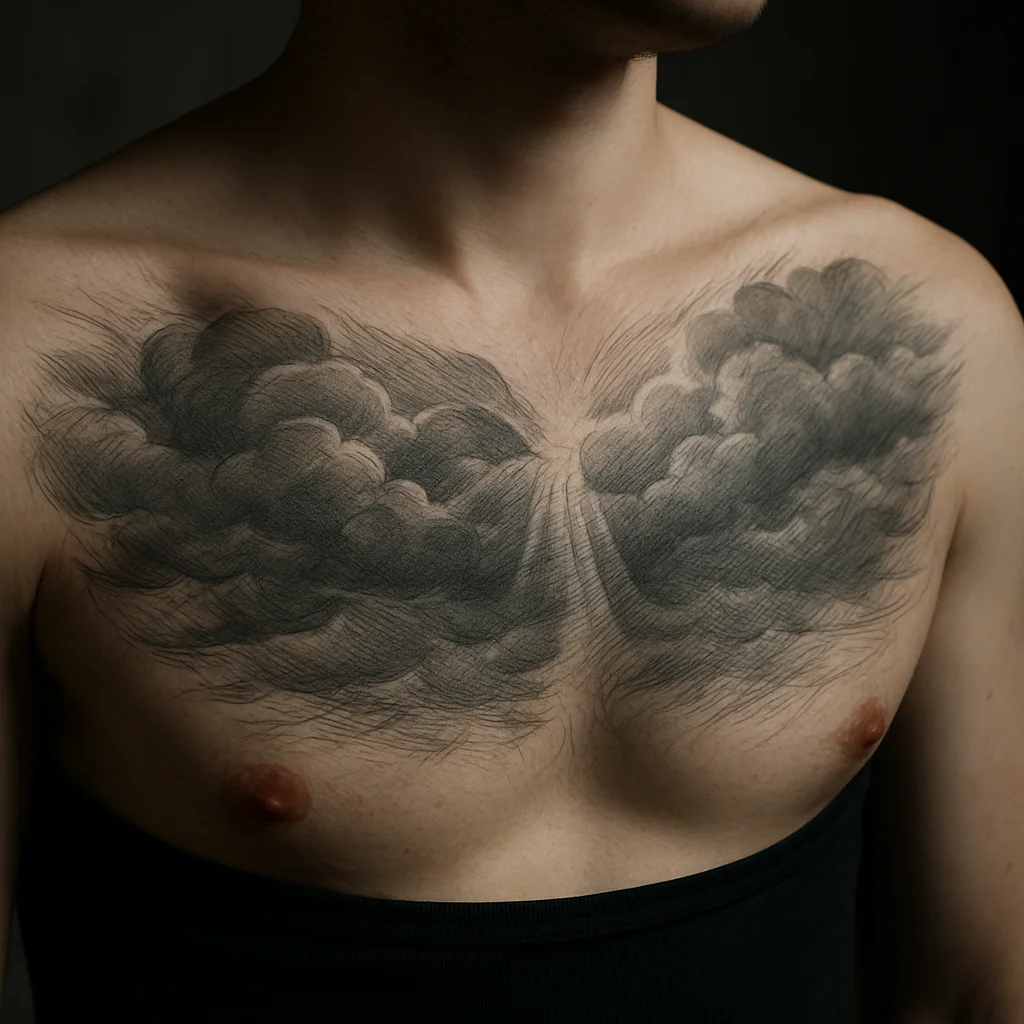
20. Storm sky with breaking light
Realistic cloud banks in graded grey covering both pecs, with a shaft of light breaking through above the sternum. It leans on smooth shading rather than line, so book an artist whose healed photos show clean grey wash. Best on a broad chest where the sky has room to gradate rather than compress.
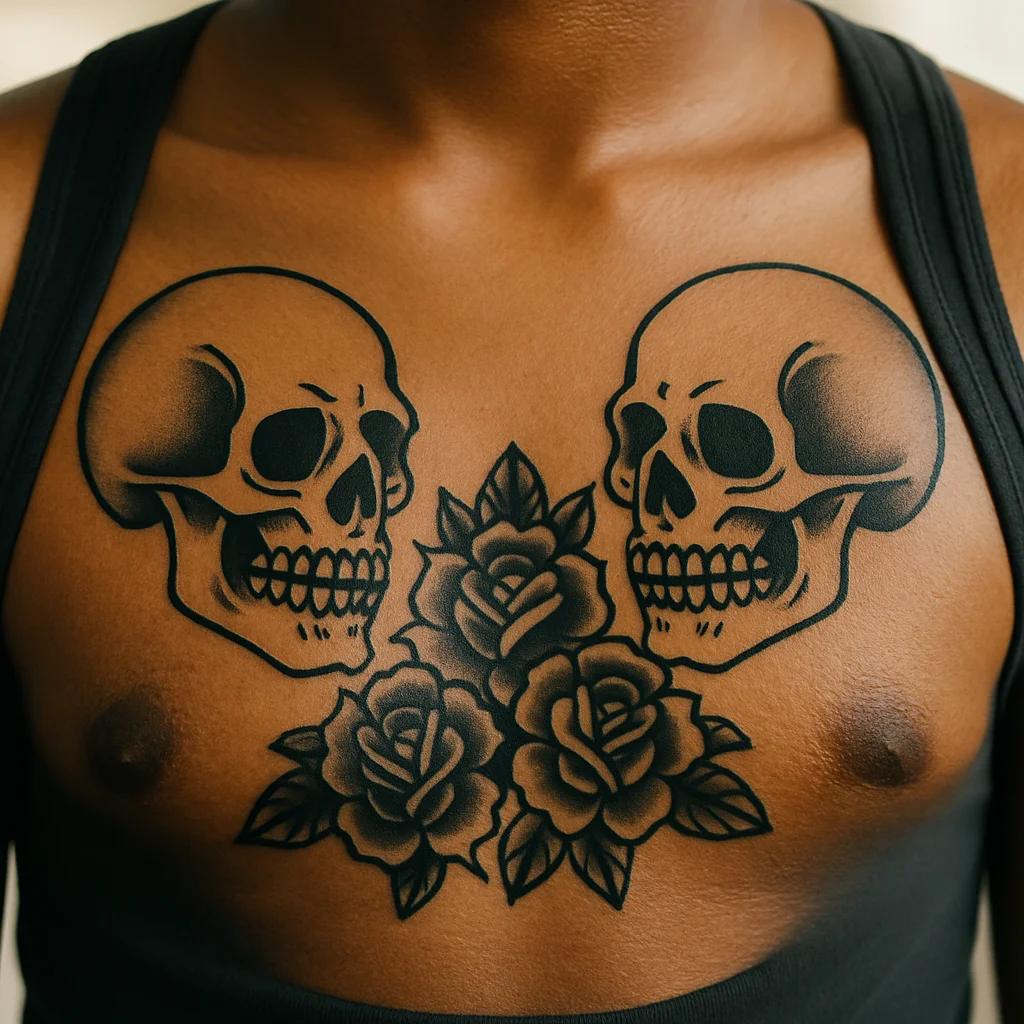
21. Mirrored skull and roses
Two skulls facing inward, one per pec, with rose clusters filling the space between them across the sternum. Mirrored designs suit the chest because the eye immediately checks for symmetry and rewards it. Traditional bold line keeps the skulls readable; heavy black behind them makes the roses pop.
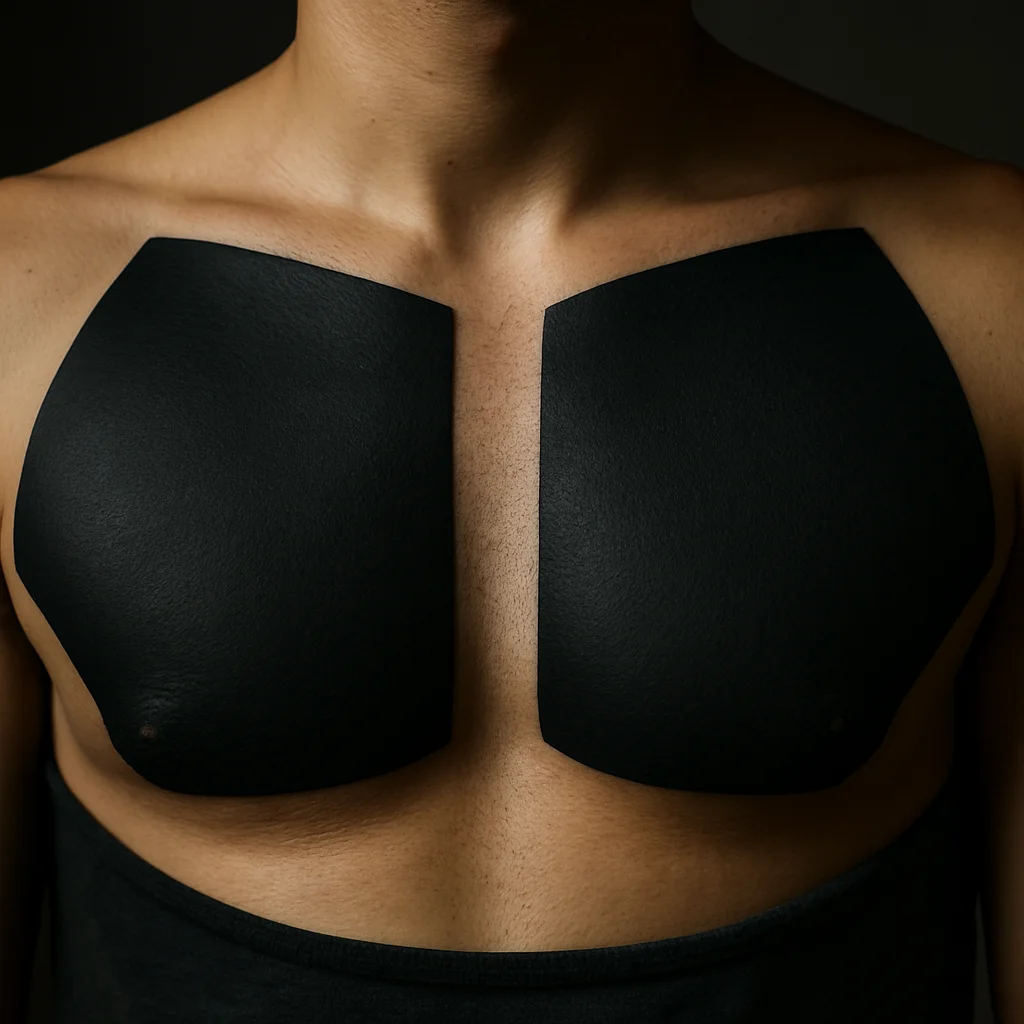
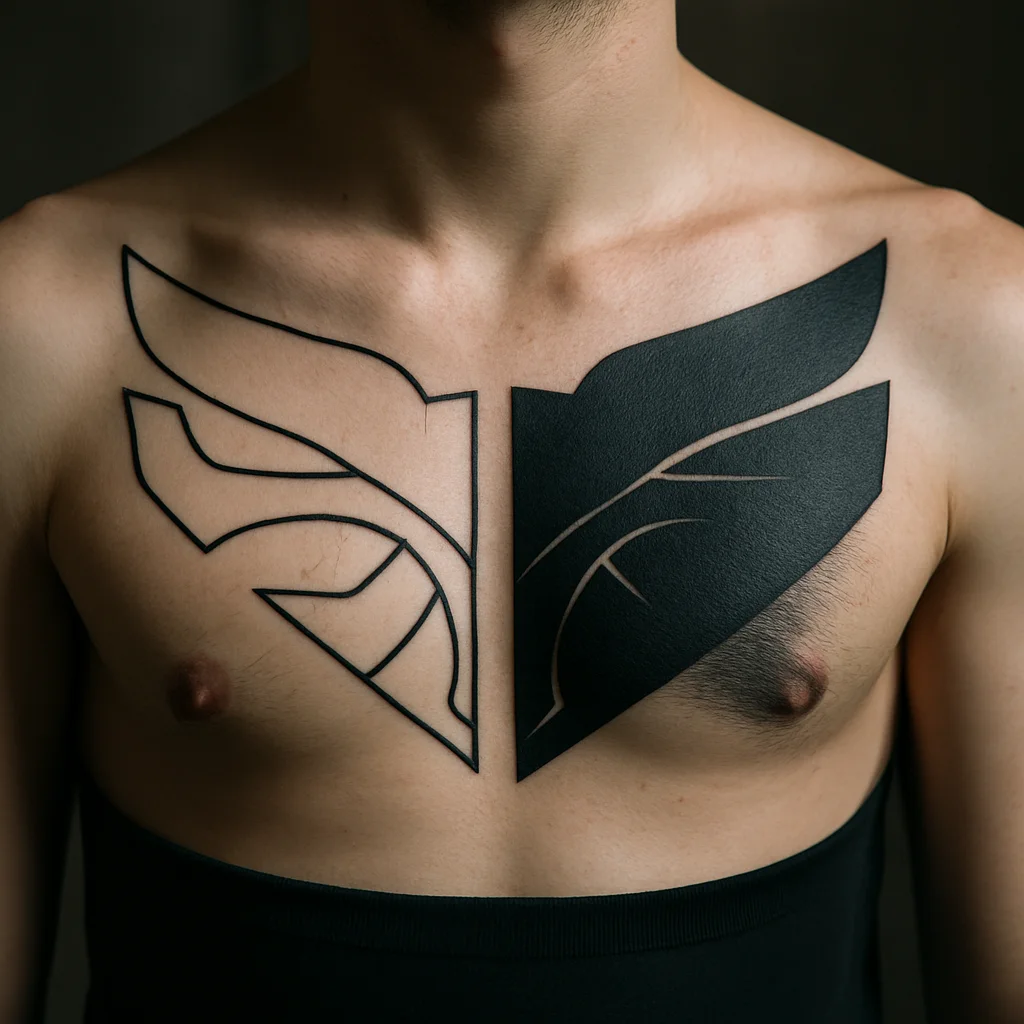
22. Abstract blackwork panels with a negative-space gap
Two large geometric fields of solid black, one over each pec, separated by a deliberate strip of untouched skin along the sternum. Modern, graphic and completely non-representational — a strong option if you want scale without symbolism. Ask for the edges to be drawn freehand on your body so the shapes respond to your actual build.
Collarbone, Shoulder and Side Connectors: Ideas 23–30
The chest does not end at the pecs. The collarbone shelf, the shoulder cap and the outer chest that rolls onto the ribs are where a chest piece either stops abruptly or starts to look like part of a bigger plan. These designs live on those borders.
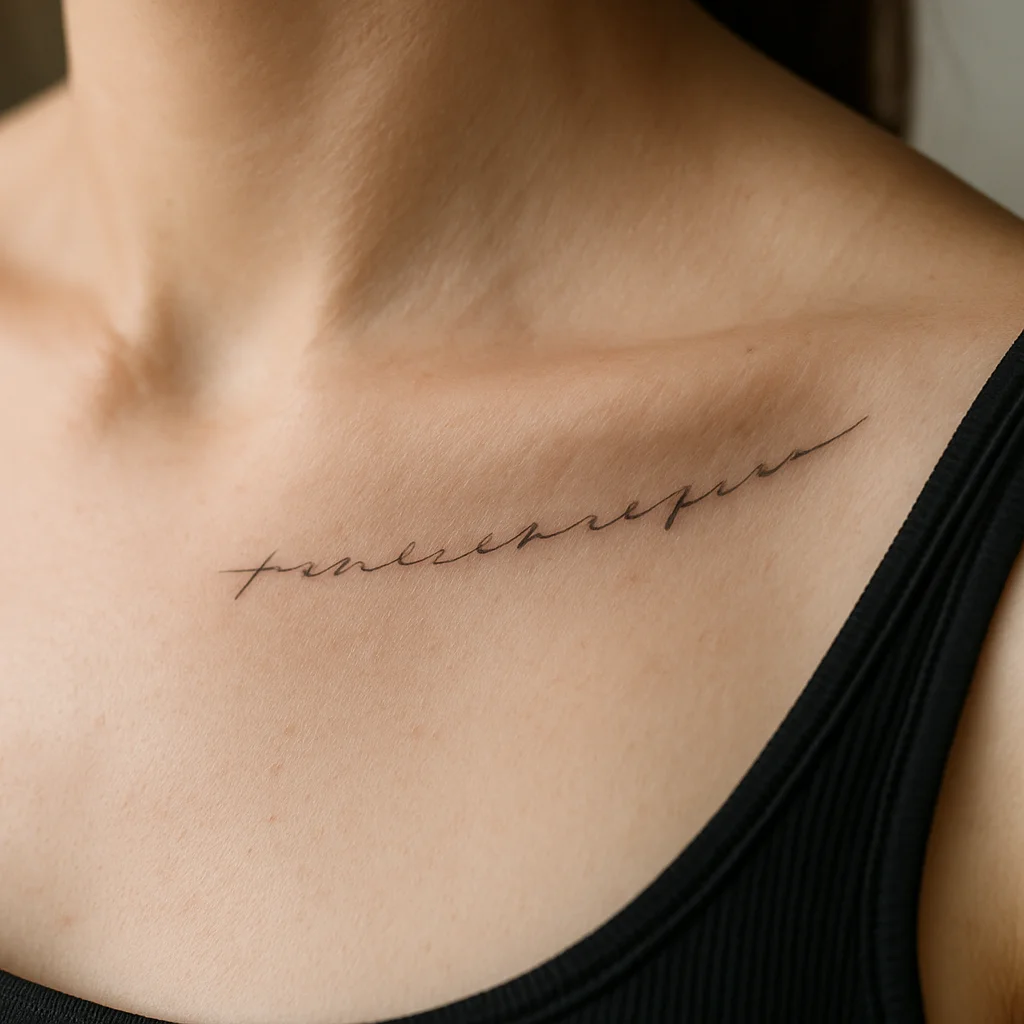
23. Script along the collarbone ridge
A single line of lettering following the bone from the sternum outward, curving slightly as the collarbone rises. Short is better — three to five words maximum. Painful because it sits directly on bone, but quick, and it disappears under any collared shirt.
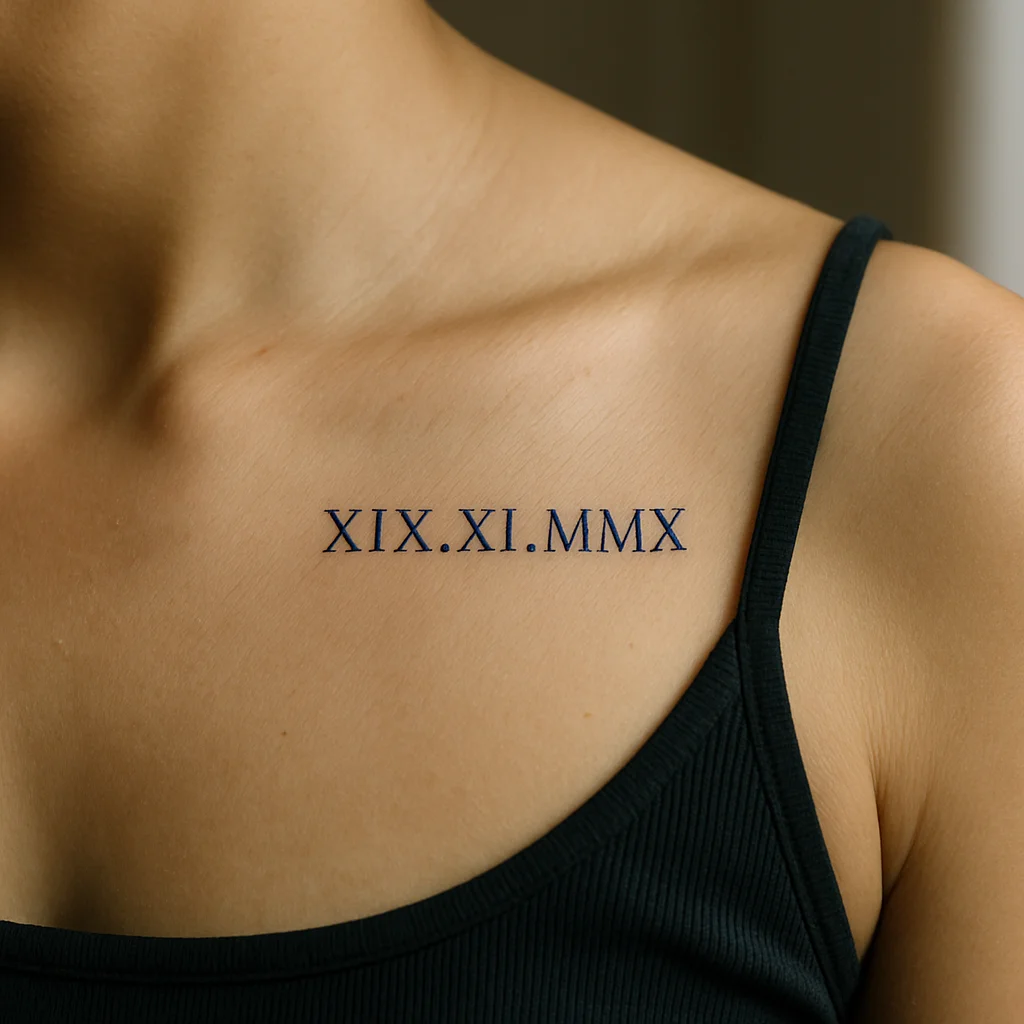
24. Roman numeral date under the collarbone
A slim row of numerals set an inch below the bone, thin enough to read as a line of texture from a distance. It is the most common way men mark a date on the chest and it stays legible if the numerals are spaced generously. Around 4–5 inches wide is the sweet spot.
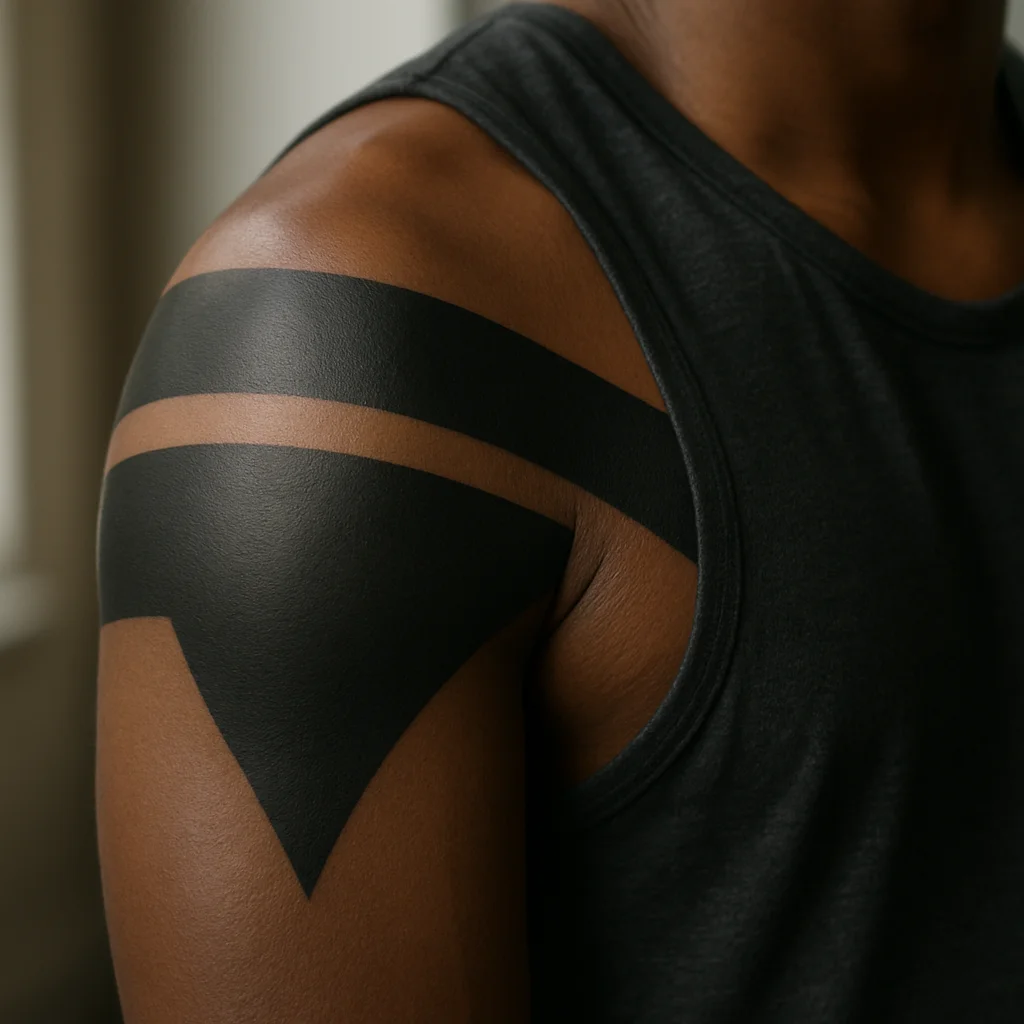
25. Polynesian-style shoulder cap hooking onto the pec
Bold black patterned bands wrapping the deltoid and reaching forward with two or three tapered points onto the upper chest. The hook shapes create movement between two body parts that otherwise look disconnected. Always have this drawn freehand — pattern this graphic must follow your own shoulder line.
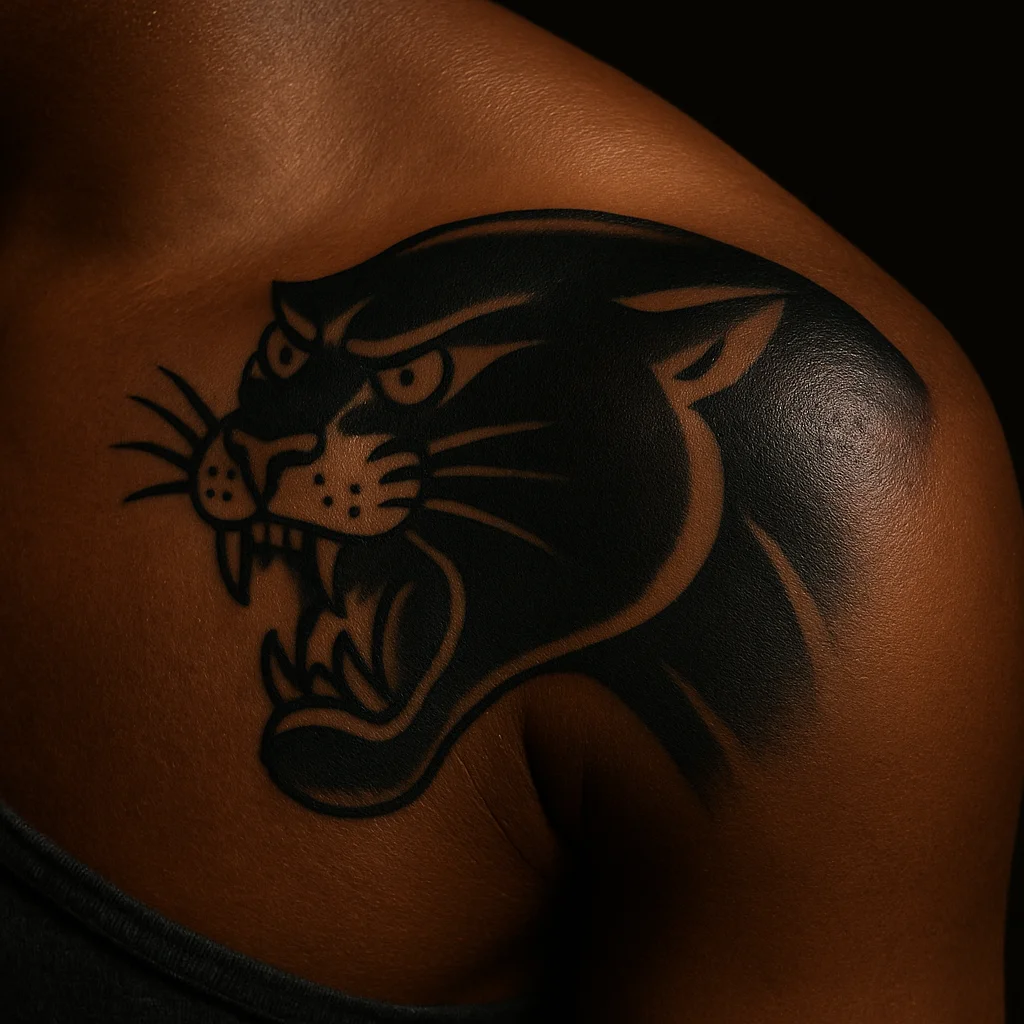
26. Traditional panther head on the shoulder cap
Snarling panther positioned on the front of the deltoid, angled so it looks down and across the chest. Heavy black fill, red mouth, claw marks optional trailing onto the pec. A compact old-school piece that connects arm and chest without committing you to a full plate.
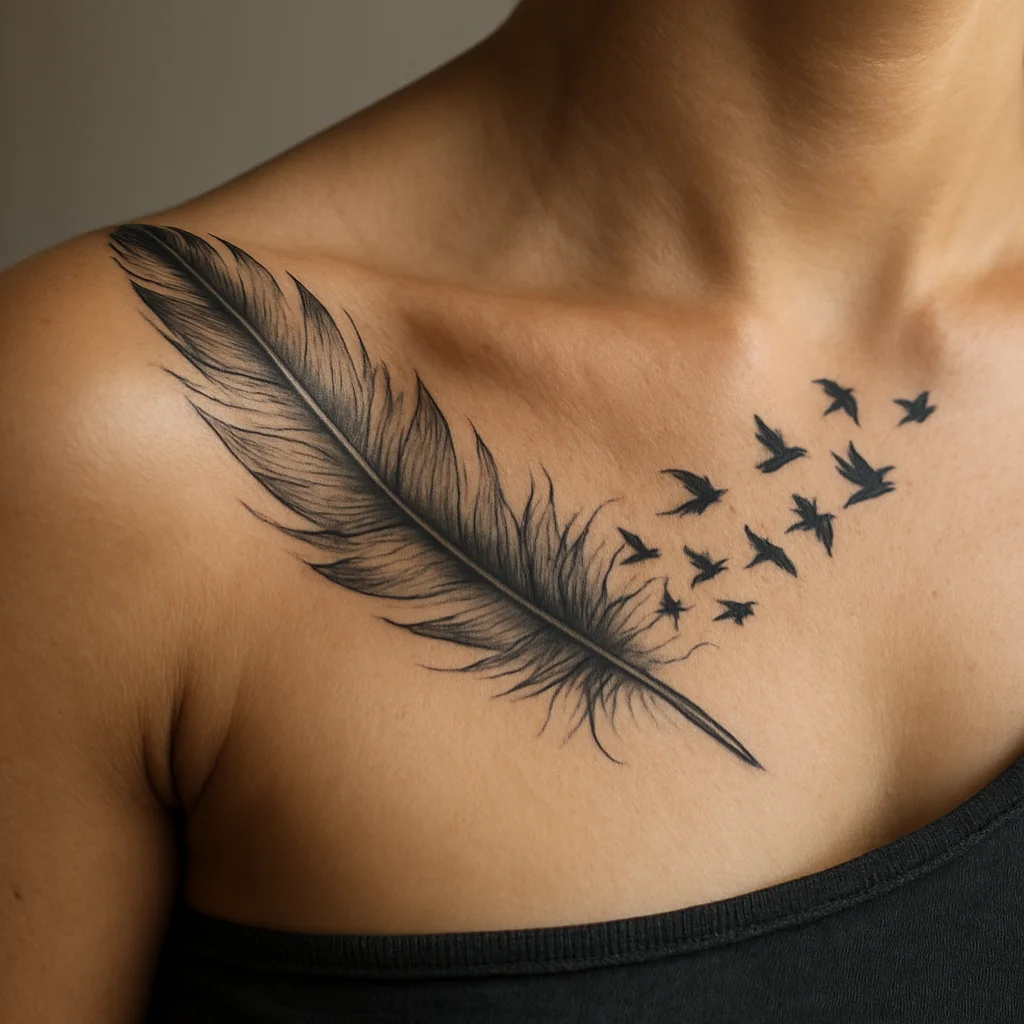
27. Feather sweep from collarbone to shoulder
A single large feather, or a loose cluster of three, laid diagonally along the line between the collarbone and the shoulder joint, barbs breaking up into small birds at the tip if you want the extra story. The diagonal follows an existing anatomical line, which is why it sits so comfortably. Keep it in grey wash with minimal outline.
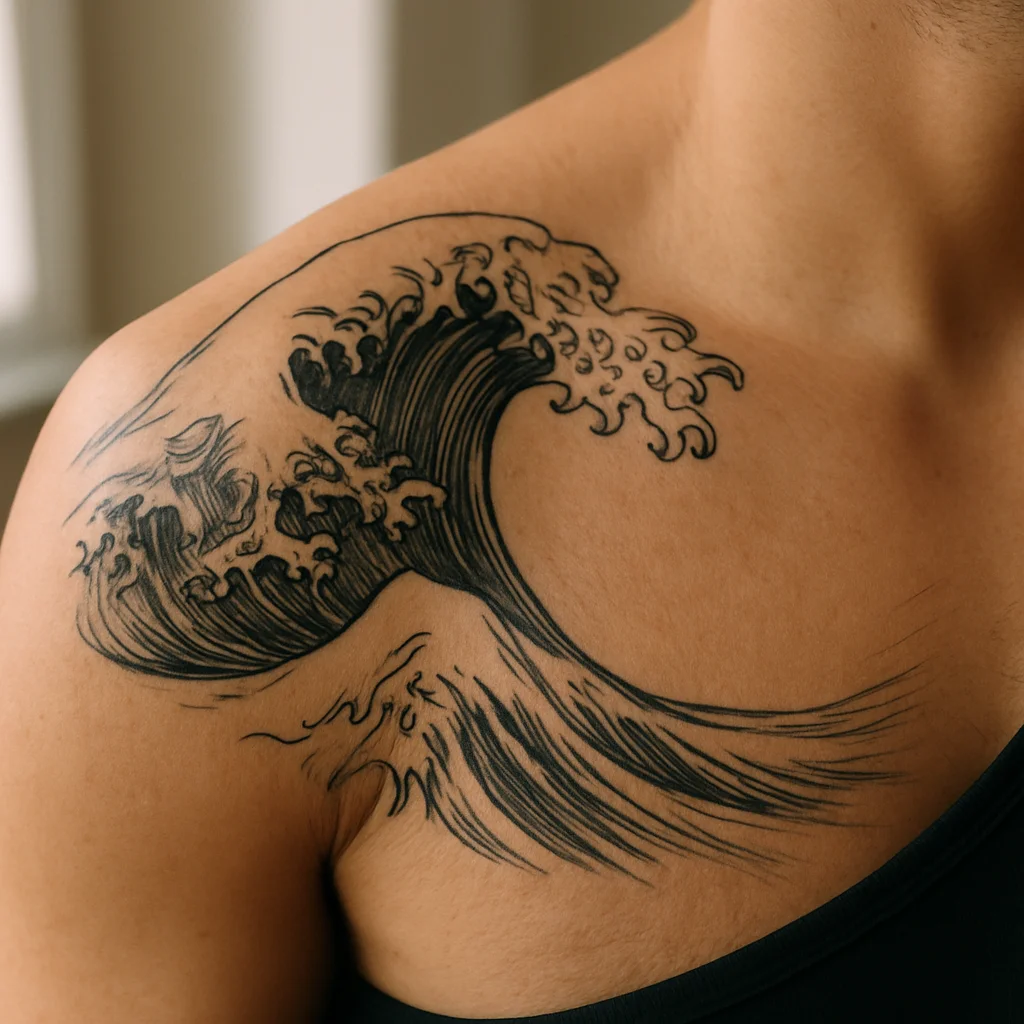
28. Japanese wave pouring over the shoulder
Water starting at the outer pec, cresting over the top of the shoulder and continuing down the arm, with foam curls and negative-space spray. It is the cleanest way to bridge chest and sleeve, and it can be added in stages over years. Have the whole flow mapped in the first design session even if you only tattoo part of it.
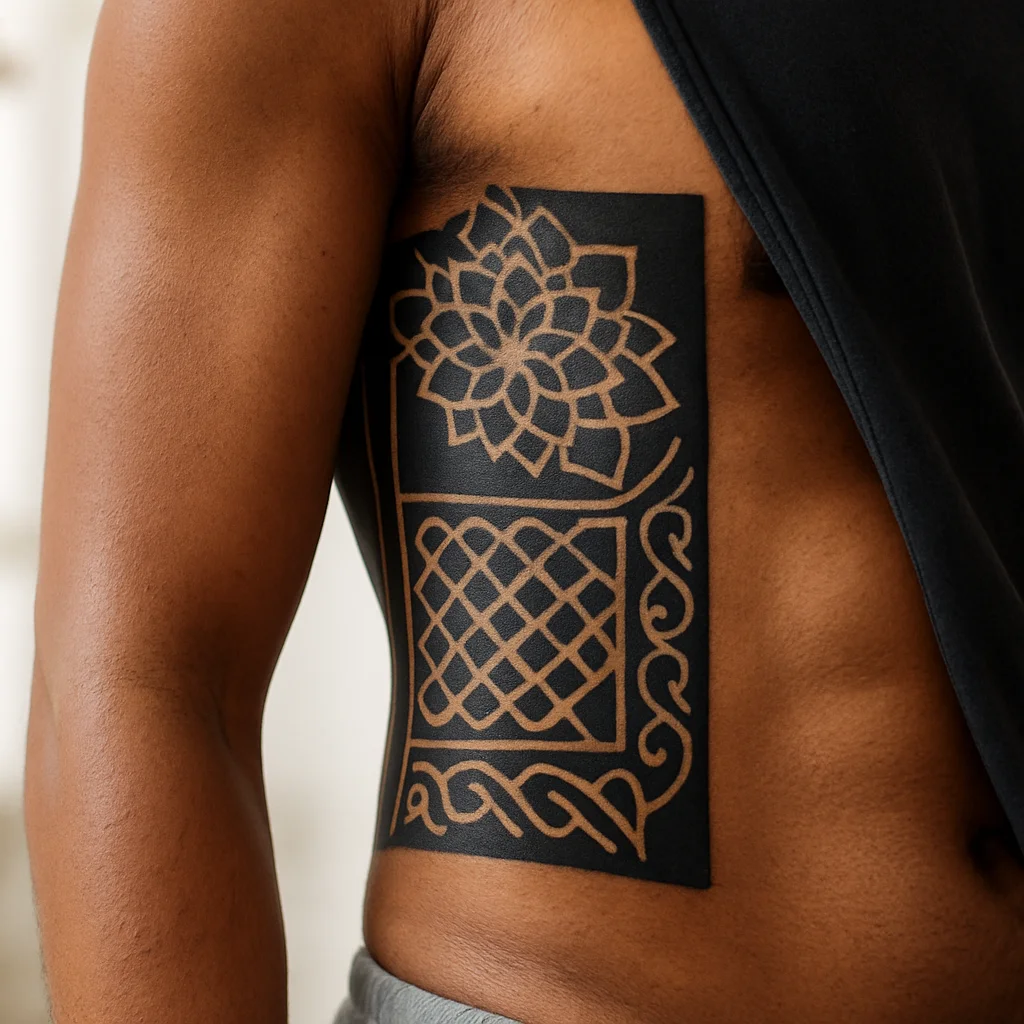
29. Blackwork panel wrapping onto the ribcage
A solid or heavily patterned shape starting at the outer edge of the pec and continuing around onto the side of the ribs, following the curve rather than stopping at it. This is where chest tattoos start to look expensive and considered. Ribs hurt considerably more than pecs, so split it across sessions.
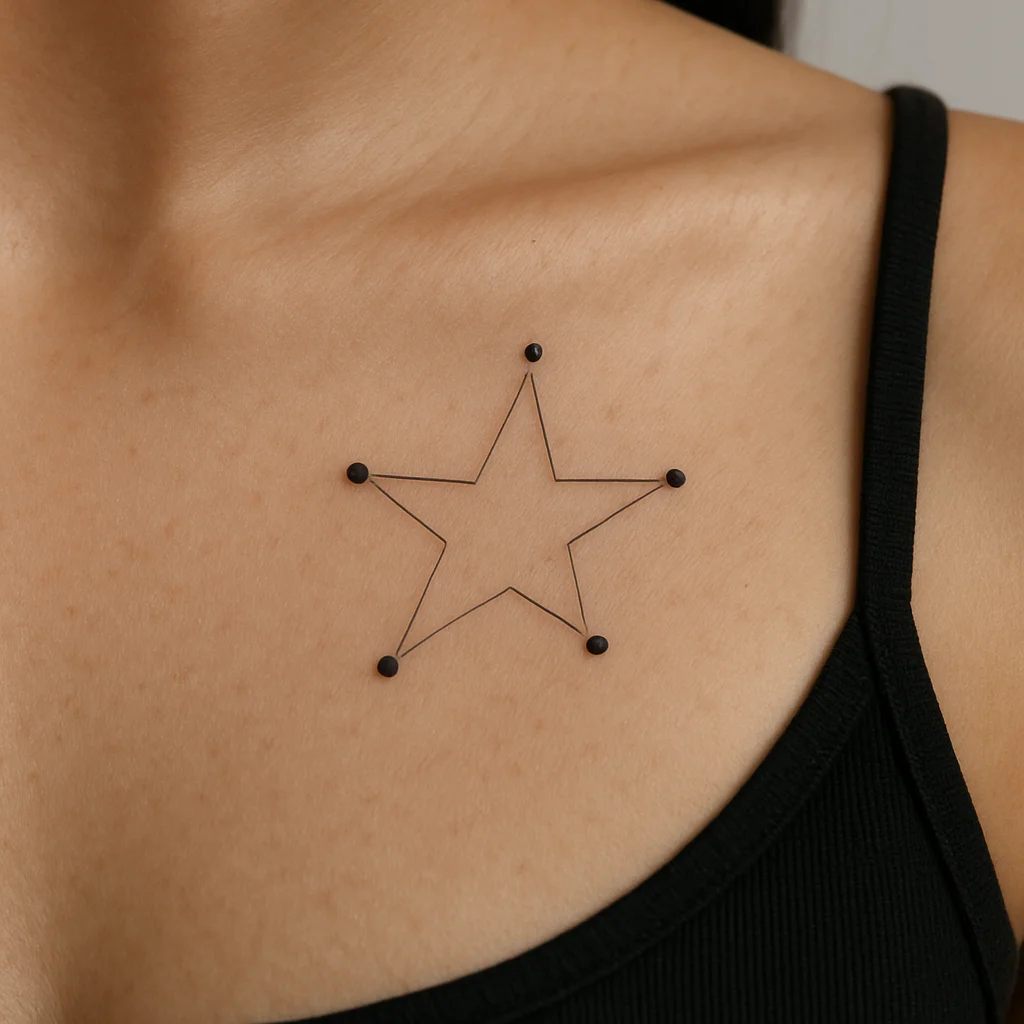
30. Constellation dots from collarbone to chest
Small solid dots of varying weight, connected by hairline strokes, tracing a specific star pattern across the upper chest below the collarbone. Minimal, easy to place around existing tattoos, and one of the least painful chest options. Ask for the dots to be built slightly larger than they look on paper so they stay crisp as they heal.
Pain, Sessions, Cost and Healing on the Chest
Chest pain varies more by inch than almost anywhere else on the body. The outer and lower pec is soft and genuinely manageable — comparable to an outer arm. The sternum, the collarbones and the area near the armpit are a different experience: bone, thin skin, and nerves close to the surface. Most men describe centre-chest work as sharp and hot rather than dull, and it gets harder as the session runs long because the vibration accumulates.
Plan around that. A single pec panel is usually one session of three to five hours. A full plate is realistically 12–25 hours of work split into sittings, and outlining a symmetrical plate should be done in one go so both sides are drawn while your body is in the same position. Book mornings, eat properly beforehand, and wear a button-up shirt to the appointment because pulling a t-shirt over a fresh chest tattoo is miserable.
On budget, chest work sits at the higher end because of the size and the artist time involved. Expect a small collarbone piece to cost roughly what a forearm tattoo of the same size would, a single pec panel to run into several hours of shop rate, and a full plate to land in the range of a full sleeve — often a four-figure total spread over months. Our breakdown of what tattoos actually cost is worth reading before you book a consultation.
Healing is where chest tattoos catch people out. The area creases when you sit, sleep and reach, so it tends to scab in the fold lines; sleeping on your back for the first week helps a lot. Skip the gym for chest and shoulder days for at least a week — sweat and stretching under a fresh tattoo cause patchy healing — and keep seat belts off the raw area with a folded cloth. Everything else is standard: clean, thin moisturiser, no soaking, no sun. The full routine is in our 30-day aftercare guide.
How to brief your artist
Bring your body, not just your phone. Say which zone you want filled, whether you ever intend to extend into a sleeve or down the stomach, and whether you shave your chest. Ask for the stencil to be checked standing, sitting and with arms raised, and ask directly how the design's outer edges are meant to end — a hard border, a fade, or an open shape that can be continued later.
Frequently asked questions
How much does a chest tattoo hurt compared to the arm?
The soft outer and lower pec feels similar to the outer arm — sore but very doable. The sternum, collarbones and the skin near the armpit are noticeably worse because the needle is working over bone and thin skin. Most men can handle three to five hours on the pec, while centre-chest sessions are often kept shorter.
Will chest hair ruin the tattoo?
No. Your artist shaves the area before tattooing and the hair grows back through the healed tattoo without damaging it. Heavy hair does visually soften very fine lines and light grey shading, so if you do not plan to shave regularly, choose bolder outlines and stronger contrast.
Should I get one pec done or commit to a full chest plate?
Start with one pec if you are unsure. It is a contained piece, costs a fraction of a plate, and can be mirrored or extended later — as long as you tell the artist that is a possibility so the outer edges are left open. Only commit to a full plate if you already know the style and imagery you want to live with.
Will a chest tattoo stretch if I gain or lose weight?
Muscle gain usually spreads a design fairly evenly and rarely causes a problem. Significant weight loss around the chest can slacken the skin and blur very tight detail, especially on the lower pec. If you expect big body changes, favour bolder line weights and avoid microscopic detail.
How soon can I train after a chest tattoo?
Give it at least a week before chest, shoulder or pressing work. Sweat sitting on a healing tattoo and repeated stretching of the skin both cause patchy healing and lost ink. Light cardio a few days in is generally fine as long as you clean the area straight afterwards.
The conversation
No comments yet. Got a thought about these designs? Start us off.
Want to weigh in? Join the community to comment, save designs and try them on your skin.