September Aster Tattoos: 28 Ideas by Petal Style
The aster's ring of skinny ray petals is what separates a great September birth flower tattoo from a blurry daisy. Here are 28 designs sorted by how those petals are drawn, with sizing, placement and aging notes for each.
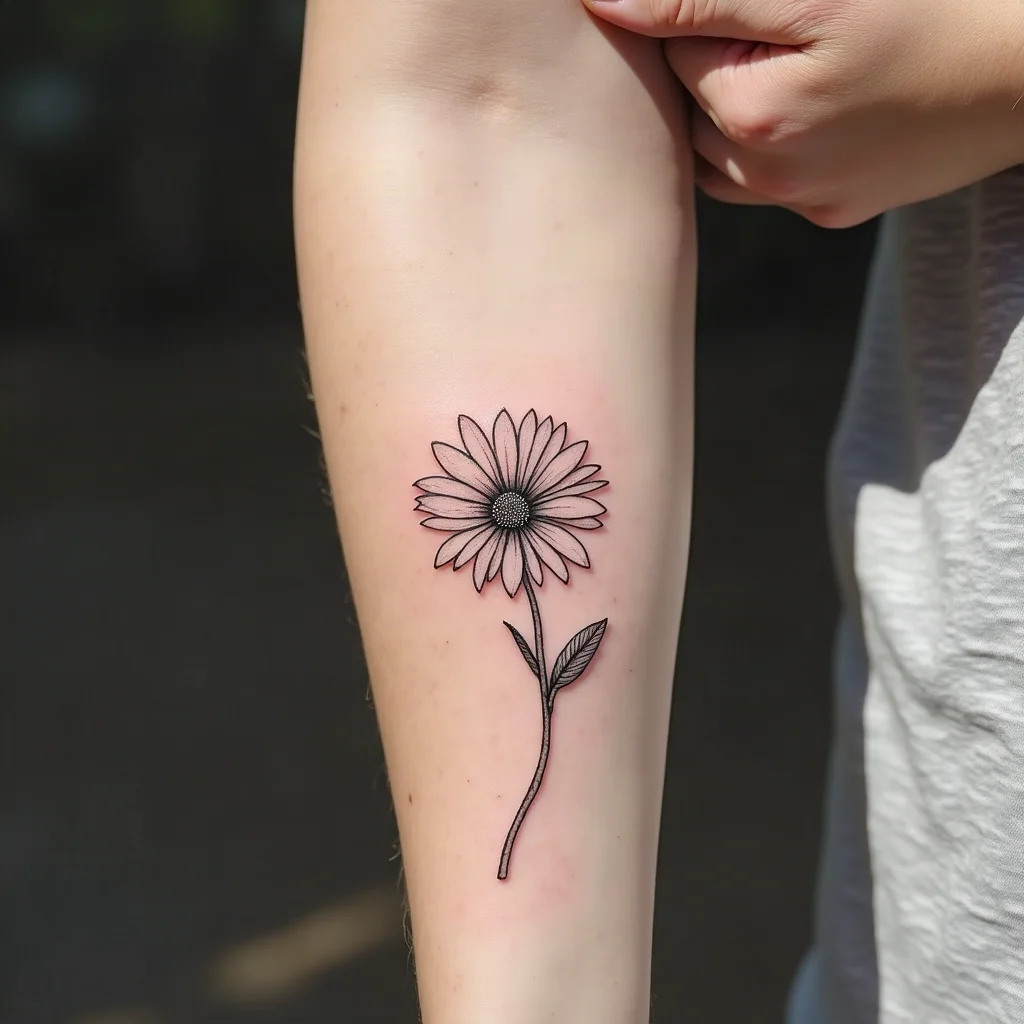
The Aster, Read Like a Tattoo Artist Reads It
Half the flash sheets labelled "aster" online are actually daisies, and your artist will thank you for knowing the difference before you sit down. A daisy has a modest ring of wide, rounded petals. An aster has dozens of narrow, slightly uneven ray petals radiating from a dense button of disc florets, and the silhouette it makes is closer to a star than a pinwheel. That is not a coincidence: the name comes from the Greek word for star.
The variety most people picture is the New England aster, violet-purple with a gold-orange center, blooming so late in the season it earned the nickname Michaelmas daisy. Symbolically it carries wisdom, patience, faith and quiet love, and it has a long history as a remembrance flower, which is why so many September asters end up as memorial pieces rather than decoration.
The design problem is petal count. Real asters can carry forty ray petals; skin cannot. Ink spreads a hair in every direction over the years, so petals drawn tighter than about a needle's width apart will eventually merge into a solid disc. Every good aster tattoo solves this the same way: fewer petals, more space between them, and uneven lengths so the ring never looks mechanical. Sixteen to twenty-two petals reads convincingly as an aster at palm size. Eight to twelve reads as an aster at coin size. Below that, you are drawing a symbol, not a botanical study, and that is a legitimate choice as long as you make it on purpose.
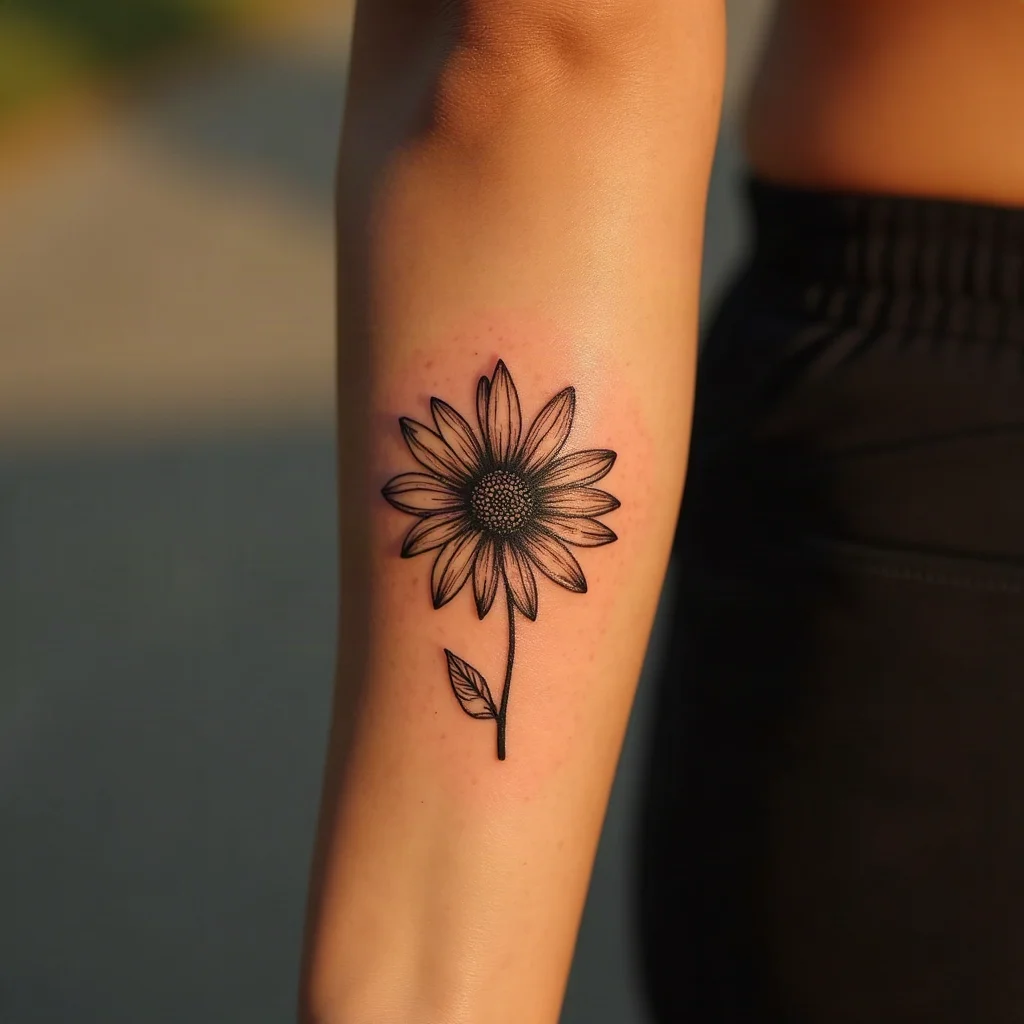
Fine-Line Asters: Entries 1-7
Fine-line is the default request for birth flower work, and asters suit it as long as the artist resists filling the ring. These seven lean on hairline weight, generous petal gaps and stippled centers instead of solid black.
1. Single-needle aster on the inner wrist
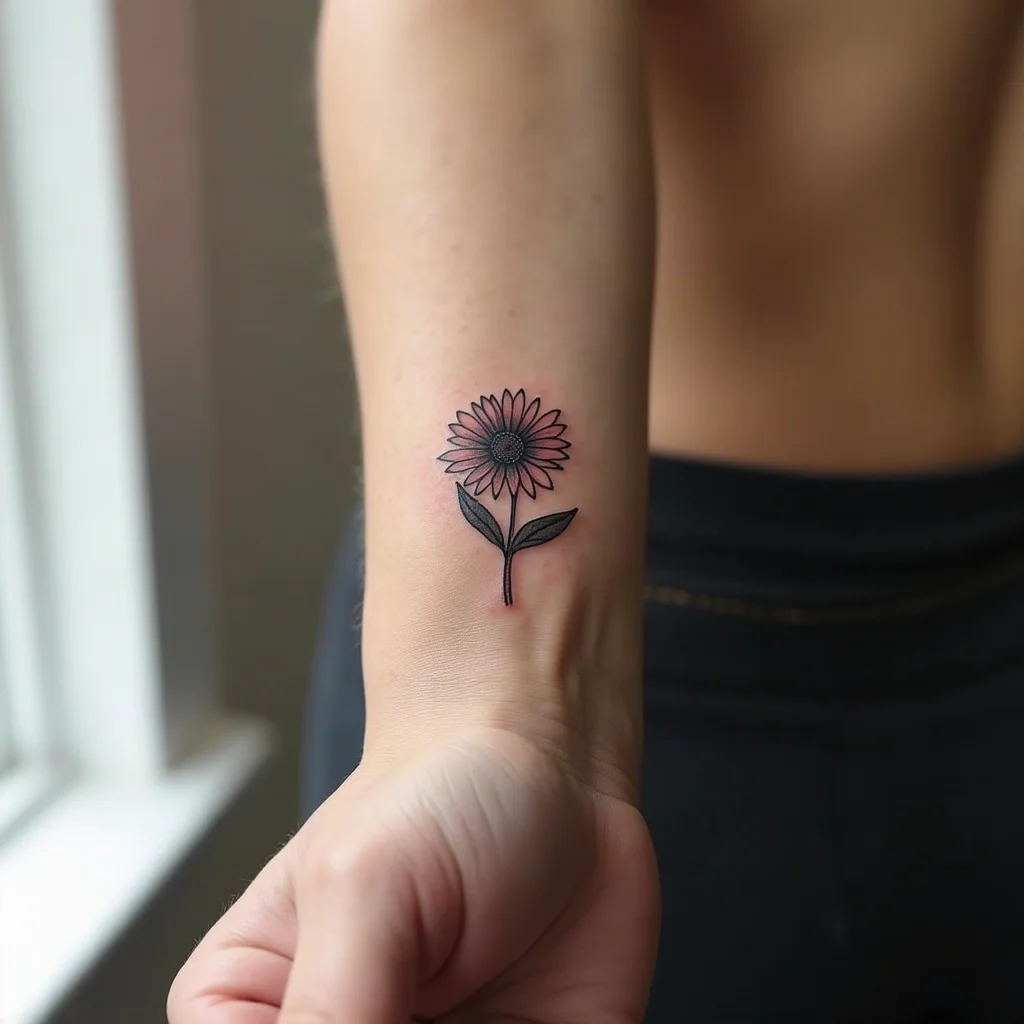
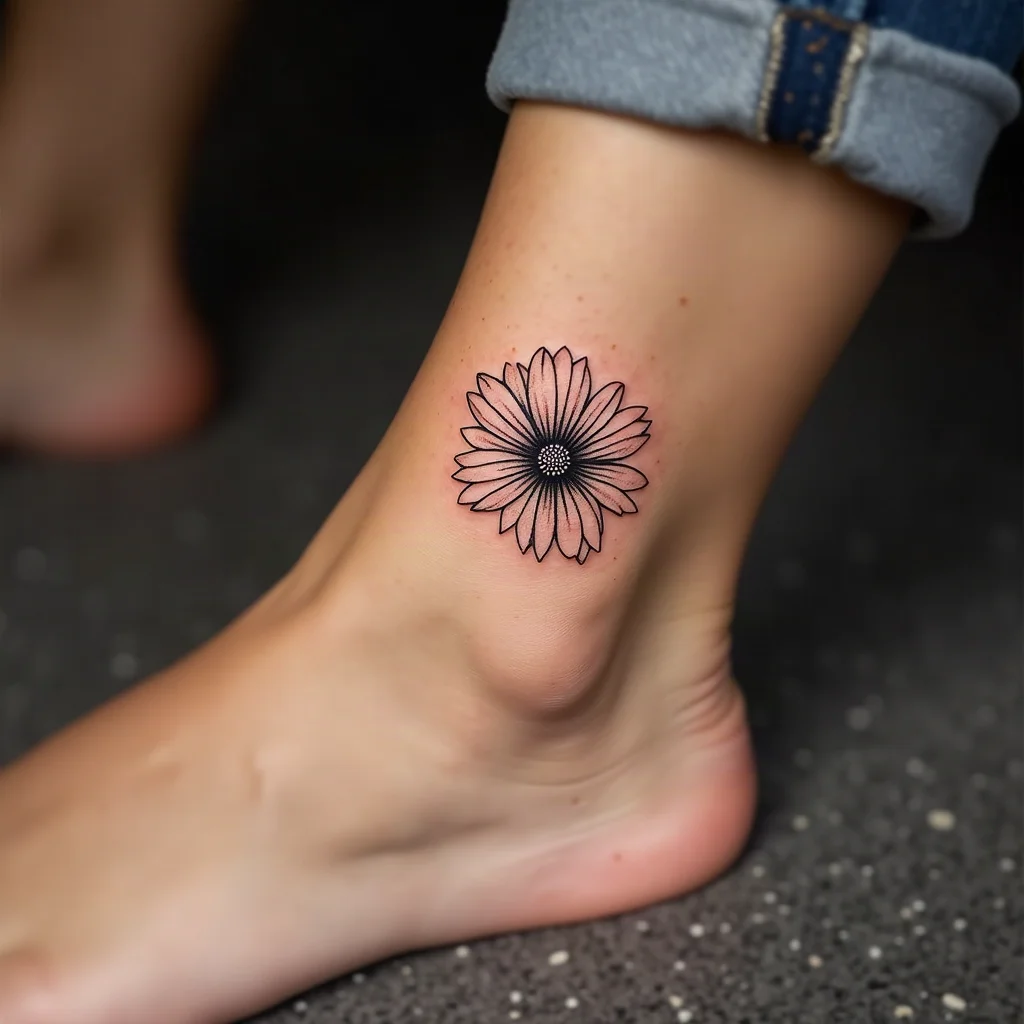
About an inch across, sixteen to eighteen hairline petals, and a center built from loose stipple rather than a filled dot. It sits neatly between the wrist creases and stays hidden under a watch. Fine-line on the wrist softens faster than most placements, so budget for a touch-up around year three.
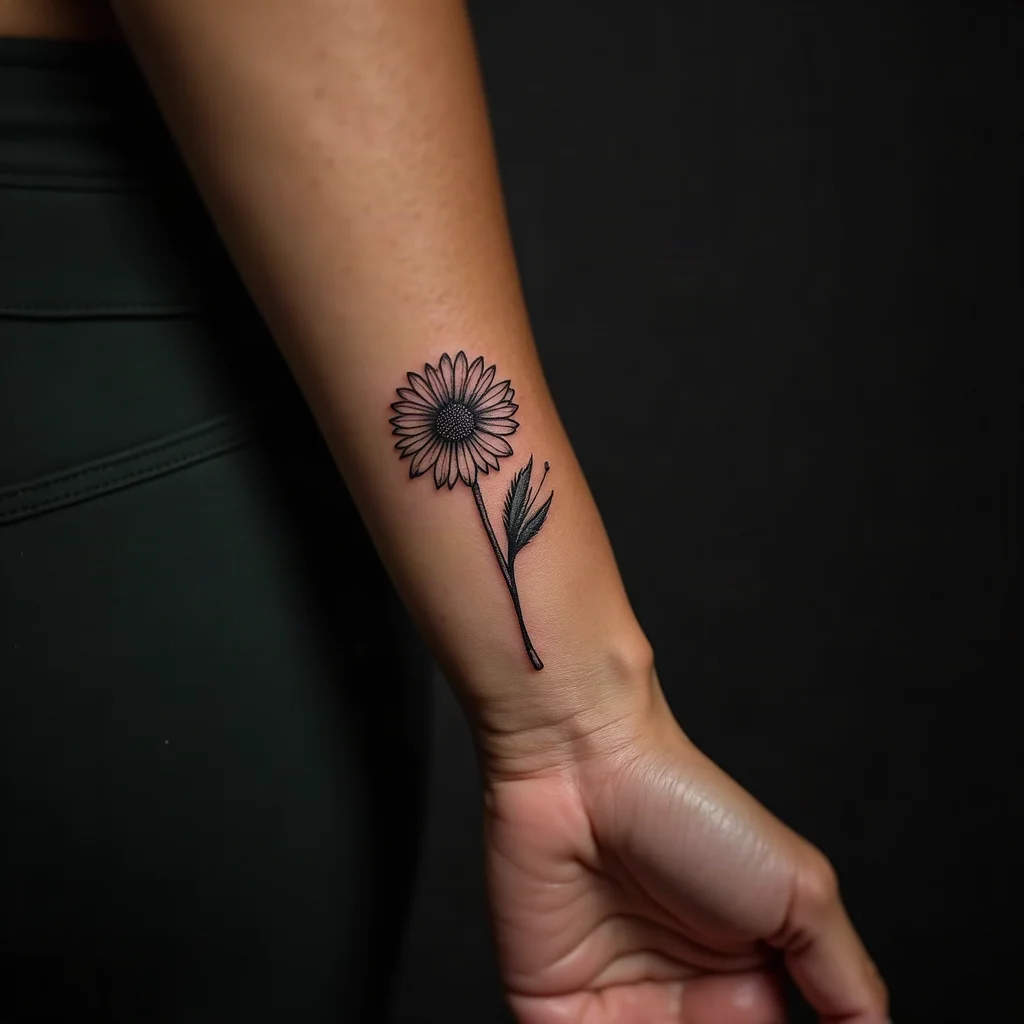
2. Twin asters on one arched stem
Two blooms on a single curved stem, three to four inches tall, one facing forward and one turned three-quarters away so you see the calyx. The arc follows the natural line of the inner forearm instead of fighting it. Great first floral: enough content to look considered, small enough to finish in an hour.
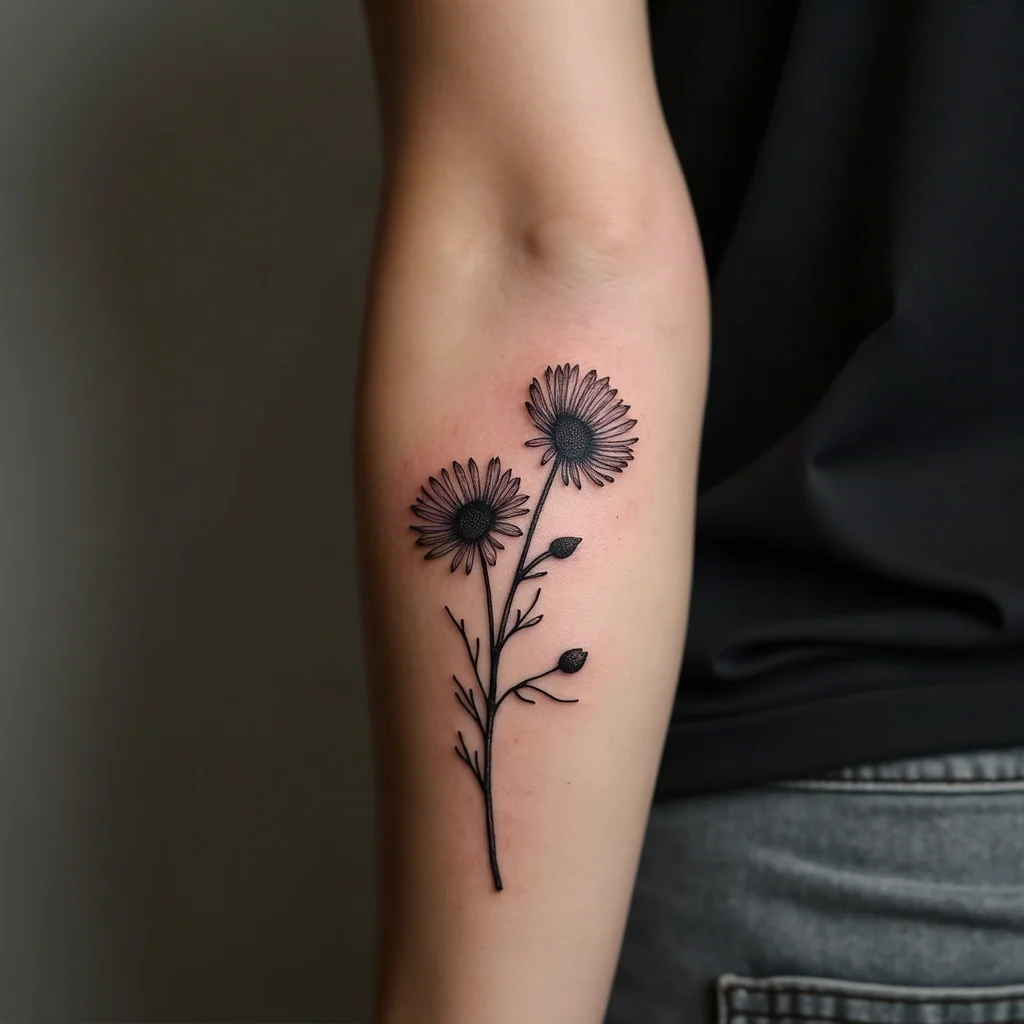
3. Aster inside a thin circle
A coin-sized bloom framed by a single hairline ring, tucked behind the ear. The frame is doing real work here, giving a tiny flower a defined edge so it does not read as a smudge from across a room. Ask for the petals to break the circle in two or three places so it feels drawn, not stamped.
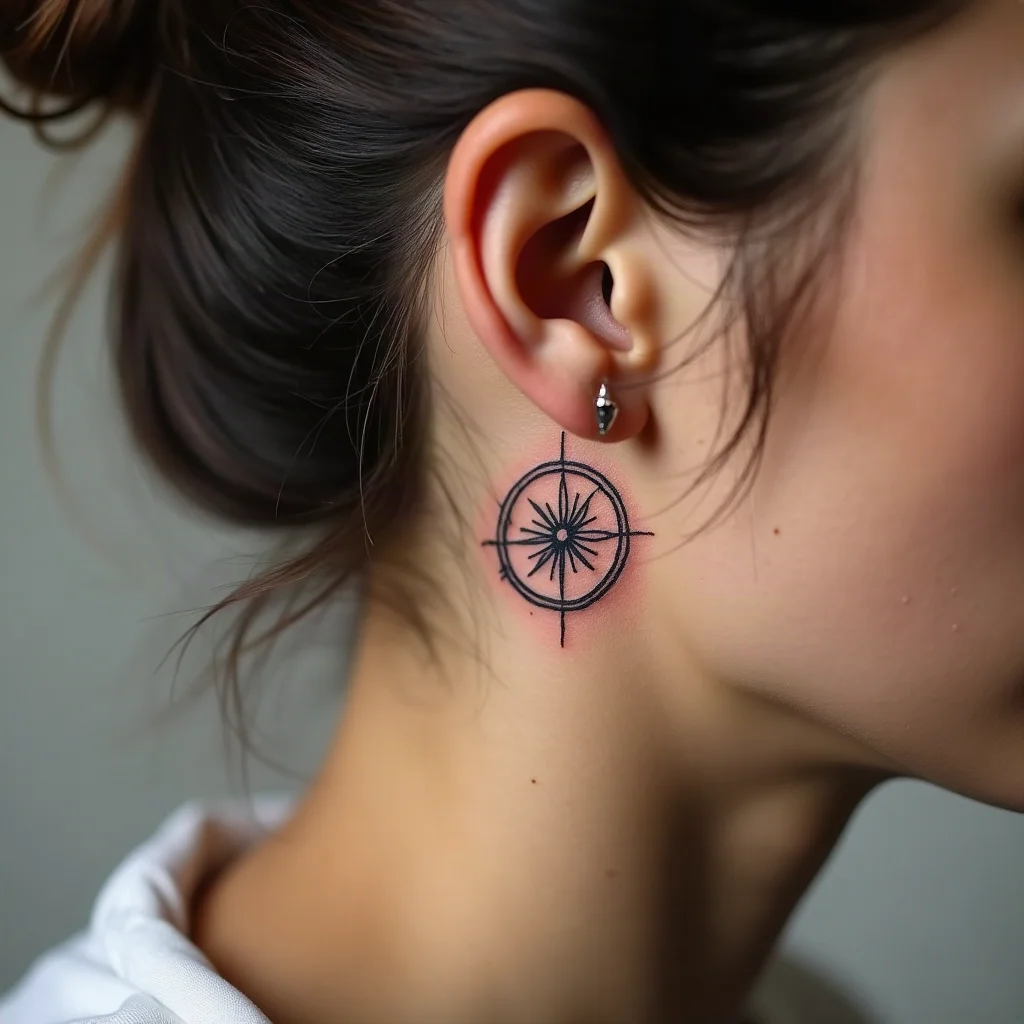
4. Side-profile aster
Instead of the flat face-on view, the flower is drawn from the side: petals fanning upward and outward from a visible green calyx and a short bent stem. Laid along the collarbone it follows the bone rather than sitting on it awkwardly. This angle is far more forgiving over time because the petals naturally spread apart.
5. Falling stem down the spine
One open aster at the base of the neck with a hairline stem tracing six to eight inches down the spine, dropping two or three loose petals along the way. It reads as a single vertical gesture, which is the only kind of composition that really works on the spine. Expect a sharp, vibrating sensation over the vertebrae and a session broken into short bursts.
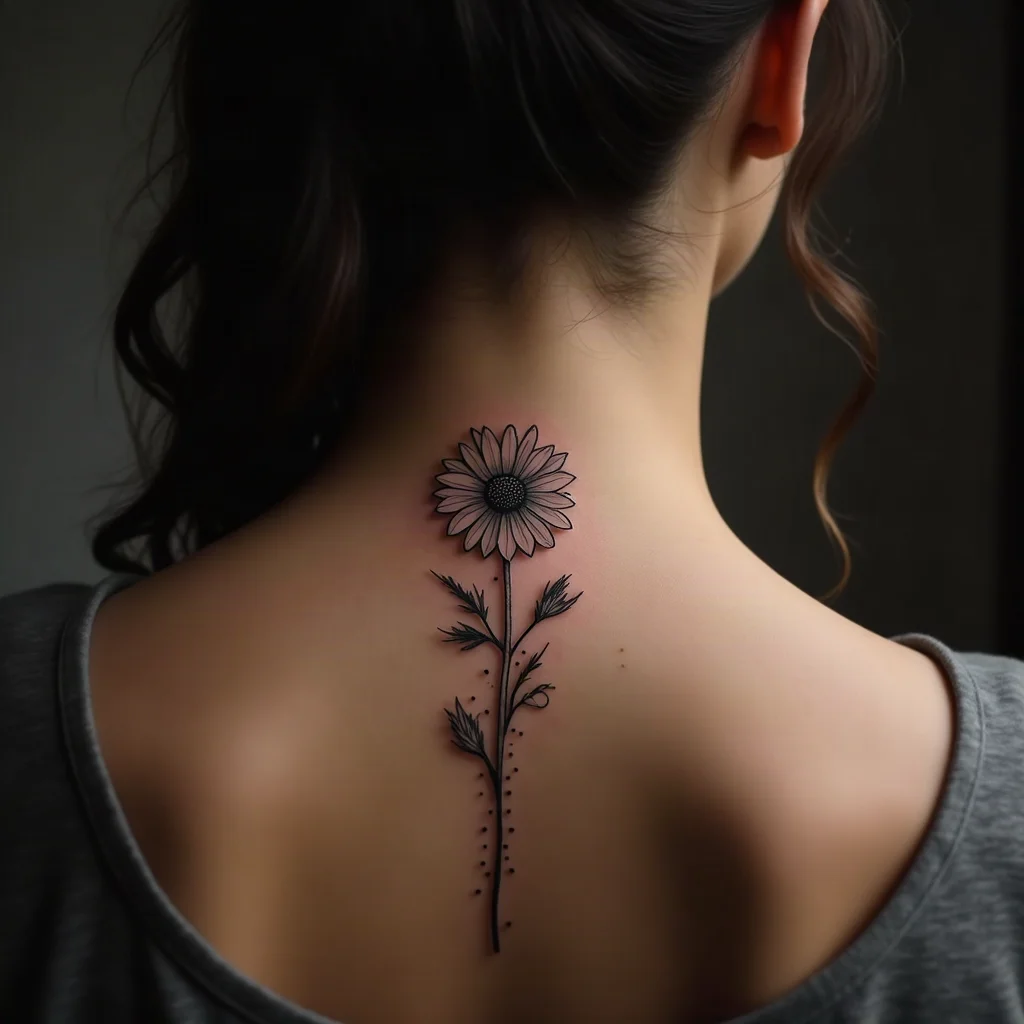
6. Aster braided with morning glory
September actually claims two birth flowers, and this design uses both: an open aster anchoring the composition with a morning glory trumpet and its curling vine wrapping past it. Four to five inches on the outer forearm gives the vine room to move. It is the most botanically interesting way to say September without adding a date.
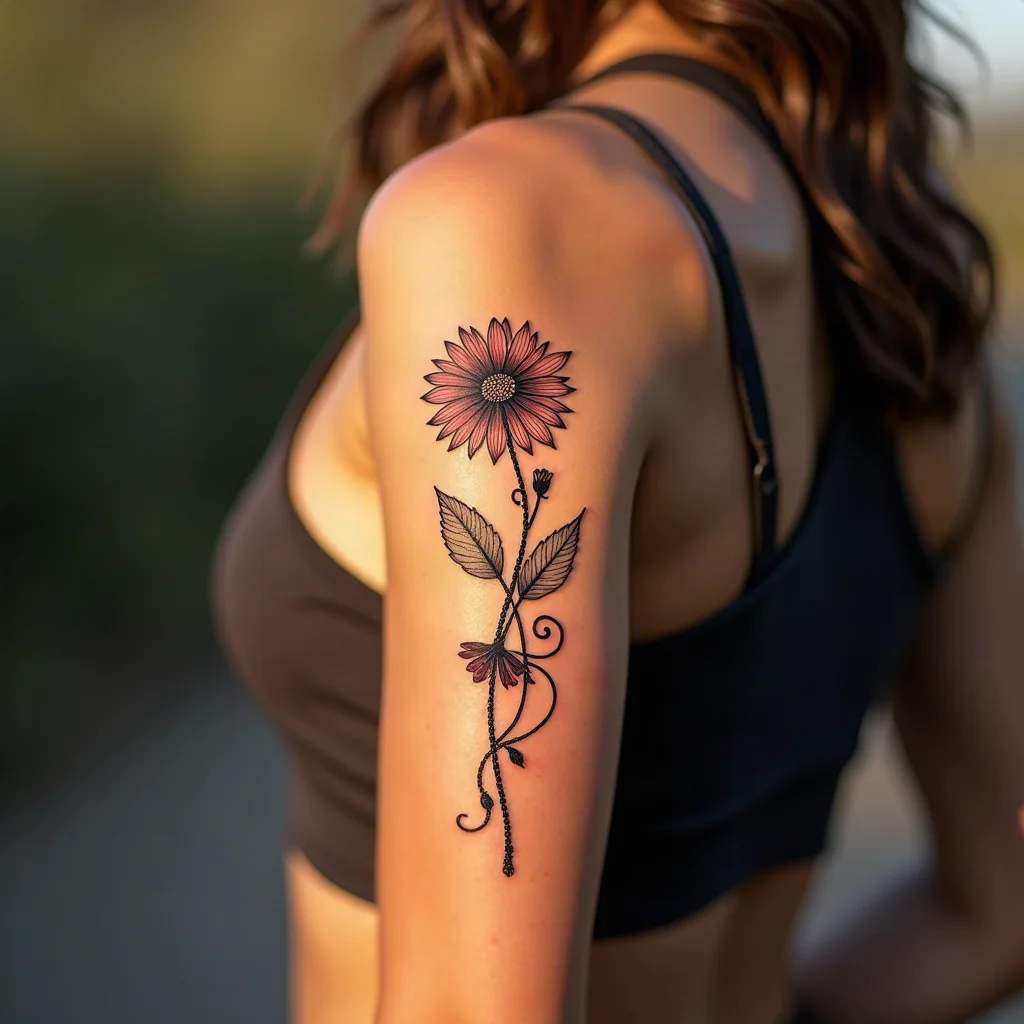
7. Bud, half-open, full bloom
Three stages of the same flower on one stem, stacked up the ankle: a tight bud, a bloom cracking open, and a full star. It carries an obvious meaning about growth without a word of script. Keep it under four inches so the smallest bud does not shrink into a dot.
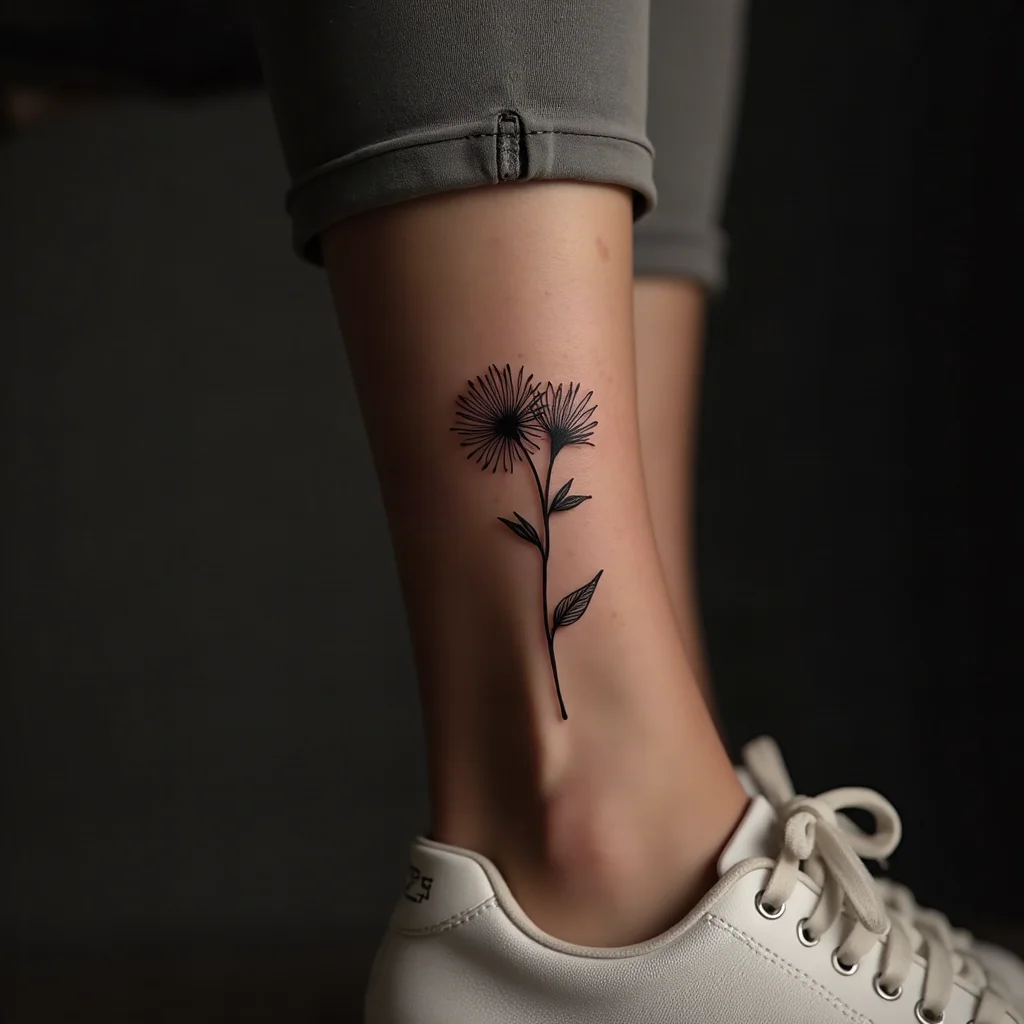
Small and Minimalist Asters: Entries 8-14
Under an inch, the aster stops being a botanical drawing and becomes a mark. These seven are built to survive at that scale, which usually means fewer petals, thicker gaps or solid shapes.
8. Micro aster on the finger
Eight tapered petals and a single dot center, roughly a half-inch across, sitting on the side of the finger below the knuckle. Fingers are the fastest-fading real estate on the body, so go in expecting a redraw every few years or choose a different spot. Ask for slightly heavier line weight than you think you need.
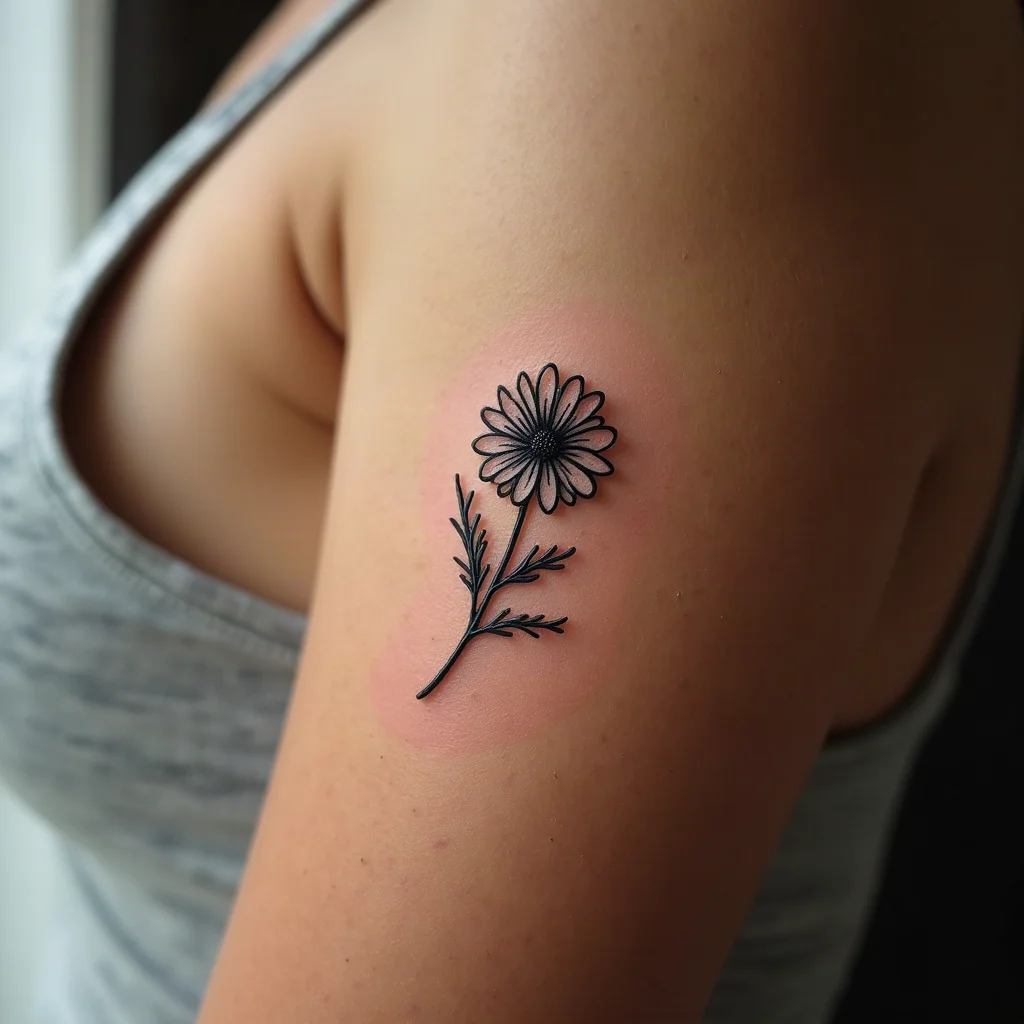
9. Eight-point star aster
A geometric reduction: eight straight, evenly tapered points around a small open circle, sitting at the nape of the neck. It nods to the flower's name rather than its botany, and it will still be crisp in twenty years. Suits anyone who likes symbols more than florals.
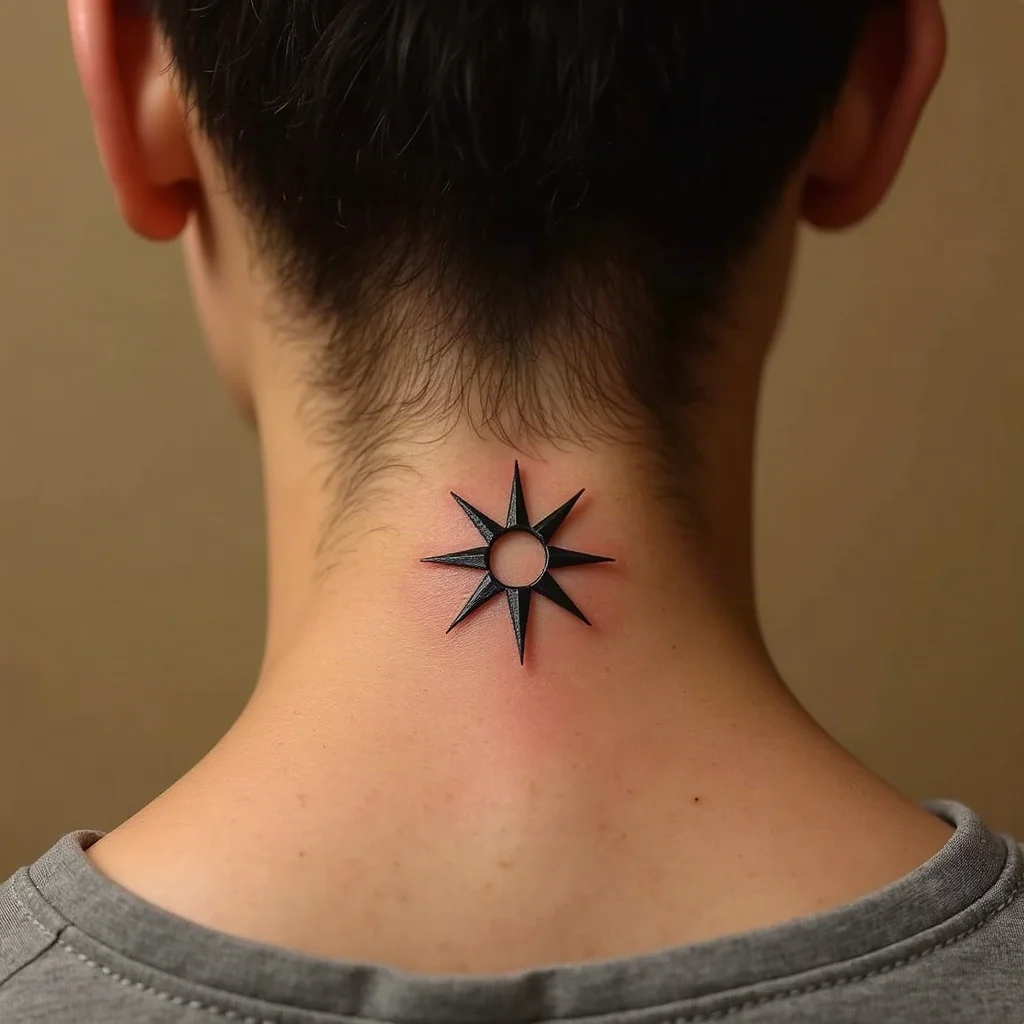
10. Solid black silhouette
The whole flower filled in as one shape, negative space only where the petals separate, about an inch on the side of the wrist. Solid black is the single most durable way to wear a small aster because there is no thin line to lose. It also photographs beautifully against a tan.
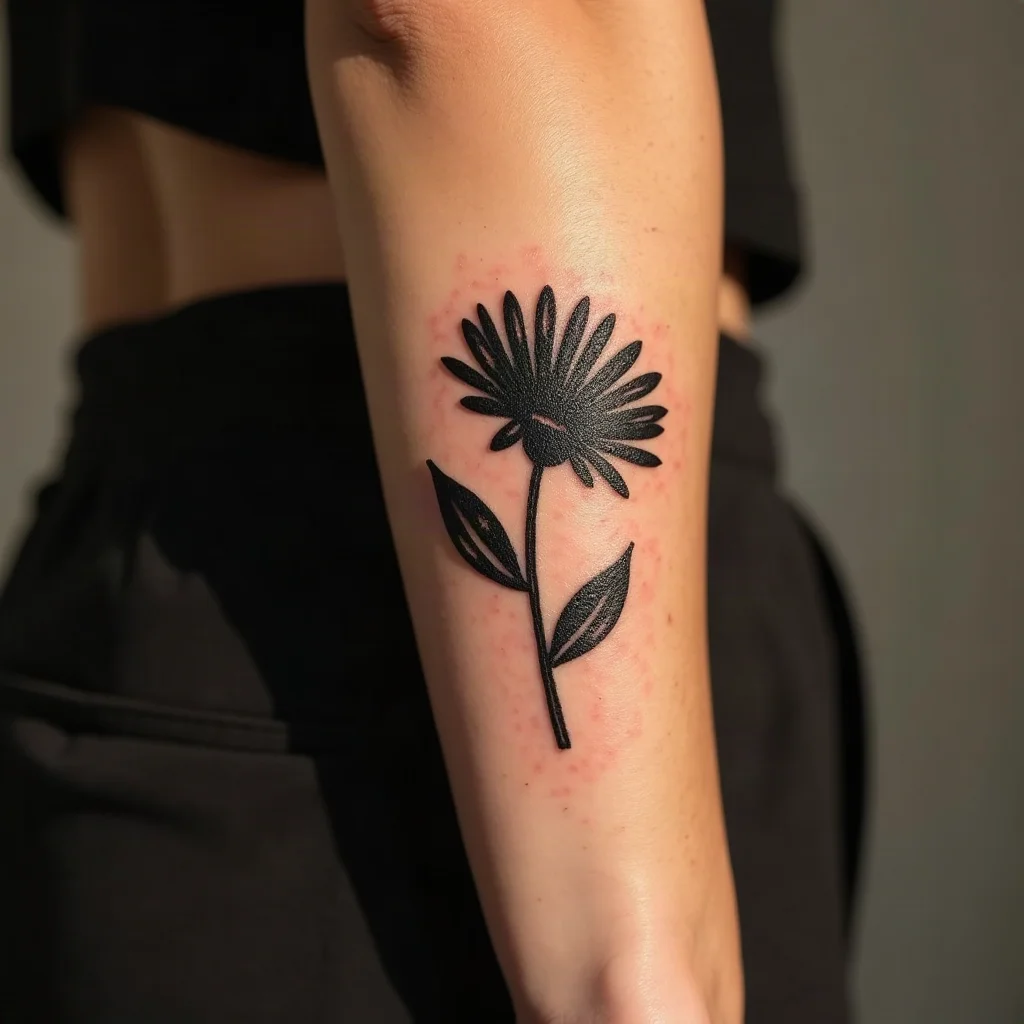
11. Dashed-petal aster
The petals are drawn as short detached dashes ringing a stippled center, deliberately airy, sitting on the top of the foot. The gaps are the whole point: nothing can blur together if nothing touches. Feet are bony and quick to sting, but the piece takes twenty minutes.
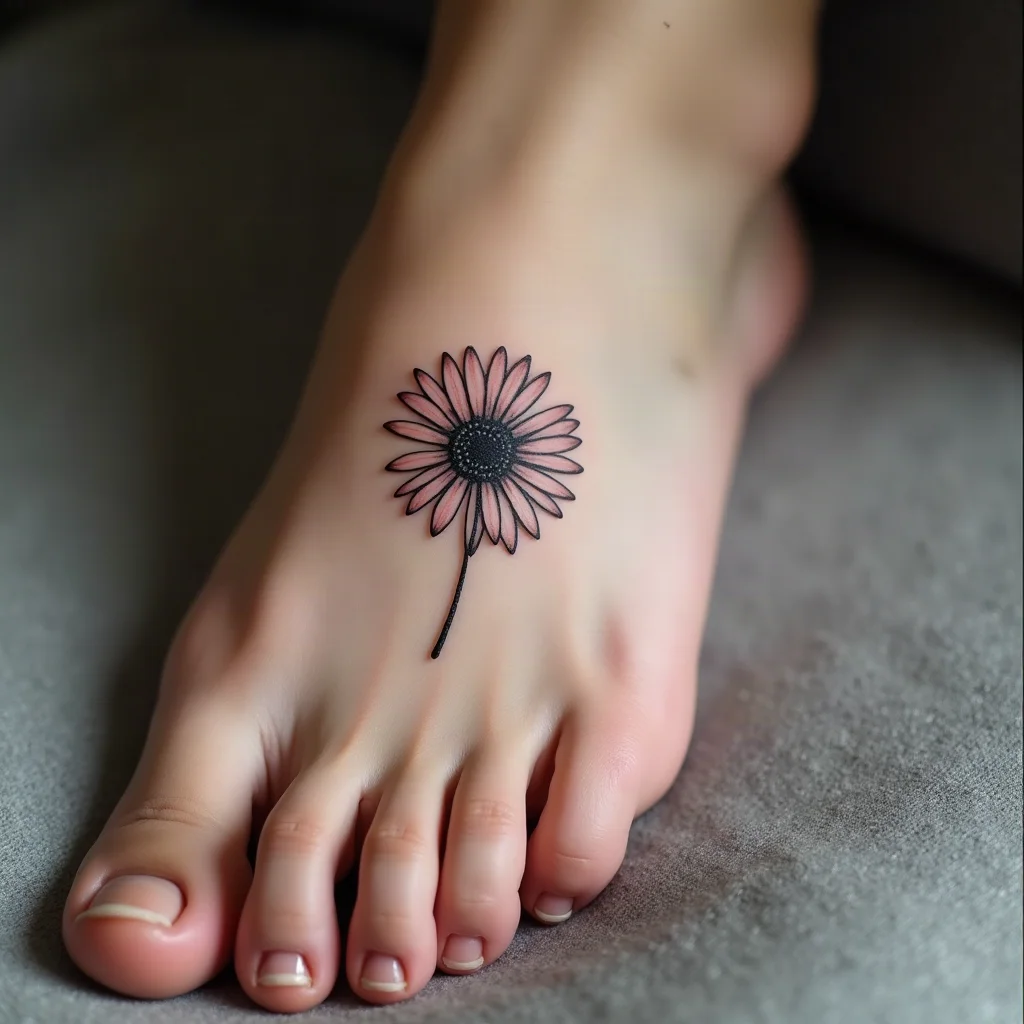
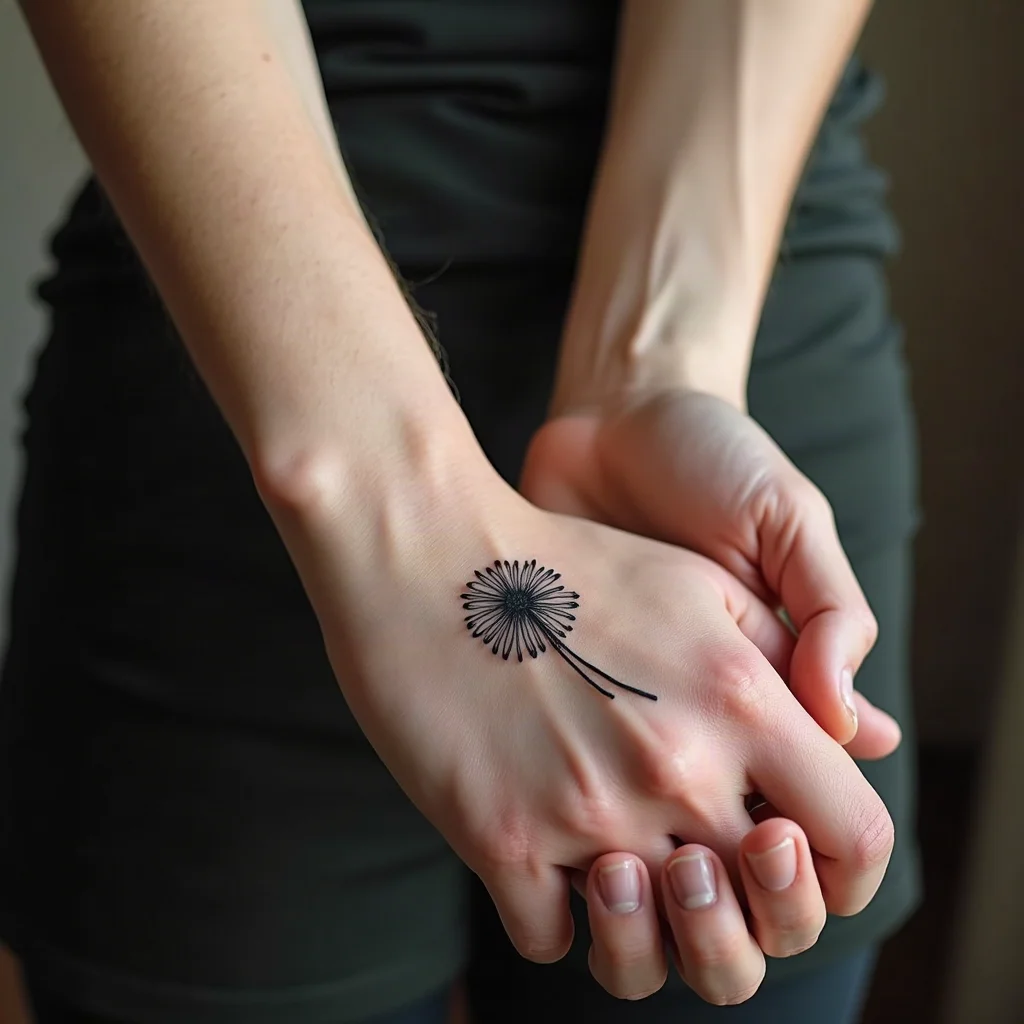
12. Shirt-button aster on the hand
A firm-lined bloom the size of a shirt button, placed on the back of the hand near the base of the thumb where the skin moves least. Hand placements need bolder outlines and honest expectations about touch-ups. Worth it if you want your birth flower where you can actually see it.
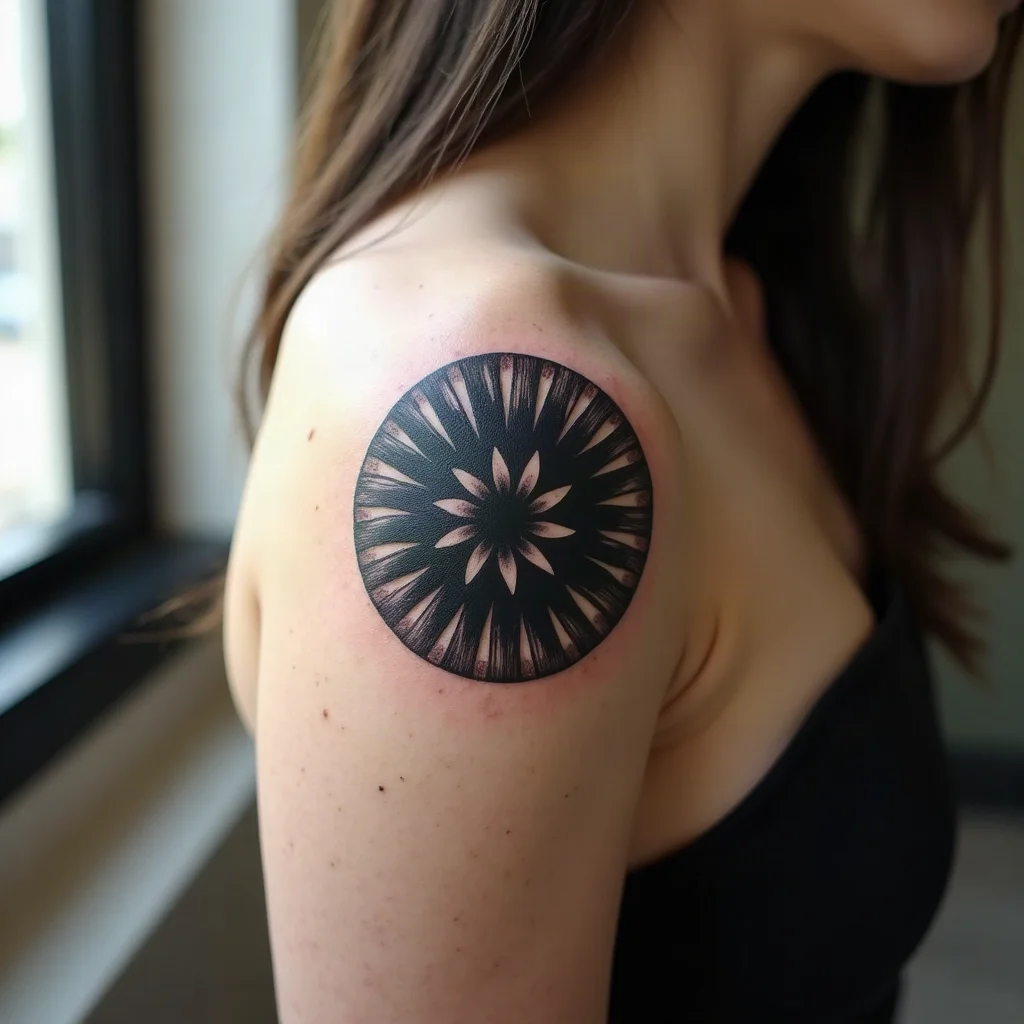
13. Negative-space aster in a black disc
A solid black circle roughly two inches wide with the aster carved out of it in unshaded skin, tucked on the shoulder blade. High contrast, very graphic, and it ages like a stone stamp. Ask for the petals to be cut wide, since negative space closes up over time rather than opening.
14. Matching micro asters for a family set
The same half-inch aster repeated on more than one person, inner wrist for each, with a tiny variation in petal count so no two are identical. It works because the shape is simple enough to reproduce faithfully by different hands if you are not all in the same city. Bring the exact same reference drawing to each artist.
Bold Asters: Traditional, Blackwork and Illustrative, Entries 15-21
Heavier styles solve the aster's aging problem outright: thick outlines and real shading hold their shape for decades. These seven trade delicacy for permanence.
15. American traditional aster
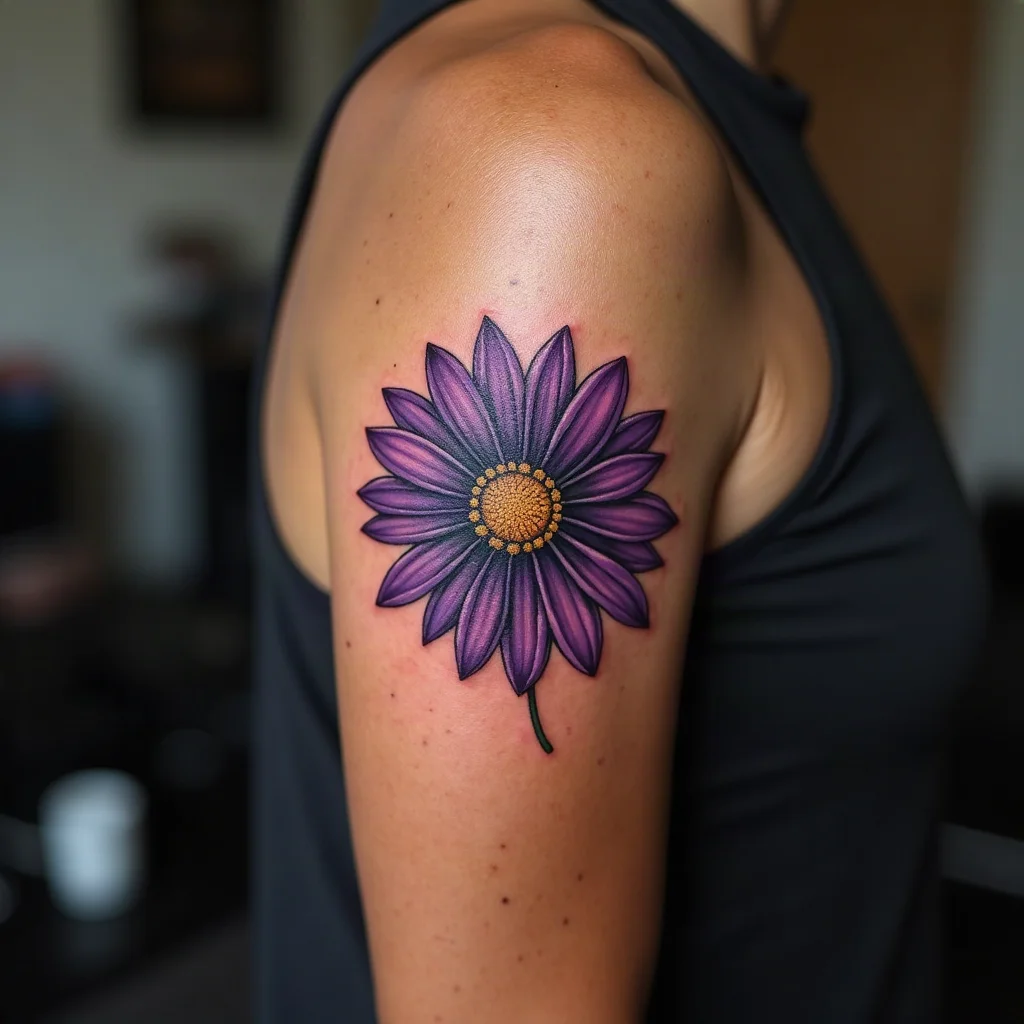
Bold black outline, twelve to fourteen fat ray petals, a solid gold center and a violet fill with a hard white highlight. Three to four inches on the upper arm, drawn with the confident symmetry old-school flowers rely on. This is the version that still looks exactly as intended at fifty.
16. Blackwork aster and moth
A large aster overlapping the wing of a heavy blackwork moth, six to eight inches on the thigh. The moth's solid mass gives the flower somewhere to sit, and the contrast between dotted petals and dense black wings does all the design work. Thigh skin takes big blackwork well and hurts less than you fear on the outer side.
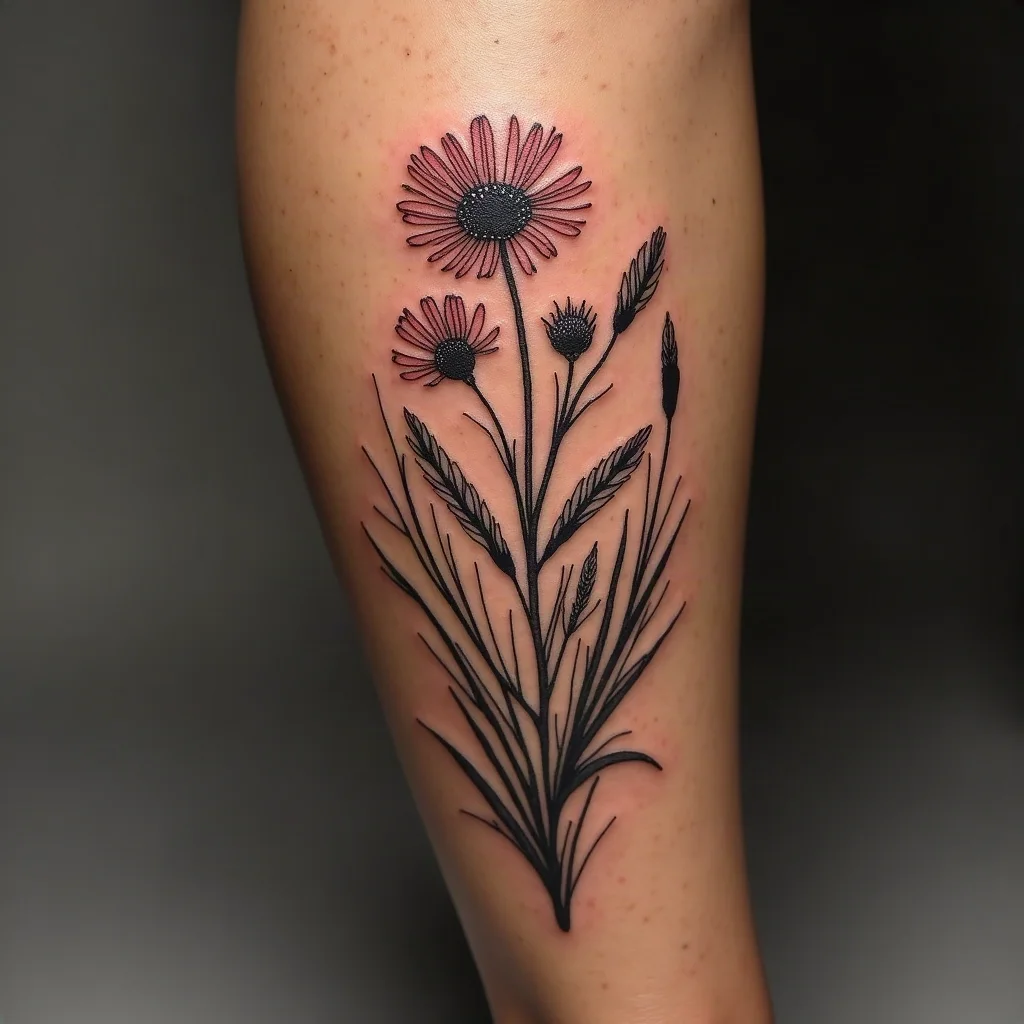
17. Whip-shaded aster bouquet
Three or four asters bundled with grasses and seed heads, shaded entirely with fast tapering whip strokes and no outlines. Five to seven inches down the calf, following the muscle. Softer than blackwork, tougher than fine-line, and it photographs beautifully in low light.
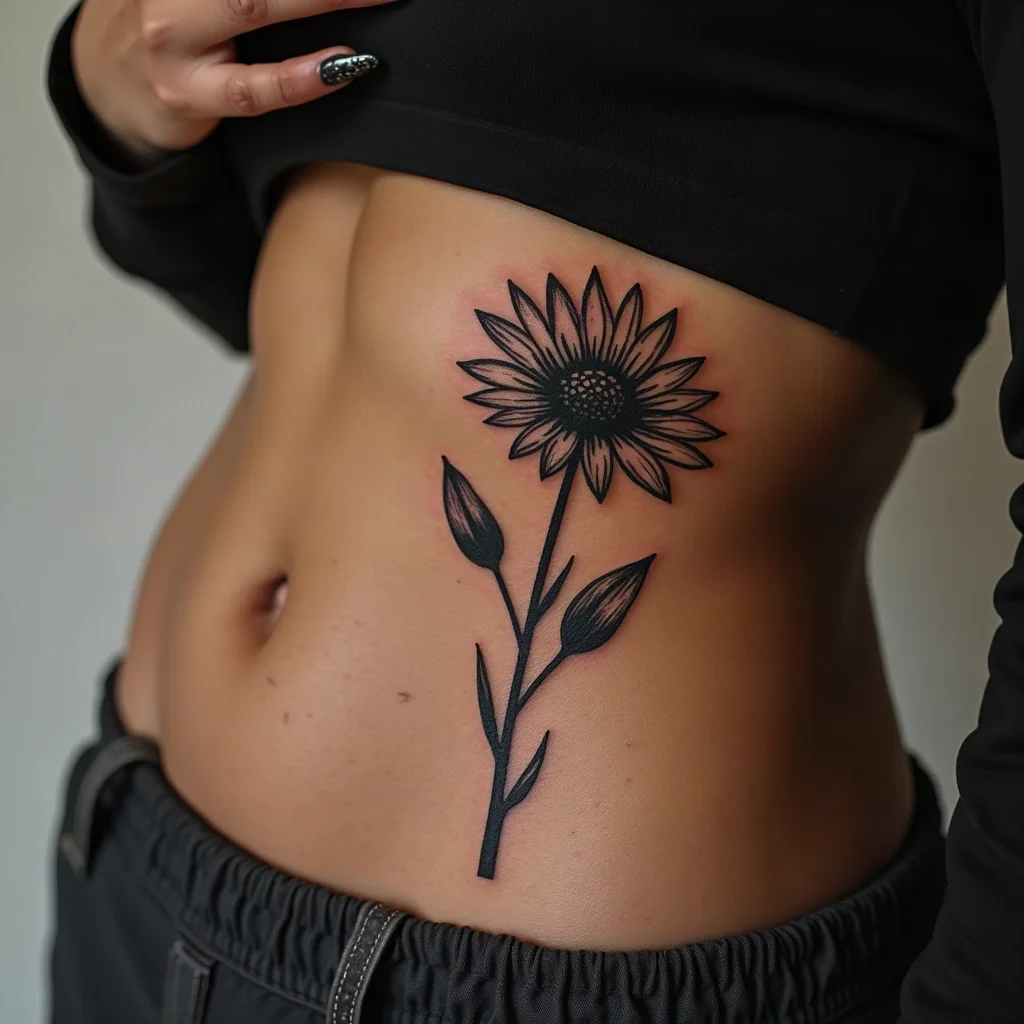
18. Engraved aster in etching style
Cross-hatched like a Victorian botanical plate, every petal built from parallel hatch lines, running along the side of the ribcage. The hatching is what makes this age well: even as lines soften, the tonal impression survives. Ribs are among the sharper sits, so plan on a couple of shorter sessions rather than one long one.
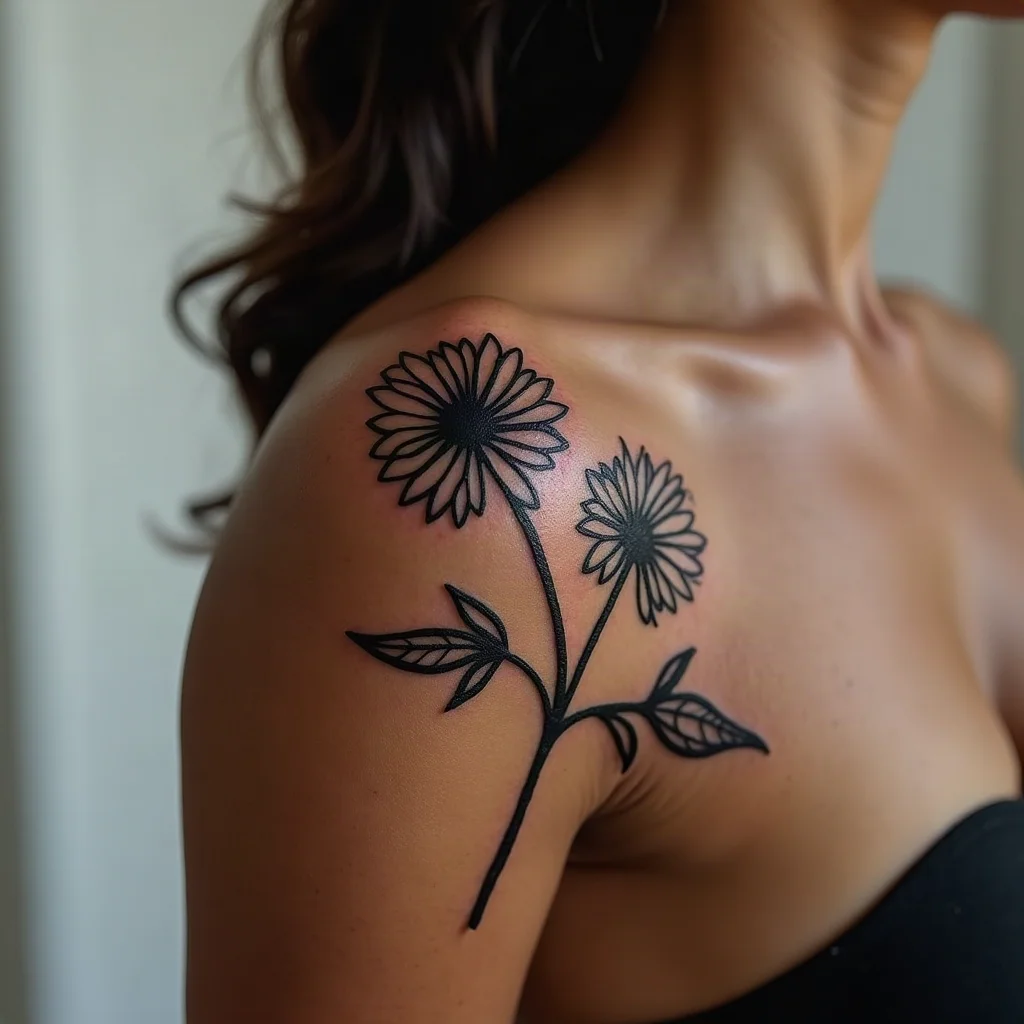
19. Aster shoulder cap
A cluster of two large asters and leaves curving over the deltoid so the composition follows the ball of the shoulder from any angle. Around six inches wide, done in illustrative black and grey with soft grey wash in the petal shadows. This is also the natural first panel if you ever want to grow into a sleeve.
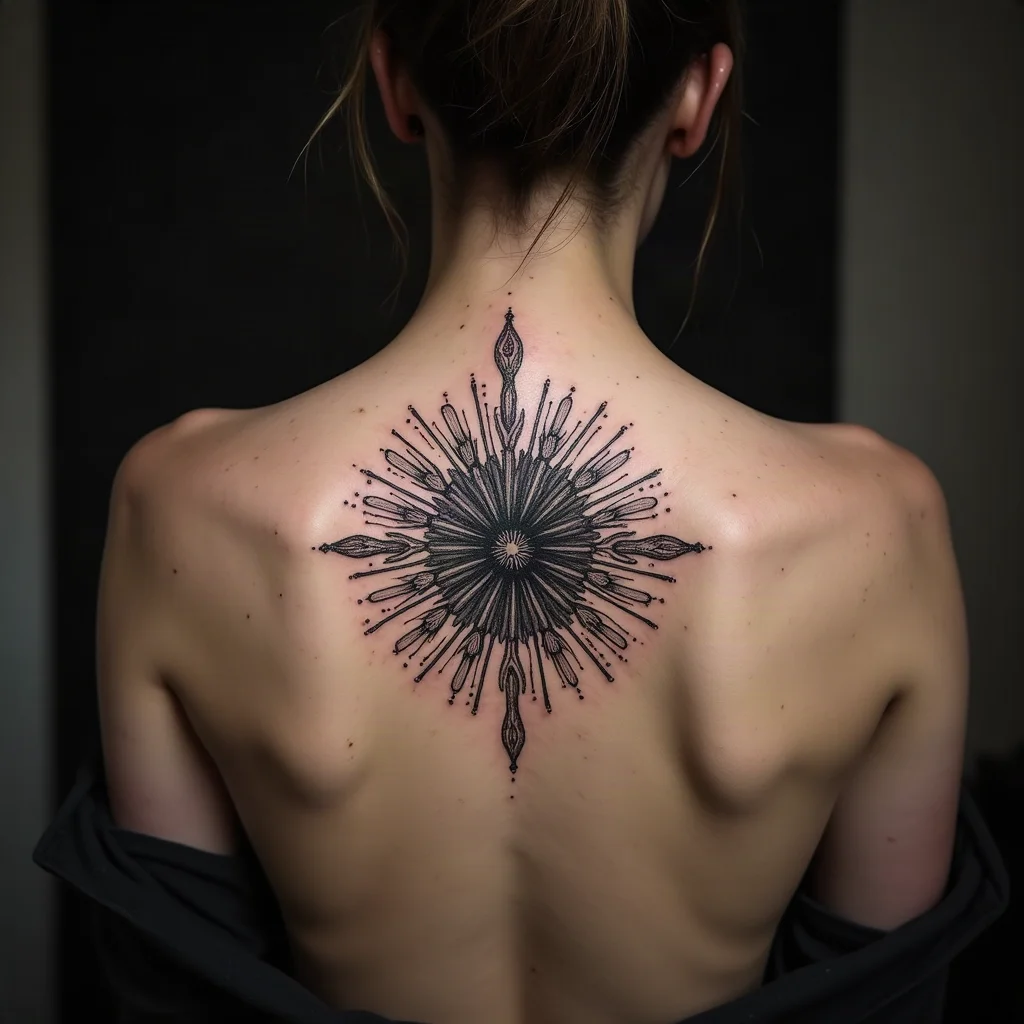
20. Radial blackwork aster
The flower abstracted into a mandala-like radial: concentric rings of petals, dot-worked gradients in the center, geometric ornament in the outer band. Eight inches or more between the shoulder blades on the upper back. Sit for it in two appointments; dotwork is slow and endurance matters more than pain tolerance.
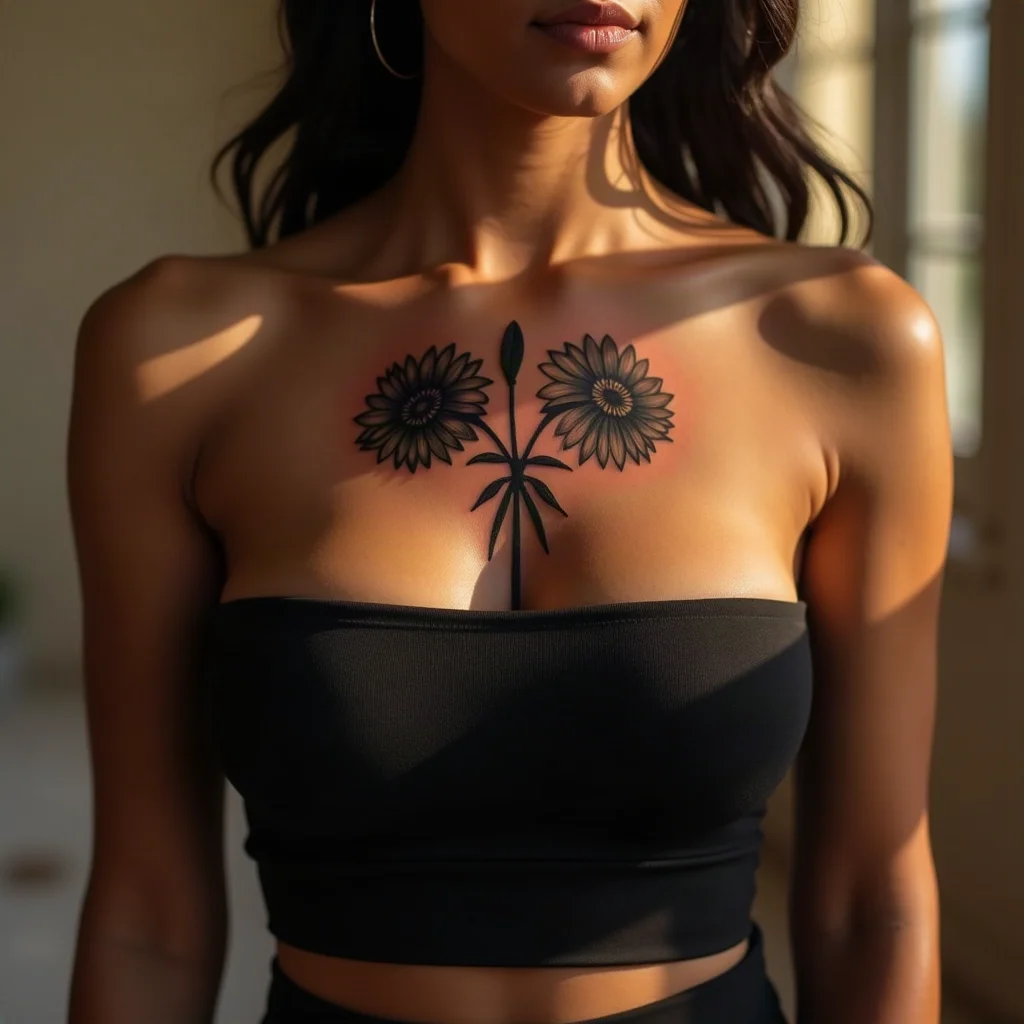
21. Sternum asters
Two mirrored asters flanking the center of the chest with stems that meet in a point below. It is a symmetrical placement, so the artist must stencil it against your actual anatomy, not a straight line. Expect the sternum to be genuinely intense and the design to demand precise mirroring in the healing photos.
Personalized Asters: Names, Dates and Second Flowers, Entries 22-28
Birth flowers are rarely just decorative. These seven build a September aster around a person, a date or a family, which is where most of these tattoos actually come from.
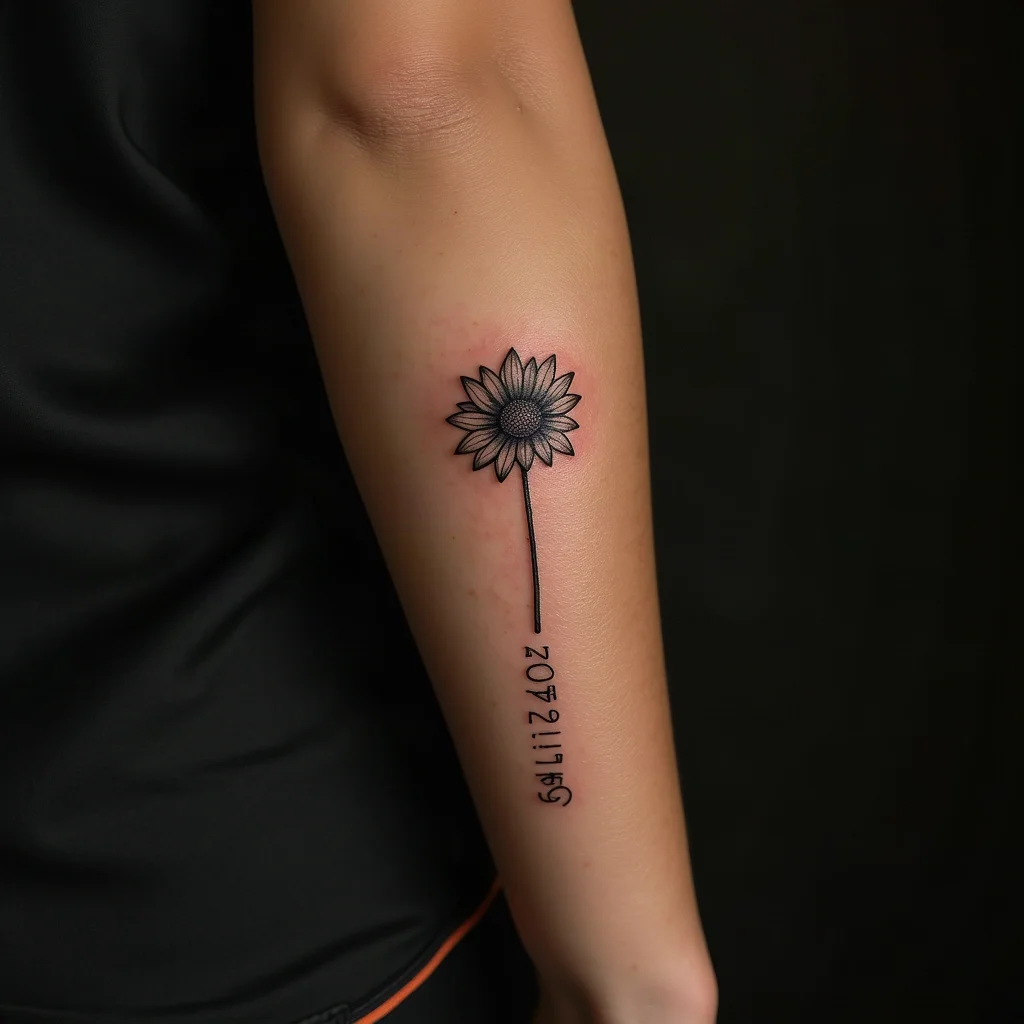
22. Aster with a date in Roman numerals
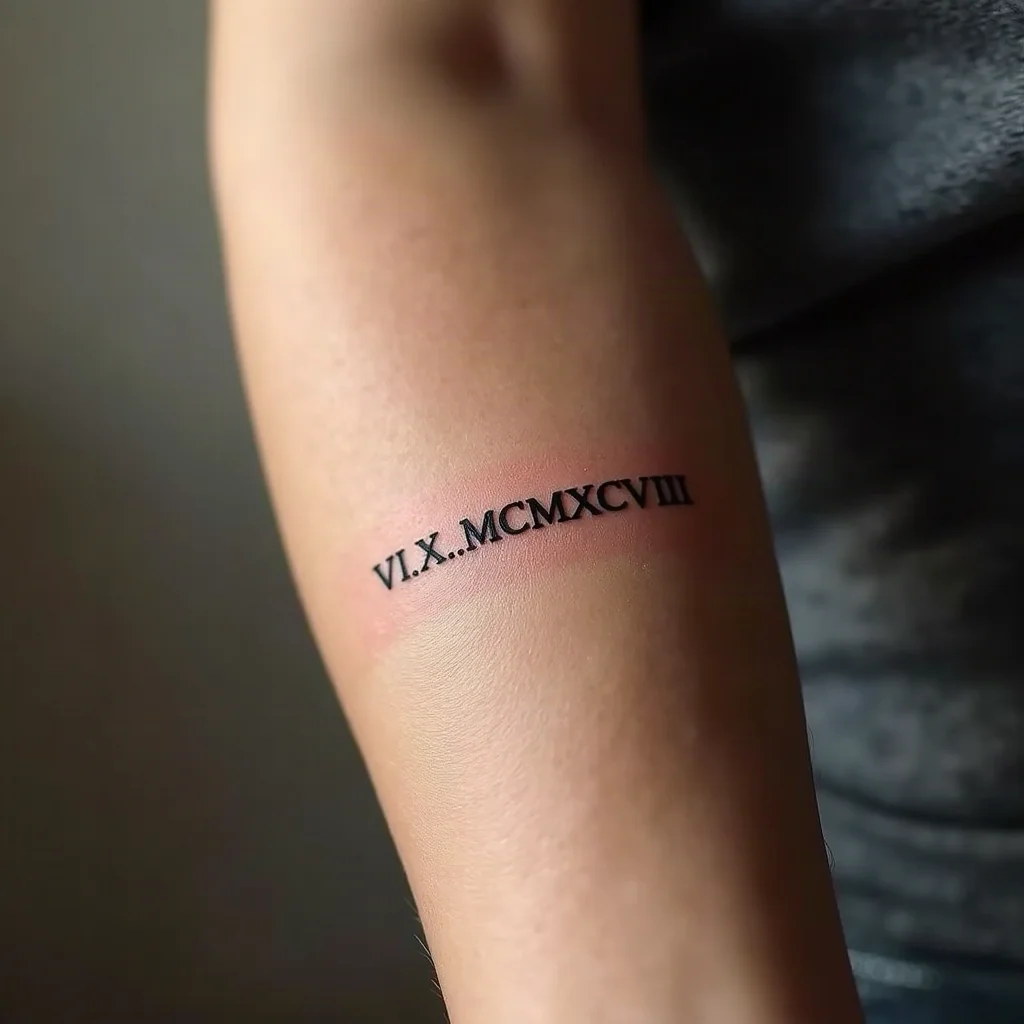
A single fine-line bloom with the birth date set in small numerals along the stem, running down the inner forearm. Keep the numerals at least a quarter-inch tall with clear spacing, since crowded serifs are the first thing to close up. Roman numerals age better than tiny cursive because the shapes are simpler.
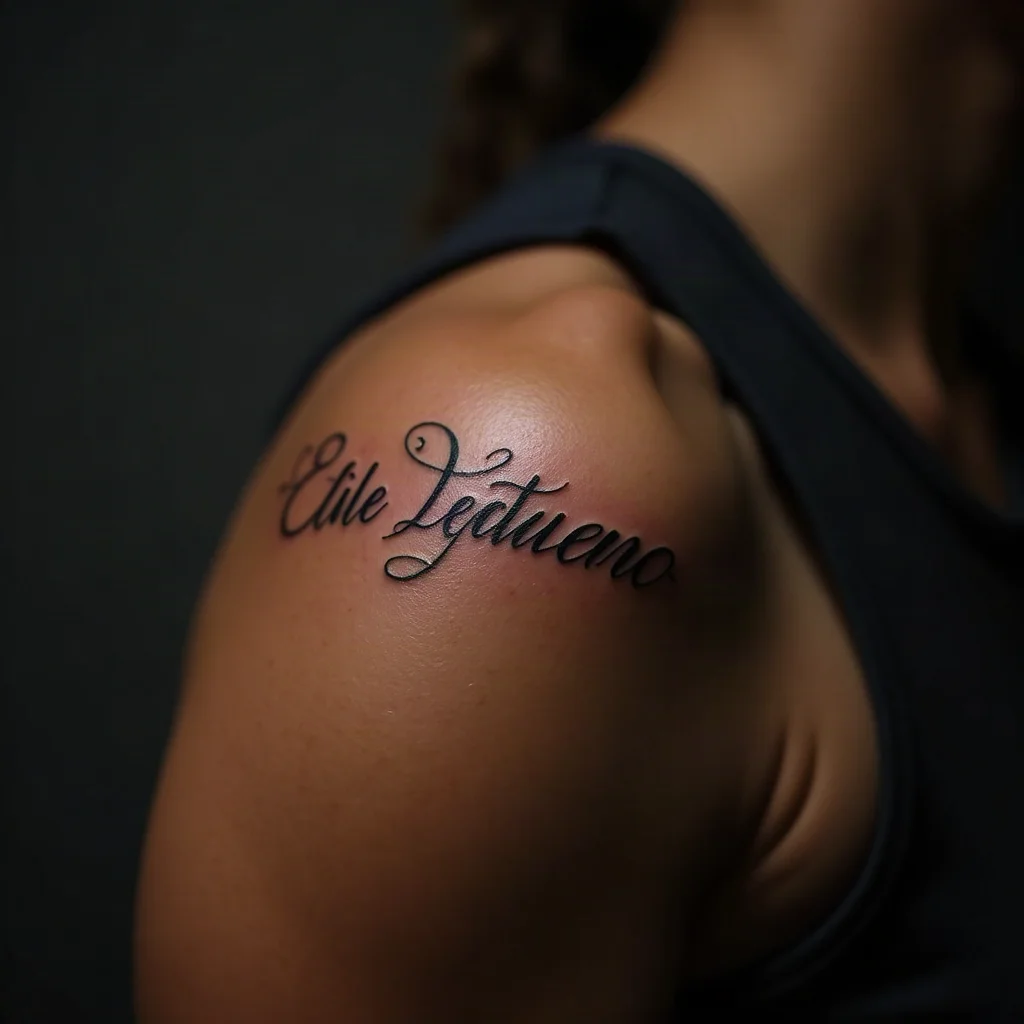
23. Aster with a name in real handwriting
The bloom sits above a name traced from an actual handwritten note, wrapping the upper arm. Scan the original at high resolution and send it to your artist ahead of time rather than photographing it in the studio. The imperfection is the point, so ask them not to clean up the letterforms too much.
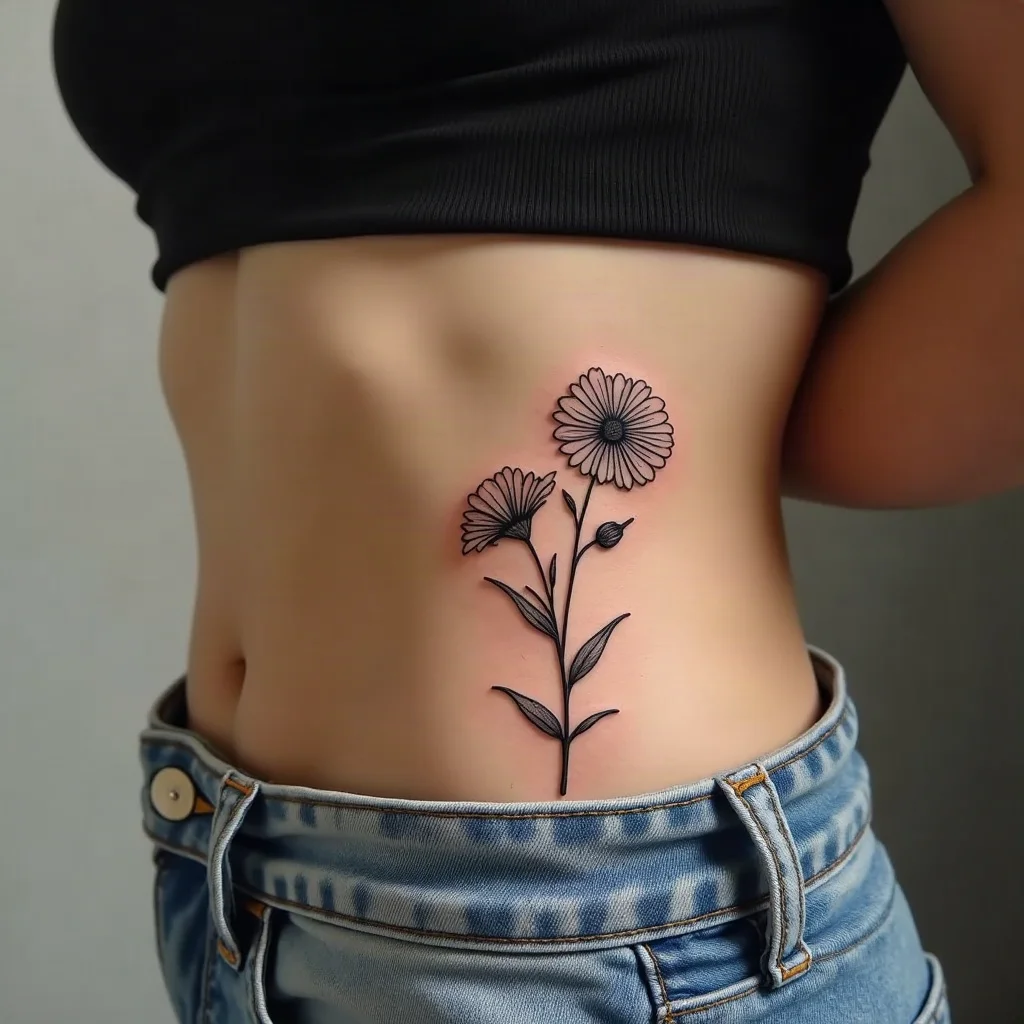
24. September aster with October's marigold
Two siblings, two months: an aster and a marigold sharing one stem base along the ribcage, drawn at matched size so neither dominates. The petal textures are different enough that they read clearly even in black and grey. If you want more options for the second flower, our marigold tattoo guide covers how that bloom behaves at small sizes.
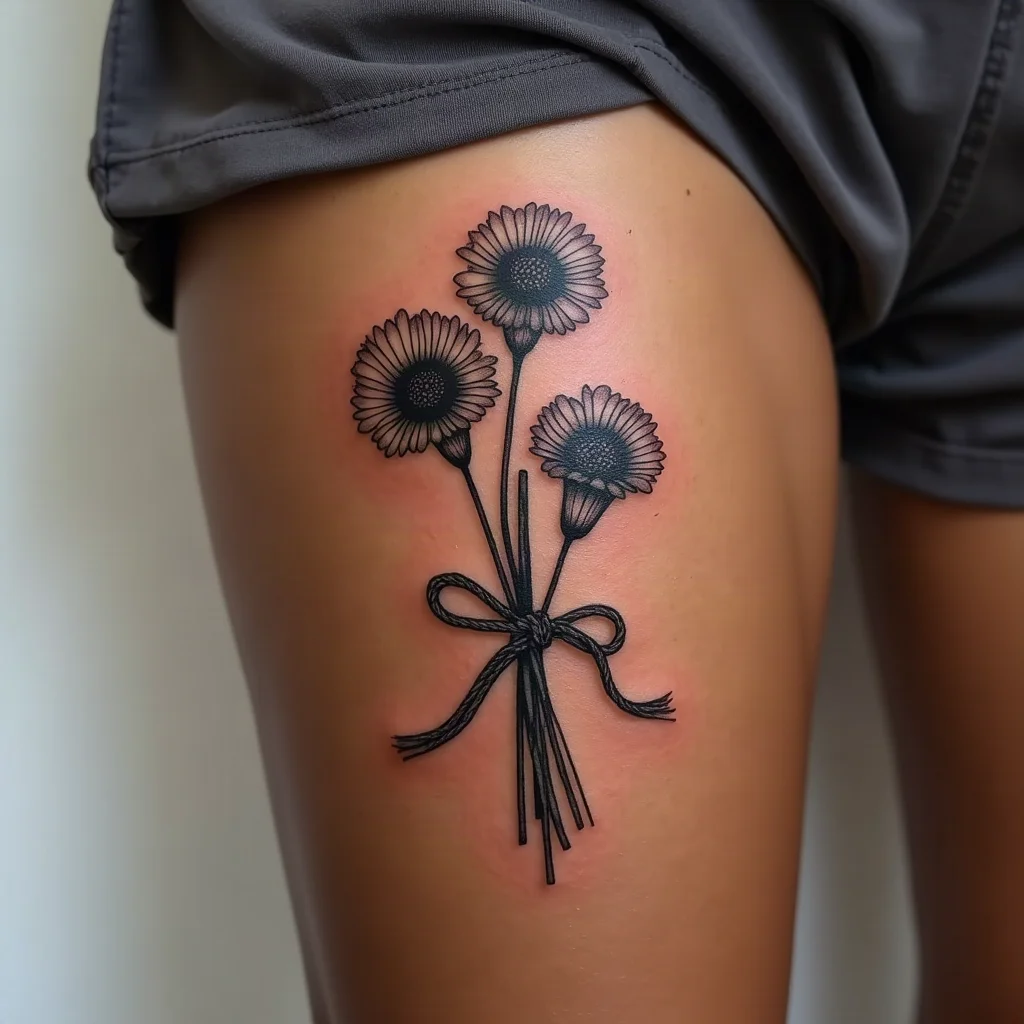
25. Three-flower family bouquet
An aster grouped with two other birth flowers, tied loosely with a ribbon or a length of twine, six to eight inches on the thigh. Ask the artist to vary the heights so it looks gathered rather than lined up. This is the best-value personalized piece: one sitting, one price, everyone included.
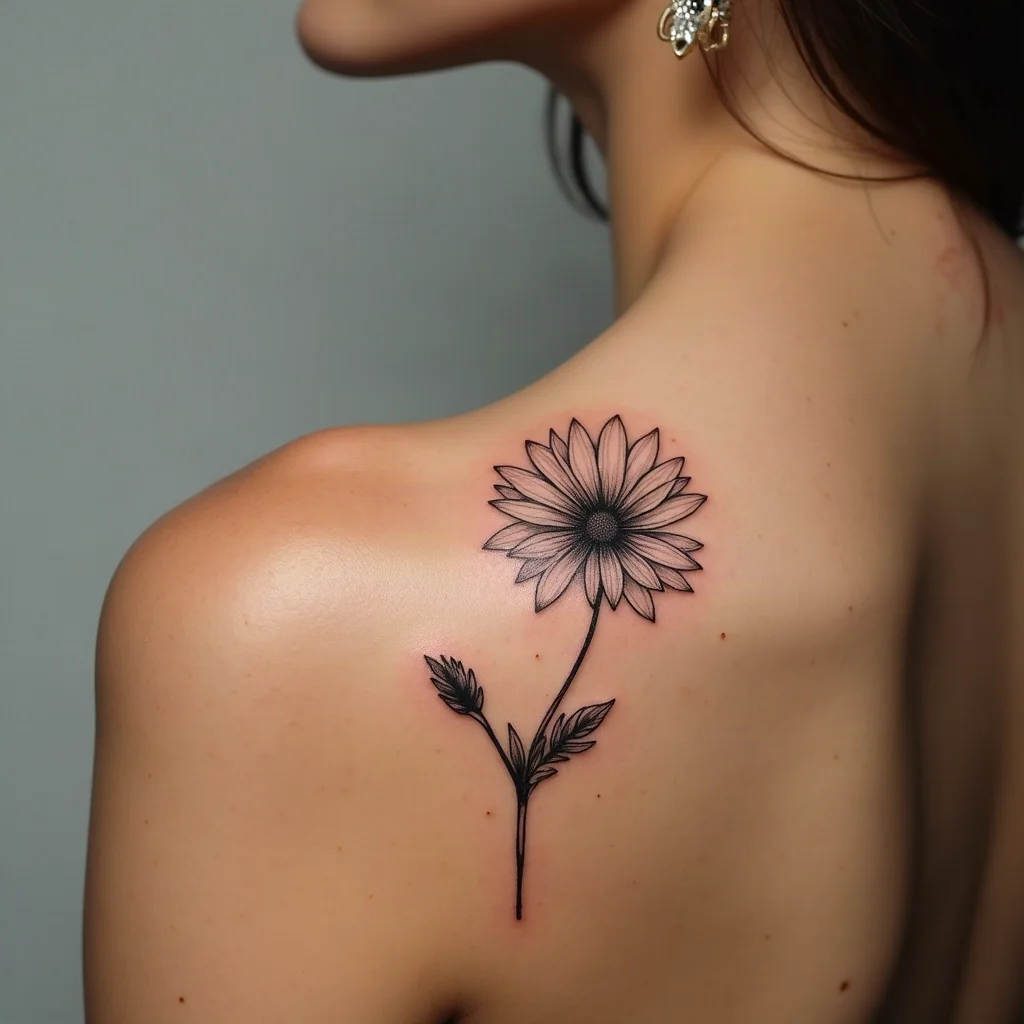
26. Memorial aster with a fallen petal
A full aster on the shoulder blade with one petal detached and drifting a couple of inches below it. Quiet, unmistakable, and no script required. Works in fine-line or soft black and grey depending on how much presence you want it to have.
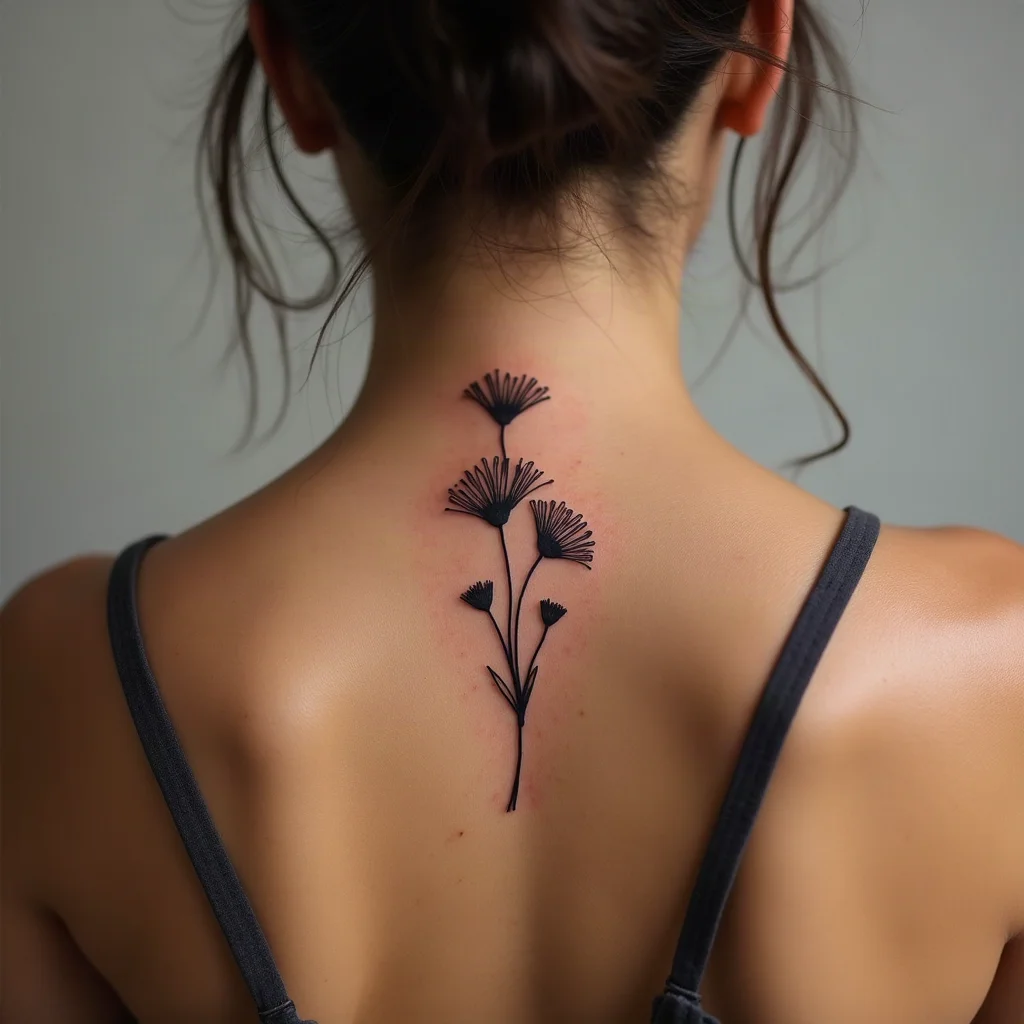
27. Aster stem column on the spine
Three or four asters at different heights on one vertical stem running from the nape to mid-back, one bloom for each family member born in September. It grows well: you can add a flower later without redesigning anything. Break it into two sessions if you are sensitive over the lower vertebrae.
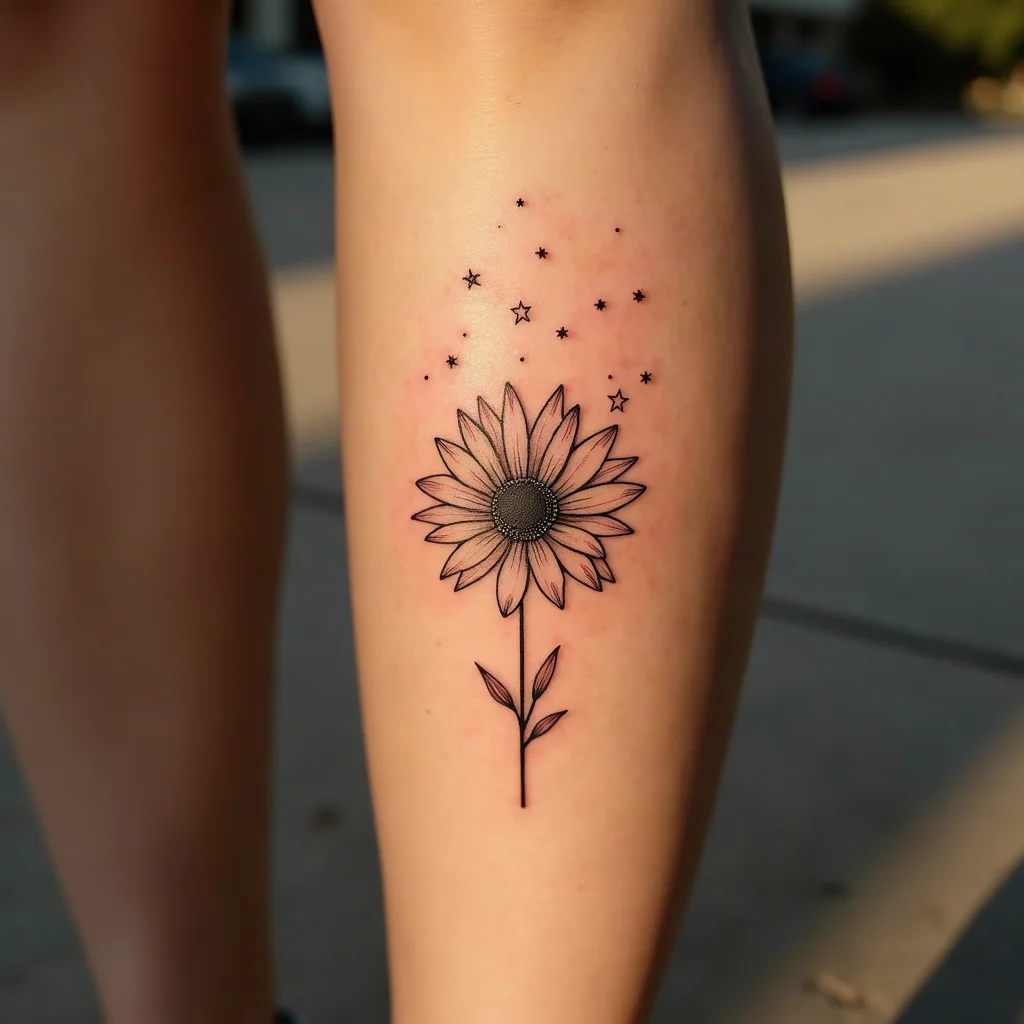
28. Aster with its constellation
A bloom drawn with fine hairlines, with three or four small stars and connecting lines extending from the petal tips as if the flower were part of a constellation. It plays on the aster's Greek name and pairs naturally with a September star sign. Four to five inches on the calf gives the star lines room to spread.
Placement, Pain and How Asters Age
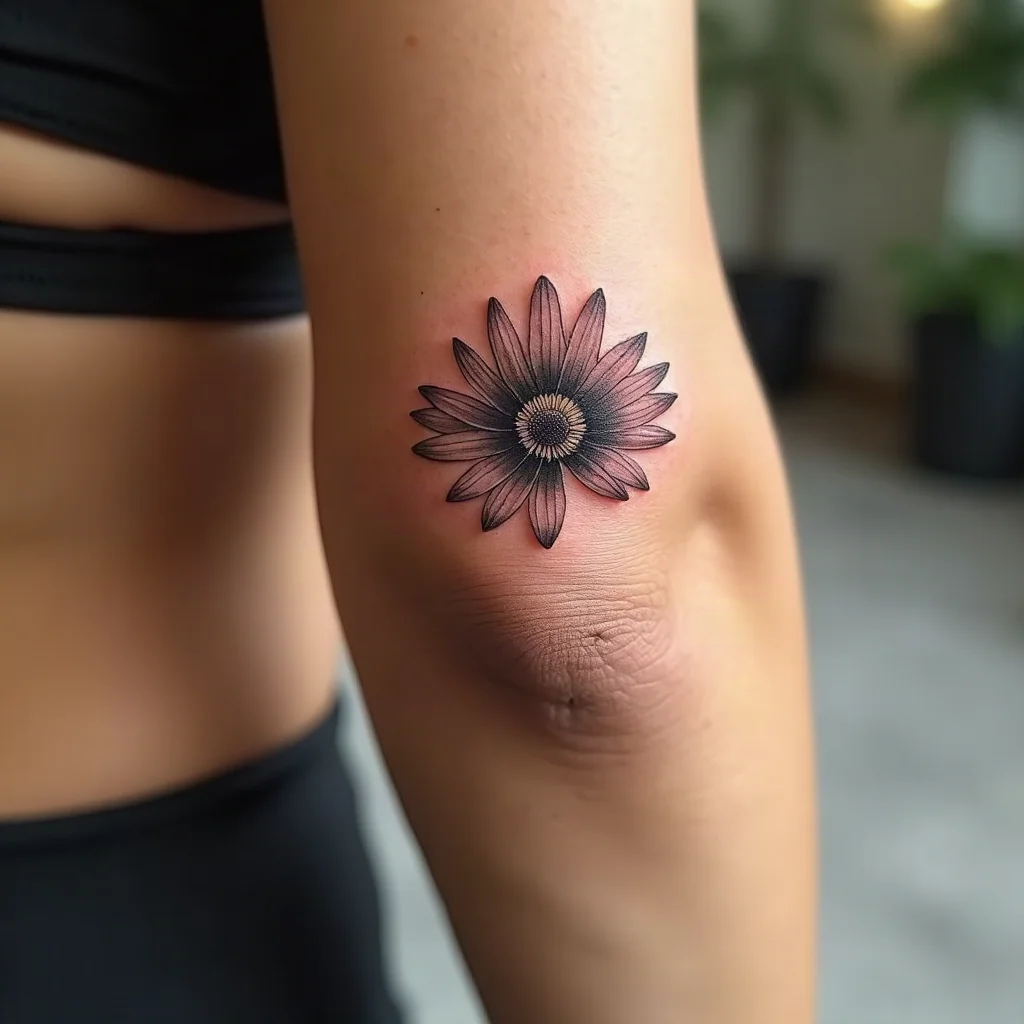
The petal ring is a circle, and circles distort on curved, moving skin. That single fact should drive your placement choice more than anything else. Flat, low-stretch panels keep an aster round: the outer forearm, the shoulder blade, the upper back, the outer thigh, the calf. Areas that bend hard or stretch, like the inner elbow, the side of the knee or the front of the shoulder joint, will slowly oval the flower.
On pain, asters are usually small enough that placement matters more than duration. Outer forearm, outer thigh and calf sit in the comfortable middle. Shoulder and upper back are easy for most people. Ribs, sternum, spine and the top of the foot are sharp because there is no padding between the needle and bone, but a two-inch flower there is a fifteen-minute problem, not an afternoon. If you are choosing purely to avoid discomfort, our pain chart by placement is a useful cross-check.
Aging is where asters differ from simpler birth flowers. Because the design is dozens of thin lines converging on one point, ink spread hits it harder than it hits a rose or a tulip. Three defenses actually work: keep petals separated by a visible gap, vary petal length so the eye reads texture rather than a perfect ring, and give the center a stippled or open treatment instead of a solid black dot that will bleed outward. Sun is the other enemy. A fine-line aster on the hand, foot or wrist that lives uncovered all summer will need attention years before the same design on a thigh.
Cost, Sizing and Briefing Your Artist
Small asters land at or near shop minimum, which in most cities sits in the rough range of an hour's rate: a single coin-sized bloom typically falls in the low-to-mid three figures. A detailed palm-sized piece with shading is usually a couple of hours. Thigh, ribcage or upper-back work with multiple flowers moves into half-day territory, and half days are commonly quoted as a flat session price rather than hourly. Sought-after fine-line specialists in big cities can sit well above these ranges, so treat any number you read online as a starting point and ask for a written quote before you commit.
Sizing rules of thumb worth repeating to your artist:
- Under one inch: eight to twelve petals, simplified, or a solid silhouette.
- One to two inches: fourteen to eighteen petals with clear gaps and a stippled center.
- Three inches and up: twenty-plus petals, layered rows, shadow under the ring.
When you brief, bring a photograph of a real New England aster rather than a Pinterest drawing, and say out loud which parts matter: the star silhouette, the uneven petal lengths, the visible disc center. Say whether you want it violet, lavender-into-white, or straight black and grey. Ask directly how they plan to keep the petals from merging in ten years, because a good answer to that question tells you a lot about the artist.
Aftercare is standard floral care: keep the wrap on as instructed, wash gently with unscented soap twice a day, use a thin layer of fragrance-free lotion, skip pools and long soaks for two weeks, and keep it out of the sun until it stops flaking. For fine-line work especially, book the free touch-up most shops offer after healing rather than assuming it settled perfectly.
Frequently asked questions
What does an aster tattoo mean?
Asters carry associations with wisdom, patience, faith and enduring love, and they have a long history as remembrance flowers. As September's birth flower, most people wear one for a birthday, their own or someone else's. The Greek root of the name means star, which is why star and constellation pairings feel so natural with this flower.
How do I make sure my aster does not look like a daisy?
Ask for many narrow ray petals of uneven length rather than a few wide rounded ones, and insist on a visible textured disc center instead of a plain dot. A slightly irregular, star-shaped silhouette is the giveaway detail. Bringing a photo of a real New England aster to the consultation solves this in one step.
What is the smallest an aster tattoo can be?
Around half an inch works if the design is reduced to eight to twelve petals or drawn as a solid silhouette. Below that, the petal gaps close up as the ink settles and you end up with a filled circle. If you want a genuinely botanical aster with visible layered petals, plan on at least an inch and a half across.
Should I get my aster in purple or black and grey?
Violet-purple with a gold center is botanically true to the New England aster and looks striking on a fresh tattoo. Black and grey holds its contrast longer and needs less maintenance, especially on sun-exposed placements like the forearm or foot. A common compromise is black and grey linework with a single wash of violet in the petals only.
Can I combine the aster with September's other birth flower?
Yes, September claims both the aster and the morning glory, and they pair well because their shapes contrast sharply. A common composition sets the open aster as the anchor with the morning glory trumpet and its curling vine wrapping around it. Four to five inches gives the vine enough room to actually curl.
The conversation
No comments yet. Got a thought about these designs? Start us off.
Want to weigh in? Join the community to comment, save designs and try them on your skin.